
Federal Reserve's Dovish Pivot: Navigating Labor Market Fragility and Equity Valuations
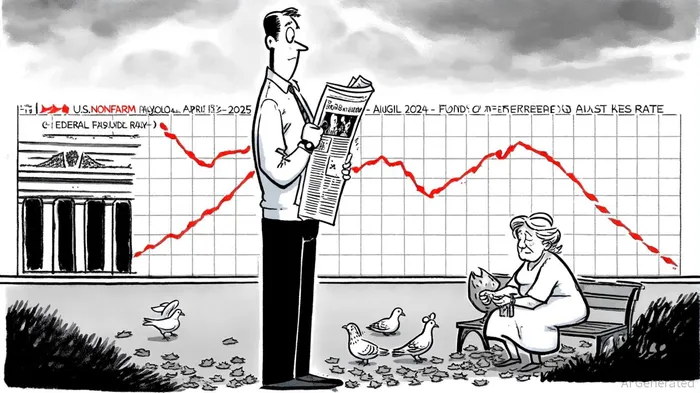
The U.S. labor market has entered a period of pronounced fragility, marked by a historic downward revision of 911,000 jobs in the year ending March 2025 and a meager 22,000 job addition in August 2025—far below expectations of 160,000 [4]. These developments have forced the Federal Reserve into a dovish pivot, with a 25-basis-point rate cut in September 2025 and projections of further easing by year-end [3]. For investors, the interplay between labor market deterioration and monetary policy adjustments presents both risks and opportunities, particularly as equity valuations react to shifting discount rates and sector-specific dynamics.
Labor Market Weakness: A Catalyst for Policy Action
The latest data paints a stark picture of a cooling labor market. Revisions to prior months' employment figures revealed that hiring was overstated by 911,000 jobs between April 2024 and March 2025, the largest such adjustment since 2002 [2]. Meanwhile, August's 22,000 job gain—the weakest since October 2020—underscored persistent fragility, with the unemployment rate rising to 4.3% and underemployment hitting 7.8% [4]. Key sectors like construction and manufacturing have seen consecutive declines, losing 78,000 jobs in manufacturing alone over the past year [5].
These trends have intensified pressure on the Federal Reserve to act. The central bank's dual mandate—maximizing employment and stabilizing prices—now faces a delicate balancing act. While inflation remains above the 2% target at 2.9% [4], the labor market's deterioration has shifted the Fed's focus toward supporting growth. The September 2025 rate cut, bringing the federal funds rate to 4.00%-4.25%, reflects this recalibration [3].
Sector-Specific Implications for Equity Valuations
The Fed's dovish pivot will have uneven effects across sectors. Lower borrowing costs are likely to benefit capital-intensive industries such as real estate, technology, and utilities, which rely on long-term financing [4]. For example, the real estate sector could see a boost from reduced mortgage rates, while tech companies may gain from increased access to cheap capital for innovation. Conversely, consumer discretionary and traditional financial services sectors could face headwinds. A weaker labor market may dampen consumer spending, and banks might see narrower net interest margins as rate differentials compress [4].
Health care and social assistance, which added modest employment in August 2025 [5], may also benefit from rate cuts, as demand for services remains resilient. However, investors should remain cautious about overexposure to sectors with structural challenges, such as manufacturing, which has seen prolonged job losses.
Strategic Considerations for Investors
The Fed's projected rate cuts—two in 2025 and one in 2026 [3]—suggest a prolonged period of accommodative policy. This environment could drive equity valuations higher, particularly for growth stocks that thrive in low-rate settings. However, the labor market's fragility introduces volatility. For instance, if unemployment rises further to 4.4% by year-end [3], consumer-driven sectors could face sharper declines.
Investors should also monitor the accuracy of BLS data, which has come under political scrutiny [2]. Revisions to employment figures could influence market expectations and Fed decisions, creating short-term turbulence. A diversified portfolio with exposure to rate-sensitive sectors and defensive plays (e.g., utilities, health care) may offer a balanced approach.
Conclusion
The Federal Reserve's proactive adjustments to a weakening labor market signal a shift toward growth support, but the path forward remains fraught with uncertainty. While rate cuts aim to stabilize employment and inflation, their impact on equity valuations will depend on sector-specific dynamics and the durability of the Fed's interventions. Investors must stay agile, leveraging insights from labor market data and policy signals to navigate this evolving landscape.







Comentarios
Aún no hay comentarios