
Federal Reserve's 2025 Outlook: Unlocking Dividend Equity Opportunities in a Disinflationary Era
The Federal Reserve's latest projections for 2025 paint a picture of modest economic growth and a softening inflationary environment. With real GDP growth forecasted at 1.6% for the year and core PCE inflation expected to trend toward 2.0% long-term, investors are increasingly turning to defensive strategies. In such a climate—marked by disinflationary pressures and cautious consumer spending—dividend-paying equities in resilient sectors offer a compelling case for capital preservation and income generation.
The Fed's Macroeconomic Playbook: A Tailwind for Defensive Stocks
According to the Federal Reserve's September 2025 Summary of Economic Projections, the U.S. economy is expected to grow at a median rate of 1.6% for 2025, with Q3 2025 growth estimates ranging from 1.3% to 3.3% across nowcasting models [1]. Meanwhile, core PCE inflation is projected to decline from 3.1% in 2025 to 2.0% over the longer term [1]. This trajectory suggests a transition toward a disinflationary environment, where demand for essential goods and services—rather than cyclical or speculative assets—will dominate.
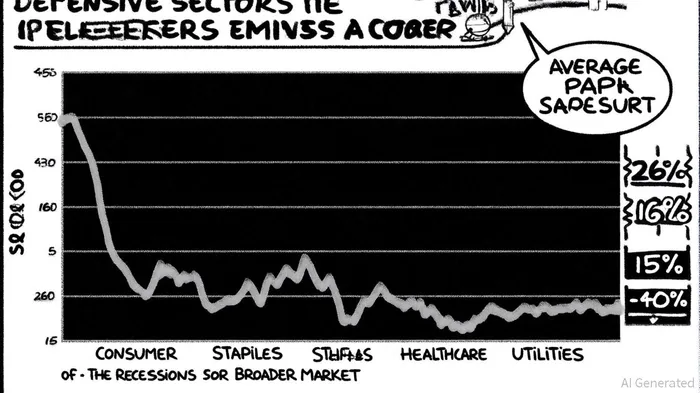
Historical data underscores the value of defensive sectors during such periods. A report by S&P Global reveals that consumer staples, healthcare, and utilities have outperformed the broader market during six U.S. recessions between 1960 and 2019, with average returns of 26%, 16%, and 15%, respectively, compared to a 40% loss for the S&P Global BMI TR [3]. These sectors thrive by providing non-discretionary goods and services, making them less susceptible to economic volatility.
High-Yield Dividend Stocks: Aligning with the Fed's Trajectory
To capitalize on the Fed's projected environment, investors should prioritize dividend stocks in sectors with strong historical resilience and sustainable payout ratios. Two elite dividend payers—Johnson & Johnson (JNJ) and Verizon Communications (VZ)—stand out as strategic holdings.
1. Johnson & Johnson (JNJ): A Healthcare Dividend Behemoth
Johnson & Johnson, a Dividend King with 64 consecutive years of dividend growth, exemplifies the stability required in a disinflationary climate. As of September 2025, JNJJNJ-- offers a dividend yield of 2.94%, with a payout ratio of 55.61%—a healthy balance between reward and sustainability [5]. The healthcare sector, broadly, has demonstrated an average 15% return during economic slowdowns, as investors flock to defensive assets [3].
JNJ's diversified business model—spanning pharmaceuticals, medical devices, and consumer health—ensures consistent cash flows regardless of macroeconomic conditions. Its recent focus on high-margin therapeutic areas (e.g., oncology and immunology) further insulates it from pricing pressures. As core PCE inflation moderates, JNJ's ability to maintain pricing power while delivering reliable dividends positions it as a cornerstone for income-focused portfolios.
2. Verizon Communications (VZ): A Telecommunications Anchor
Verizon, part of the Morningstar Dividend Leaders Index, offers a yield of approximately 4.5% as of Q3 2025 [1]. The telecommunications sector, often grouped with utilities in defensive investing strategies, benefits from inelastic demand for connectivity and entertainment. With the Fed's disinflationary outlook reducing the cost of capital, VZ's high-yield profile becomes even more attractive.
Verizon's financial health is underscored by its 75% payout ratio and $1.30 per share quarterly dividend [2]. The company's 5G expansion and fiber broadband investments also position it for long-term growth, even as economic growth remains tepid. During past disinflationary periods, utilities and telecoms have consistently outperformed cyclical sectors, making VZ a strategic play for both income and capital appreciation.
Strategic Rationale: Why Act Now?
The current macroeconomic environment—modest growth, disinflation, and a Fed poised to cut rates in 2026—creates a tailwind for high-quality dividend stocks. By investing in JNJ and VZ, investors secure exposure to sectors with:
- Proven resilience: Consumer staples, healthcare, and utilities have historically gained 15–26% during recessions [3].
- Sustainable yields: Both stocks offer yields above the 10-year Treasury (2.8% as of September 2025) [4].
- Payout security: JNJ's 55.61% payout ratio and VZ's 75% ratio ensure dividends remain well-covered [2][5].
Conclusion: A Dividend-Driven Path to Resilience
As the Fed navigates a delicate balance between growth and inflation, dividend stocks in defensive sectors offer a dual benefit: steady income and downside protection. Johnson & JohnsonJNJ-- and Verizon Communications, with their robust financials and sectoral advantages, are prime candidates for investors seeking to hedge against macroeconomic uncertainty while capturing above-market returns.
In a world where the Fed's playbook increasingly favors stability over stimulus, these two stocks represent a disciplined, data-driven approach to building a resilient portfolio.







Comentarios
Aún no hay comentarios