
Federal Realty's Q2 2025 FFO Guidance Hike: A Blueprint for Outperforming Retail REITs in a Challenging Climate
In a retail landscape marked by shifting consumer preferences and economic uncertainty, Federal Realty Investment TrustFRT-- (FRT) has emerged as a standout performer. The REIT's Q2 2025 results—marked by a 6% upward revision to its FFO guidance, robust leasing momentum, and strategic capital allocation—underscore why premium retail REITs with diversified, grocery-anchored portfolios are uniquely positioned to outperform in today's environment.
The FFO Surge: A Reflection of Resilience
Federal Realty reported Q2 2025 FFO per diluted share of $1.91, a 13% year-over-year increase, driven by $0.15 in NMTC transaction income. Even excluding this one-time boost, core FFO of $1.76 still outpaced 2024's $1.69. The company raised its 2025 FFO guidance to $7.16–$7.26 per share, a range that reflects disciplined execution and confidence in its asset base.
This performance isn't an anomaly. Grocery-anchored retail REITs have consistently outpaced non-grocery peers since 2023. As of Q4 2024, grocery-anchored vacancy rates stood at 3.5%, the lowest in a decade, while rents grew 3.1% year-over-year—the highest among retail subtypes. In contrast, non-grocery sectors like neighborhood and power centers saw rent growth of just 2.9% each.
Leasing Momentum: The Power of Essential Demand
Federal Realty's Q2 leasing activity was equally impressive. The REIT signed 119 leases for 643,810 square feet of comparable retail space, achieving 10% cash basis rollover growth and 21% straight-line growth. Portfolio occupancy hit 93.6%, with small shop leased rates rising 90 basis points year-over-year to 93.4%.
The secret to this success? Grocery anchors. With 80% of its centers featuring grocery tenants, Federal Realty benefits from the inelastic demand for essential goods. Foot traffic to grocery stores hit 17.2 billion visits in 2024—a 10.9% increase from 2019—creating a halo effect for adjacent tenants. This dynamic is particularly valuable in a climate where discretionary retail sectors face headwinds from e-commerce and shifting consumer spending.
Strategic Capital Allocation: Reinforcing Long-Term Value
Federal Realty's Q2 capital moves further solidify its competitive edge. The REIT acquired two high-quality open-air centers in Kansas for $289 million, while selling underperforming California assets for $143 million. This “buy high, sell low” strategy reflects a disciplined approach to portfolio optimization.
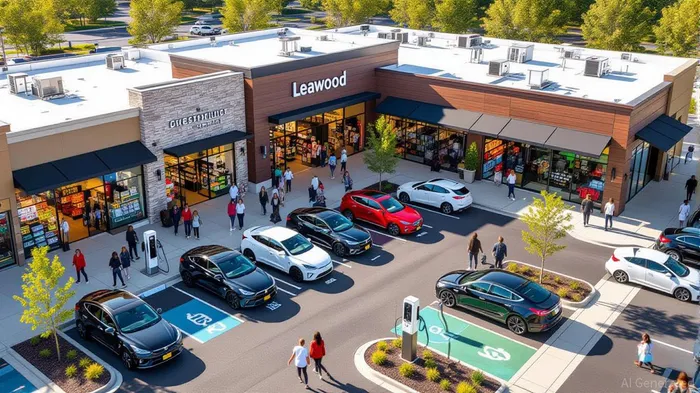
The company also announced a partnership with Mercedes-Benz High-Power Charging (HPC), integrating over 500 ultra-fast EV charging stalls into its retail destinations. This move aligns with the growing demand for sustainable infrastructure and enhances the appeal of its properties to both tenants and shoppers.
Why Grocery-Anchored REITs Outperform
The broader industry data validates Federal Realty's strategy. Grocery-anchored retail properties saw record transaction volumes in 2024, with an average price per square foot of $209—up 1.4% year-over-year. REITs like Regency CentersREG-- and Agree RealtyADC-- have also increased their presence in this sector, recognizing its defensive characteristics.
In contrast, non-grocery REITs struggle with higher vacancy rates and weaker absorption. For example, mall REITs like Simon Property GroupSPG-- (SPG) face declining foot traffic as consumers prioritize experiential spending over traditional retail. The contrast is stark: while grocery-anchored REITs benefit from stable cash flows, non-grocery peers must rely on speculative growth in sectors like entertainment or dining.
Investment Implications
Federal Realty's Q2 results and the broader industry trends point to a clear thesis: investors should prioritize premium retail REITs with grocery-anchored portfolios. These assets offer:
1. Defensive Characteristics: Low vacancy rates and rent growth driven by essential demand.
2. Scalability: Partnerships with grocers and EV charging providers create new revenue streams.
3. Dividend Resilience: Federal Realty's 58th consecutive annual dividend increase (now $4.52 annualized) highlights its financial strength.
Conclusion
Federal Realty's Q2 2025 performance is more than a quarterly win—it's a case study in how strategic positioning can drive outperformance. As the retail sector continues to evolve, the REIT's focus on grocery-anchored assets, disciplined capital allocation, and tenant diversification positions it as a top-tier investment. For investors seeking resilience in a volatile market, the message is clear: anchor your portfolio in the essentials.







Comentarios
Aún no hay comentarios