
Federal Funding Penalties and Supply Chain Risk: The Ripple Effects of California's Trucker License Crisis
The infrastructure and logistics sectors are facing a growing storm of regulatory and financial uncertainty, driven by California's ongoing trucker license crisis and the federal government's response. For investors, the interplay between policy enforcement, funding penalties, and supply chain stability has created a complex web of risks that could reshape capital allocation and operational strategies in the years ahead.
Federal Funding Penalties: A Double-Edged Sword
The U.S. Transportation Department has imposed significant financial penalties on California for its handling of commercial driver's licenses (CDLs) for immigrant drivers. According to a report by , California lost $160 million in federal funding after delaying the revocation of 17,000 licenses issued to non-citizens, including asylum seekers and DACA recipients. This penalty, announced by Transportation Secretary Sean Duffy, was tied to a January 5, 2025, compliance deadline. Meanwhile, the federal government whiteld an additional $40 million from California over alleged failures to enforce English proficiency requirements for truckers, as reported by Reuters.
These penalties are not merely symbolic. They signal a broader shift in federal oversight, with the Transportation Department threatening to decertify California's entire CDL program if compliance is not achieved. Such a move would halt all CDL issuance in the state, exacerbating labor shortages in an industry already strained by driver recruitment challenges.
Infrastructure Projects in Peril
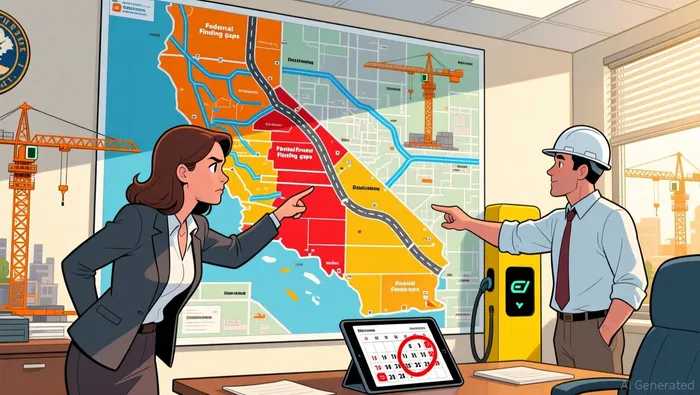 The ripple effects of these penalties extend far beyond the trucking sector. Federal funding cuts have disrupted California's infrastructure pipeline, particularly for projects under the Infrastructure Investment and Jobs Act (IIJA) and the Inflation Reduction Act (IRA). As detailed by , the Department of Transportation froze $20 billion in grant agreements in January 2025, citing the need for project-by-project reviews. This freeze has caused operational delays and increased costs for transportation and housing initiatives, with USDOT memos explicitly targeting projects related to green infrastructure, electric vehicles, and equity-focused programs.
The high-speed rail project, a cornerstone of California's infrastructure ambitions, has also been impacted. The state recently dropped a lawsuit seeking to reinstate $4 billion in federal funding, opting instead to pivot toward private investment. This shift underscores the vulnerability of large-scale projects to federal policy shifts and highlights the risks for investors relying on public-private partnerships.
Supply Chain Vulnerabilities and Labor Market Tensions
California's trucking industry, which accounts for 20% of the state's truckers being immigrants, is at the epicenter of this crisis. Federal officials argue that lax enforcement of eligibility rules has compromised public safety, citing high-profile crashes involving immigrant drivers. Conversely, California maintains that its actions align with new federal regulations and that the penalties are politically motivated according to the same report.
For investors, the conflict raises critical questions about supply chain resilience. A potential labor shortage-exacerbated by license revocations-could disrupt freight movement, particularly in a state that handles 12% of U.S. freight tonnage. The Sikh Coalition and Asian Law Caucus have already warned of mass work stoppages if revocations proceed, a scenario that could ripple through global supply chains reliant on California's ports and highways.
Legal and Political Uncertainty
The crisis has also sparked legal battles that further complicate the investment landscape. A class-action lawsuit challenges the disproportionate impact of license revocations on immigrant communities, while the House Transportation Committee's proposed budget cuts threaten $3.1 billion in unobligated funds for equity-focused projects. These developments highlight the growing politicization of infrastructure funding, with subjective metrics-such as marriage rates and vaccine mandates- now influencing grant allocations.
Investment Implications
For the infrastructure and logistics sectors, the California crisis underscores three key risks:
1. Regulatory Volatility: Frequent policy shifts and subjective federal criteria increase operational uncertainty.
2. Funding Dependency: Projects reliant on federal grants face heightened exposure to political and administrative delays.
3. Labor Market Disruptions: A shrinking qualified driver pool could drive up transportation costs and delay deliveries.
Investors should closely monitor the USDOT's enforcement actions, California's compliance efforts, and the broader political climate. Diversifying investments across logistics technologies (e.g., autonomous vehicles) and alternative labor models may mitigate some risks. However, the sector's exposure to federal policy remains a wildcard, with potential implications for returns and project timelines.
Conclusion
The California trucker license crisis is more than a regulatory dispute-it is a harbinger of systemic risks in the infrastructure and logistics sectors. As federal funding penalties and supply chain vulnerabilities converge, investors must navigate a landscape where policy decisions can swiftly alter the trajectory of projects and markets. The coming months will test the resilience of both state and federal actors, with long-term implications for capital flows and operational strategies.







Comentarios
Aún no hay comentarios