
The Fed's Uncertain December Rate Cut and Its Impact on Sectoral Performance
Financial Sector: A Beneficiary of Elevated Rates
Banks and financial institutionsFISI-- stand to gain in a "higher-for-longer" scenario, as elevated interest rates widen net interest margins. The Federal Open Market Committee (FOMC) minutes from October 2025 highlighted significant disagreements among policymakers, with a 25 basis point cut ultimately passed despite a rare two-sided dissent according to internal reports. If the Fed pauses in December, financials could see further tailwinds, as higher rates sustain lending profitability. J.P. Morgan Global Research notes that banks and mortgage lenders are structurally positioned to benefit from prolonged elevated rates. However, this advantage is contingent on the Fed avoiding aggressive rate cuts, which could compress margins and erode returns.
Tech and Growth Stocks: Vulnerable to Rate Volatility
Conversely, growth stocks and technology companies face headwinds in a higher-rate environment. These sectors are sensitive to discount rates, which rise with interest rates, reducing the present value of future earnings. Vanguard warns that sectors like private equity and small-cap firms are particularly vulnerable to structural forces behind elevated rates, including reduced exit opportunities and rising debt costs. While J.P. Morgan projects two more rate cuts in 2025, a non-recessionary easing cycle could temporarily buoy tech stocks, as seen in historical patterns where the S&P 500 and high-yield bonds outperform. However, the risk of a recessionary scenario remains a critical wildcard.
Real Estate and Infrastructure: Innovation as a Mitigation Strategy
The real estate sector is navigating a dual challenge: affordability constraints and supply bottlenecks. Yet, innovation is emerging as a key differentiator. For instance, Daniel Kaufman's expansion of AI-driven real estate and infrastructure platforms underscores how modular construction and digital workflows can reduce costs and accelerate development timelines. Similarly, Catella Investment Management's adoption of Optiml's Real Estate Decision Intelligence platform highlights the integration of sustainability and financial analytics to align with regulatory frameworks. These strategies position forward-thinking real estate firms to thrive despite higher borrowing costs. Meanwhile, Choice Properties' normal course issuer bid reflects a defensive approach to optimize capital efficiency in a high-rate environment.
Defensive Sectors: Utilities and Consumer Staples
Defensive sectors like utilities and consumer staples are expected to hold up relatively well in a higher-rate environment. Vanguard emphasizes that these sectors, characterized by stable cash flows and low debt burdens, offer resilience amid economic uncertainty. However, their outperformance is contingent on a non-recessionary scenario. In a downturn, even defensive sectors could face pressure, though their role as income-generating assets remains attractive in a low-yield world.
Strategic Implications for Investors
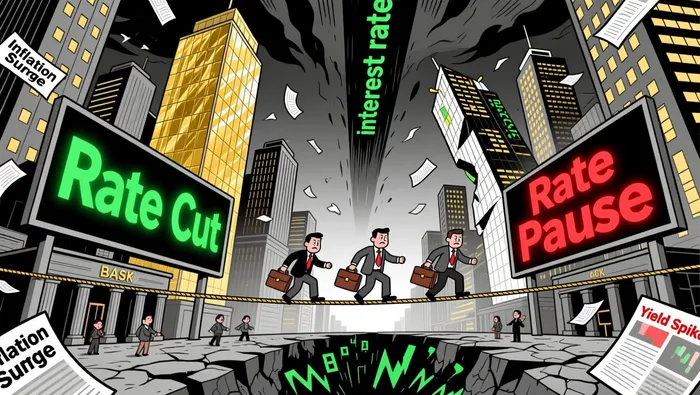
For investors, the key lies in hedging against both rate-cut and rate-pause scenarios. In a non-recessionary easing cycle, allocations to the S&P 500 and high-yield bonds could yield strong returns, while gold and Treasuries serve as hedges in a downturn. Tech-sector companies with high-quality earnings growth remain compelling long-term opportunities, provided rate volatility is managed through diversification. Real estate and infrastructure investments and sustainability platforms offer a unique blend of growth and resilience.
The Fed's December decision will likely hinge on incoming data, with Governor Barkin's emphasis on a data-dependent approach underscoring the central bank's cautious stance. As political considerations-such as the potential transition of the Fed chair under President Trump-add another layer of complexity, investors must remain agile. The "higher-for-longer" rate environment demands a nuanced strategy, balancing sectoral exposure with macroeconomic signals to navigate the Fed's uncertain path.





Comentarios
Aún no hay comentarios