
The Fed's 'Skinny Accounts' and the Dawn of Institutional Crypto Adoption: Strategic Investment Opportunities in Bitcoin Infrastructure
The Fed's "Skinny Accounts": A Gateway to Inclusion
Governor Christopher Waller's proposal for "skinny accounts" is more than a technical tweak-it's a strategic recalibration. These accounts allow crypto-native firms to settle payments directly with the Fed, bypassing traditional banks as intermediaries. By imposing balance caps, no interest on balances, and limited access to emergency lending, the Fed balances innovation with risk management, as the Fed's roadmap explains (Fed roadmap). This approach mirrors the central bank's broader goal of "embracing disruption" while maintaining systemic stability, a position echoed by the White House fact sheet (White House fact sheet).
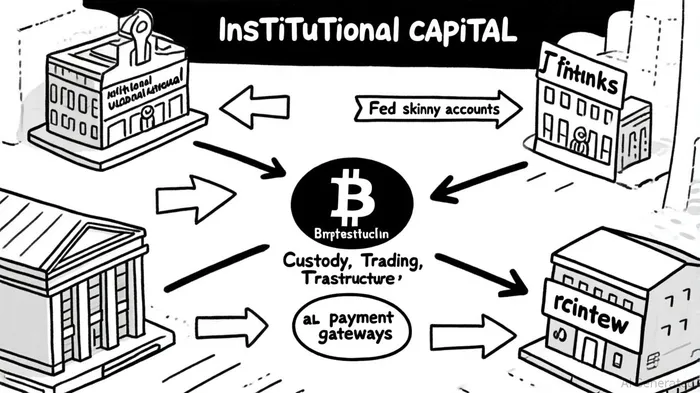
For institutional investors, the implications are clear: crypto firms can now access the same rails as legacy banks, reducing friction in cross-border settlements and custodial services. This is particularly transformative for Bitcoin infrastructure, where direct access to the Fed's systems could streamline liquidity management and reduce reliance on volatile third-party platforms.
Regulatory Easing and the Normalization of Crypto
The Fed's decision to end its Novel Activities Supervision Program in August 2025, as reported by Blockchain News (Blockchain News), further lowers the barrier to entry for banks. Previously, institutions had to notify the Fed before engaging in crypto activities, a process that stifled innovation. Now, crypto services fall under standard supervisory frameworks, aligning with the Office of the Comptroller of the Currency's (OCC) and FDIC's recent clarifications, according to an Arnold & Porter advisory (Arnold & Porter advisory). This normalization reduces compliance costs and encourages banks to offer crypto custody and trading services, creating a fertile ground for institutional adoption.
Meanwhile, the Trump administration's Strategic Bitcoin Reserve and Digital Asset Stockpile underscore a growing recognition of Bitcoin's role in national economic strategy. While the exact mechanics of these initiatives remain opaque, their existence legitimizes Bitcoin as a strategic asset class, likely prompting institutional investors to allocate capital to infrastructure that supports such reserves.
Strategic Investment Opportunities in Bitcoin Infrastructure
The convergence of regulatory clarity and Fed innovation points to three key investment areas:
Custody Solutions: As institutions seek secure storage for Bitcoin, custodial platforms with Fed access (via skinny accounts) will gain a competitive edge. Companies offering multi-signature wallets, insurance partnerships, and compliance tools are well-positioned to capture market share.
Trading and Liquidity Platforms: Direct Fed access reduces settlement risks, enabling crypto exchanges to offer faster, cheaper transactions. Firms integrating real-time gross settlement (RTGS) systems with Bitcoin trading could dominate the next phase of institutional on-ramps.
Payment Gateways: The Fed's focus on payment innovation aligns with Bitcoin's potential to disrupt cross-border remittances. Startups building bridges between the Fed's rails and blockchain networks (e.g., stablecoins, layer-2 solutions) stand to benefit from increased institutional demand.
Risks and Considerations
While the outlook is bullish, investors must remain cautious. Regulatory shifts can reverse quickly, and the Fed's "skinny accounts" are still in the proposal phase. Additionally, Bitcoin's price volatility and macroeconomic headwinds (e.g., interest rates) could dampen adoption. However, the normalization of crypto under standard frameworks, as tracked by Paul Hastings (Paul Hastings), suggests that institutional participation is inevitable, albeit with a learning curve.
Conclusion
The Fed's "skinny accounts" are notNOT-- just a technical innovation-they're a catalyst for institutional crypto adoption. By lowering barriers and fostering a more inclusive payment ecosystem, the central bank is paving the way for Bitcoin to transition from speculative asset to strategic infrastructure. For investors, the next frontier lies in the companies building the rails, vaults, and tools that will underpin this new era.






Comentarios
Aún no hay comentarios