
Fed Under Siege: How Political Attacks Are Shaking Bond Markets and What Investors Should Do
The Federal Reserve's independence—a cornerstone of financial stability for decades—is under unprecedented strain as President Trump and Vice President Pence escalate their public criticism of Chair Jerome Powell. This political warfare threatens to erode confidence in the Fed's ability to set monetary policy without political interference, creating fertile ground for heightened interest rate volatility and bond market turbulence. For investors, navigating this environment requires a sharp focus on defensive strategies, such as short-duration bonds and inverse rate ETFs, to hedge against policy uncertainty.
The Fed's Independence Under Fire
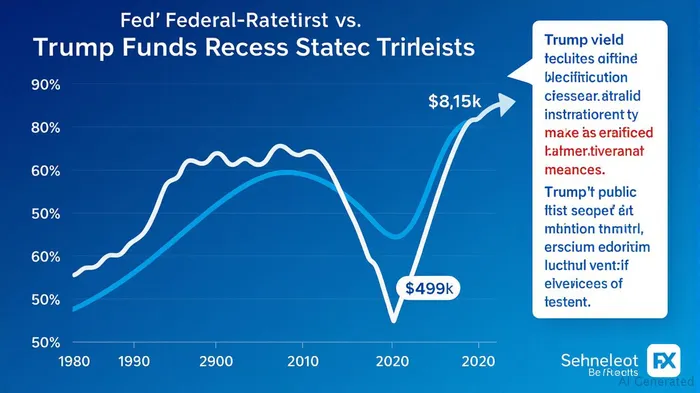
Trump's relentless attacks on Powell—labeling him “stupid” and vowing to replace him—have blurred the line between political theater and economic governance. The administration's demands for immediate rate cuts to ease federal debt costs clash with the Fed's dual mandate of price stability and maximum employment. Compounding the tension, Vice President Pence has endorsed Trump's right to publicly critique the Fed, even proposing legislation to narrow its mandate to focus solely on inflation. This political pressure has spilled into financial markets, with Treasury yields dropping sharply during periods of heightened rhetoric.
For instance, the 10-year Treasury yield fell to 4.27% in April 2025 following Trump's threats to install a “shadow chair” to pressure Powell, while the 2-year yield dipped to 3.76%—a stark contrast to the Fed's stated “wait-and-see” approach to rate cuts. These moves reflect investor anxiety about the Fed's ability to remain insulated from political whims.
The Risks of Eroding Central Bank Credibility
The Fed's credibility is its most valuable asset. When markets doubt its independence, it risks a dangerous feedback loop: investors may demand higher yields to compensate for perceived policy instability, which could force the Fed to raise rates further to combat inflation—a scenario known as fiscal dominance.
Historically, periods of Fed credibility crises have been marked by sharp bond market swings. During the 1970s, when the Nixon administration pressured the Fed to keep rates low, inflation surged to 13%, triggering a collapse in bond prices. More recently, the 2013 “taper tantrum”—a spike in yields after the Fed hinted at slowing bond purchases—showed how market confidence can crater on policy signals alone. Today's political attacks add another layer of uncertainty, magnifying the risk of similar volatility.
Investment Strategies for a Volatile Fed Era
Investors must prioritize duration management and hedges against policy uncertainty. Here's how to position:
- Short-Duration Bonds:
Opt for Treasury ETFs like the iShares 1-3 Year Treasury Bond ETF (SHY), which hold bonds with maturities of three years or less. Short-term Treasuries are less sensitive to rate changes and offer liquidity. Their yields are also less likely to be upended by sudden Fed pivots.
Inverse Rate ETFs:
Instruments like the ProShares UltraShort 20+ Year Treasury ETF (TBT) profit when long-term Treasury yields rise—a scenario that could unfold if markets lose faith in the Fed's ability to control inflation. While volatile, these ETFs provide asymmetric protection against sudden rate spikes.Cash and Gold:
Maintain a cash buffer to capitalize on dislocations. Gold (GLD) and the Swiss franc (FXF) also act as safe havens if the dollar weakens amid Fed credibility concerns.
Why This Works
The Fed's projected two rate cuts in 2025 remain conditional on economic data, but political interference could delay or negate them. Short-duration bonds limit exposure to this uncertainty, while inverse rate ETFs profit if yields rise due to inflation fears or Fed missteps.
Conclusion
The Fed's independence is at a crossroads. As Trump and Pence ratchet up political pressure, bond markets face a reckoning. Investors who embrace short-duration strategies and hedging tools will be best positioned to navigate the storm. History shows that when central banks lose credibility, fixed income markets suffer—making proactive defense a necessity.
Stay nimble, stay short, and brace for turbulence.
This article synthesizes the provided research data to emphasize the risks of political interference in monetary policy and offers actionable strategies to mitigate them. The recommendations are grounded in historical precedent and current market dynamics.







Comentarios
Aún no hay comentarios