
The Fed's Shifting Balance Sheet Strategy and Implications for Money Market Instruments
The Inflection Point: QT Slowdown and SRF Surge
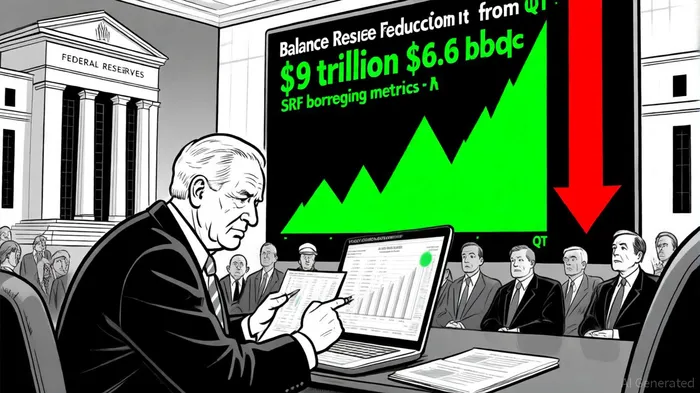
The Fed's QT program, which began in June 2022, has been a cornerstone of its post-pandemic normalization effort. However, the program's progress has faltered. By Q3 2025, the SRF-a tool designed to provide emergency liquidity-saw record borrowing of over $10 billion, with collateralized assets including $2 billion in Treasuries and $8.2 billion in mortgage-backed securities, according to Reuters. This surge reflects a market starved of liquidity, as QT's aggressive reduction of the Fed's balance sheet has inadvertently tightened financial conditions.
Analysts now anticipate the FOMC will halt QT at its October 2025 policy meeting, according to a Reuters analysis. Deutsche BankDB-- strategists argue that this shift is necessary to stabilize money market pressures, while J.P. Morgan analysts suggest the Fed may implement temporary interventions post-QT, including adjusting the SRF's borrowing rate to encourage its use. Such measures would mark a departure from the Fed's earlier focus on balance sheet reduction and signal a return to active liquidity management.
Implications for Money Market Instruments
The Fed's pivot will directly impact short-term debt markets. As QT slows, the easing of funding pressures is expected to lower Treasury yields and support risk assets, as the MarketMinute report noted. However, the interim period-marked by uncertainty around temporary interventions-could create volatility in repo rates and money market instruments.
For instance, the SRF's record usage has already pushed the federal funds rate higher, narrowing the spread between the Fed's policy rate and short-term market rates, Reuters reported. If the Fed adjusts the SRF's borrowing rate to incentivize its use, repo-linked assets such as commercial paper and asset-backed securities could see renewed demand. Conversely, prolonged liquidity strains might prompt the Fed to resume balance sheet expansion, potentially through Treasury purchases, as suggested by some strategists in the Reuters analysis.
Strategic Positioning for Investors
Investors in short-term debt and repo-linked assets should adopt a dual approach:
Hedge Against Volatility: Given the uncertainty surrounding temporary interventions, prioritize instruments with short durations and high liquidity. Money market funds with exposure to overnight reverse repos or short-term Treasuries can provide stability amid rate fluctuations, as noted in the MarketMinute report.
Leverage SRF Dynamics: The SRF's role as a liquidity buffer suggests that repo-linked assets collateralized by high-quality securities (e.g., Treasuries) may outperform. Investors should monitor Fed communications for hints about potential rate adjustments to the SRF, which could signal shifts in market access, Reuters has observed.
Anticipate Balance Sheet Expansion: If the Fed resumes asset purchases in early 2026, as some analysts predict in the Reuters analysis, investors should position for a "risk-on" environment. Sectors like growth equities and high-yield corporate bonds could benefit from lower borrowing costs and improved liquidity.
Conclusion
The Fed's shift from QT to liquidity injections underscores a broader recalibration of monetary policy. While the cessation of QT will alleviate immediate funding pressures, the path forward remains contingent on the Fed's willingness to adapt to evolving market conditions. For investors, the key lies in balancing caution with agility-leveraging the SRF's role as a liquidity lifeline while preparing for potential balance sheet expansion. As the Fed navigates this inflection point, those who align their strategies with its evolving priorities will be best positioned to capitalize on the opportunities ahead.





Comentarios
Aún no hay comentarios