
Fed Reverse Repo Facility Use Tumbles to Fresh Low Since 2021
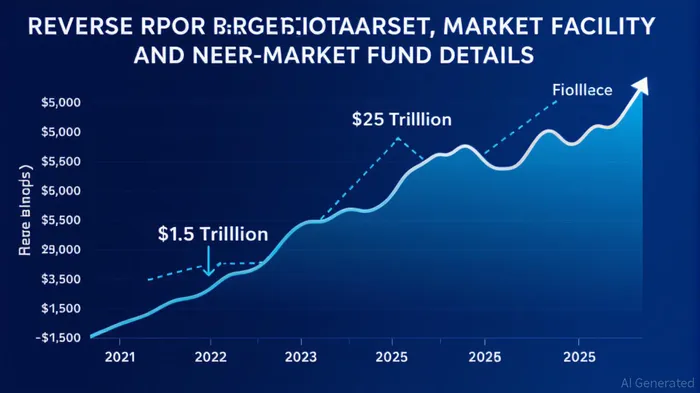
The Federal Reserve’s reverse repo (RRP) facility, once a cornerstone of short-term liquidity management, has collapsed to near-zero levels in 2025, marking a pivotal shift in monetary policy and market dynamics. This decline—from a peak of $1.5 trillion in 2023 to negligible balances—reflects the Fed’s aggressive balance sheet reduction, which has shrunk its holdings from $9 trillion to $6.7 trillion since 2023 [1]. The implications for short-term fixed income markets and money market funds (MMFs) are profound, signaling a reconfiguration of liquidity flows and investor behavior in a tightening credit environment.
The Fed’s Balance Sheet Drawdown and Liquidity Reallocation
The Fed’s quantitative tightening (QT) program has prioritized reducing short-term assets, particularly Treasury securities, while maintaining a passive approach to long-dated bond holdings. This strategy has created a paradox: while QT exerts upward pressure on short-term yields, the Fed’s continued reinvestment of maturing long-term bonds has suppressed long-term rates [2]. The result is a fragmented yield curve, with short-term rates rising modestly and long-term rates remaining anchored by the Fed’s large bond portfolio [3].
The RRP facility, which once provided a safe haven for excess cash, has become increasingly irrelevant as the Fed unwinds its emergency liquidity programs. This shift has forced investors to seek alternative yield sources, including intermediate-duration bonds and credit assets. For instance, BlackRockBLK-- notes that investors are now favoring active credit strategies over long-dated Treasuries, which face weaker demand due to rising term premiums [4].
Money Market Funds as a New Liquidity Anchor
With reverse repo availability dwindling, MMFs have emerged as a critical liquidity buffer. In Q3 2025, inflows into MMFs surged as investors sought stable returns amid rate-cut expectations. The Bank of England’s June 2025 rate cut to 4.25% and the Fed’s anticipated two rate cuts in 2025 have further bolstered MMF demand, as investors extend the duration of their holdings to capture higher yields before rates fall [5].
The reduced RRP facility also disrupts traditional repo market dynamics. Historically, foreign banks used the RRP to manage quarter-end liquidity, preventing sharp rate drops. Now, with this floor removed, repo rates have become more volatile, pushing investors toward MMFs for stability [6]. Morgan StanleyMS-- highlights that MMFs now offer a “hybrid” role: combining the safety of cash with the yield potential of short-term fixed income [7].
Strategic Opportunities in a Shifting Landscape
The RRP’s collapse creates opportunities for tactical positioning. First, investors should consider shifting from cash-heavy MMFs to intermediate-duration bonds, which benefit from the Fed’s scarcity-driven bond market. BlackRock argues that active credit strategies—such as high-quality corporate bonds or municipal securities—can outperform Treasuries in this environment [8].
Second, the Fed’s focus on short-term QT means long-term yields will remain suppressed. Investors seeking yield should avoid long-dated Treasuries and instead target sectors with tighter credit spreads, such as investment-grade corporates or securitized assets [9].
Finally, the reduced RRP availability underscores the importance of liquidity management. As Ancora notes, 4% money market rates may not persist, prompting investors to lock in higher yields before rate cuts materialize [10].
Conclusion
The Fed’s reverse repo facility has reached a historic low, signaling a structural shift in liquidity dynamics. While this marks the end of an era for emergency liquidity, it also opens new avenues for short-term fixed income and MMF strategies. Investors who adapt to this evolving landscape—by embracing active credit, intermediate-duration bonds, and disciplined liquidity management—will be well-positioned to capitalize on the Fed’s tightening cycle.
Source:
[1] Fed's balance sheet drawdown enters new stage as reverse repos largely drained, [https://www.reuters.com/business/finance/feds-balance-sheet-drawdown-enters-new-stage-reverse-repos-largely-drained-2025-08-29/]
[2] QT-Lite: Quantitative tightening's limited impact, [https://www.blackrock.com/us/individual/insights/fed-balance-sheet]
[3] First Quarter 2025 Money Market Commentary, [https://www.firstamericanfunds.com/index/OurInsights/InsightsCommentary/first-quarter-2025-money-market-commentary-.html]
[4] Fed Rate Cuts & Potential Portfolio Implications | BlackRock, [https://www.blackrock.com/us/financial-professionals/insights/fed-rate-cuts-and-potential-portfolio-implications]
[5] Money Market Funds 2025 Outlook, [https://www.morganstanley.com/im/en-us/liquidity-investor/insights/market/money-market-funds-2025-outlook.html]
[6] OFR Short-term Funding Monitor - Market Digests, [https://www.financialresearch.gov/short-term-funding-monitor/market-digests/volume/chart-28/]
[7] Liquidity lowdown: How changing rate expectations are shaping money market funds in 2025, [https://www.rlam.com/uk/institutional-investors/our-views/2025/how-changing-rate-expectations-are-shaping-money-market-funds-in-2025/]
[8] Fed Rate Cuts & Potential Portfolio Implications | BlackRock, [https://www.blackrock.com/us/financial-professionals/insights/fed-rate-cuts-and-potential-portfolio-implications]
[9] Fed Rate Cuts & Potential Portfolio Implications | BlackRock, [https://www.blackrock.com/us/financial-professionals/insights/fed-rate-cuts-and-potential-portfolio-implications]
[10] The Days of 4% Money Market Rates May be Numbered…, [https://ancora.net/the-days-of-4-money-market-rates-may-be-numbered/]







Comentarios
Aún no hay comentarios