
The Fed's Restrictive Policy Path and Its Implications for 2026 Investment Strategy
The Federal Reserve's approach to monetary policy in 2026 is poised to remain cautious and data-dependent, with a limited rate-cut environment expected to dominate the year. After delivering a 25-basis-point cut in December 2025, the Fed has positioned itself within a "broad range of estimates" of a neutral rate, balancing its dual mandates of controlling inflation and supporting the labor market. Median forecasts from the December 2025 meeting suggest only one rate cut in 2026, with growth expectations rising to 2.3%. However, market expectations, as reflected in bond yields, are pricing in two rate cuts by year-end 2026, signaling a potential divergence between official projections and investor sentiment. This divergence underscores the need for investors to reassess portfolio positioning in a landscape where policy outcomes remain uncertain.
Assessing Market Readiness for a Limited Rate-Cut Environment
The Fed's policy path for 2026 is marked by internal divisions. While Goldman SachsGS-- Research anticipates a pause in easing until March 2026, followed by cuts in June and September, the median forecast from the December 2025 meeting points to a single cut. Seven policymakers have signaled resistance to further easing, contrasting with four who advocate for a more aggressive approach. This fragmentation complicates market readiness, as investors must navigate a central bank that is recalibrating its stance amid evolving economic conditions.
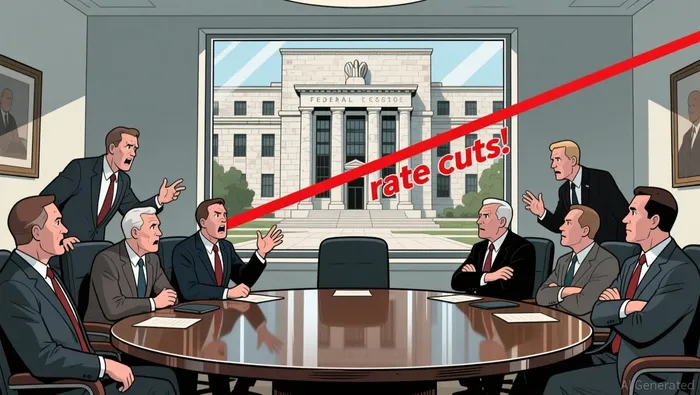 Key risks include a potential softening of inflation and labor market deterioration, particularly among college-educated workers. The incoming Fed chair, assuming office in May 2026, will face the challenge of unifying a divided committee while responding to fiscal stimulus and shifting labor dynamics. As a result, investors should prepare for a policy environment where rate cuts are neither guaranteed nor predictable, necessitating agile portfolio strategies.
Positioning Portfolios for 2026: Strategic Asset Allocation
In a limited rate-cut environment, asset allocation must prioritize resilience and adaptability. According to a report by the National Bureau of Economic Research (NB), investors should favor equities-particularly cyclicals and quality growth-while expanding exposure beyond U.S. large-cap stocks to include small-cap and international equities. Cyclicals, such as industrials and consumer discretionary sectors, are likely to benefit from a potential economic rebound, while quality growth stocks offer downside protection in a volatile market.
Fixed-income strategies should shift away from cash and ultra-short bonds, with a focus on extending duration and adding credit exposure. This approach capitalizes on the expectation of lower yields in 2026 while mitigating the risks of a prolonged pause in rate cuts. Additionally, private markets present an attractive opportunity, with liquidity strategies such as secondaries and co-investments gaining traction as M&A activity normalizes in the second half of 2026.
Conclusion
The Fed's restrictive policy path in 2026 demands a nuanced investment approach. While official projections suggest a single rate cut, market expectations and economic uncertainties point to a more dynamic environment. By favoring equities with growth potential, extending fixed-income duration, and leveraging private markets, investors can position portfolios to thrive in a landscape where policy outcomes remain fluid. As the central bank navigates its transition from quantitative tightening to easing, strategic agility will be the cornerstone of successful portfolio management in 2026.





Comentarios
Aún no hay comentarios