
Fed Rate Cuts and the Shifting Asset Allocation Landscape
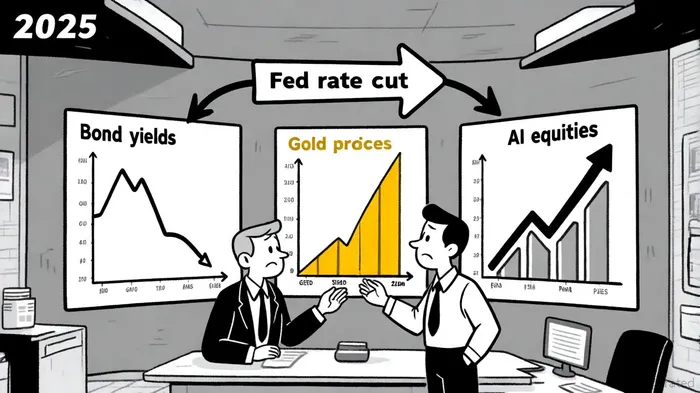
The Federal Reserve's 25-basis-point rate cut in September 2025 marked a pivotal shift in monetary policy, signaling a strategic pivot from inflation containment to addressing labor market vulnerabilities[1]. With the federal funds rate now in a 4.00%-4.25% range, the Fed's decision has sent ripples through global markets, creating distinct tailwinds for bonds, gold, and AI-driven equities. This analysis unpacks how these asset classes are being reshaped by the Fed's accommodative stance, supported by granular market data and institutional insights.
Bonds: A Tale of Yield Volatility and Strategic Rebalancing
The immediate aftermath of the rate cut revealed a nuanced bond market response. While the Fed's easing initially drove 10-year Treasury yields below 3.62%[5], subsequent economic data—particularly surging producer prices—prompted a rebound in yields. By September 17, the 10-year yield had climbed to 4.074%, reflecting investor caution about inflation persistence[1]. This duality underscores a key challenge for bondholders: shorter-duration bonds benefit from declining cash yields, while longer-duration instruments face headwinds if inflationary pressures persist[5].
Active bond strategies are gaining traction in this environment. For instance, the iShares Flexible Income Active ETF (BINC) has outperformed passive alternatives like AGG by capitalizing on less-represented sectors and optimizing yield capture[1]. Investors are increasingly favoring the “belly” of the yield curve (3- to 7-year maturities) for its balance of income and resilience in a non-recessionary context[2]. However, as Fed Chair Jerome Powell noted, the path of inflation remains uncertain, and a misstep in rate-cut timing could reignite volatility[1].
Gold: Safe Haven or Speculative Play?
Gold's post-rate-cut trajectory has been anything but linear. The precious metal surged to an all-time high of $3,707.40 per ounce immediately after the Fed's announcement, only to retreat to $3,634 within 24 hours as the U.S. dollar strengthened[1]. This volatility highlights gold's dual role as both an inflation hedge and a currency-sensitive asset. While the Fed's easing cycle theoretically supports gold demand, the dollar's relative strength has tempered its appeal for international buyers[1].
Analysts suggest gold is likely to trade in a $3,600–$3,900 range in the near term, with further gains contingent on geopolitical tensions or a sharper inflationary uptick[2]. Unlike bonds, gold's performance is less tied to the Fed's rate path and more to macroeconomic narratives—such as trade policy uncertainty and global growth concerns—that remain unresolved[3].
AI-Driven Equities: The New Rate-Cut Beneficiaries
The AI sector has emerged as a standout winner in the Fed's pivot. The Nasdaq Composite, a bellwether for AI and tech stocks, hit an intraday record of 22,439.10 on September 17, 2025, fueled by lower borrowing costs and robust earnings from hyperscalers like NVIDIANVDA-- and AMD[4]. The global AI market, valued at $638.23 billion in 2025, is projected to balloon to $3.68 trillion by 2034, with AI-focused companies delivering average returns of 68.5% year-to-date[3].
Lower interest rates directly benefit AI firms by reducing capital costs for R&D and infrastructure. For example, MicrosoftMSFT-- and AmazonAMZN-- are allocating billions to expand AI data centers, a trend accelerated by the Fed's easing[3]. However, the sector's beta values (1.6–2.2) highlight its vulnerability to rate reversals, making it a high-reward, high-risk bet[3].
Conclusion: Navigating the New Normal
The Fed's September 2025 rate cut has catalyzed divergent outcomes across asset classes. Bonds require a tactical approach to duration and sector selection, gold remains a barometer for macroeconomic sentiment, and AI equities are poised for growth but carry elevated risks. As the Fed projects two more cuts in 2025, investors must balance these dynamics while staying attuned to evolving inflation data and global economic signals. In this shifting landscape, adaptability—and a clear-eyed view of the Fed's dual mandate—will be paramount.







Comentarios
Aún no hay comentarios