
Fed Rate Cuts and Their Ripple Effects on the Mortgage and Housing Sectors
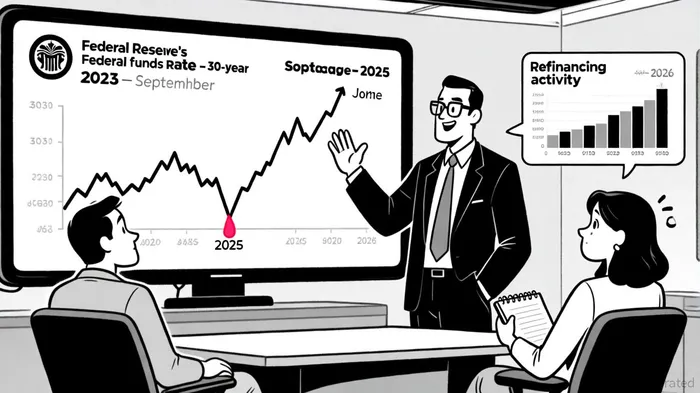
The Federal Reserve's September 2025 rate cut—its first easing move since December 2024—has sent ripples through the mortgage and housing sectors, creating both challenges and opportunities for investors. By reducing the federal funds rate by 0.25 percentage points to a range of 4.00%–4.25%, the Fed signaled a shift toward a more neutral policy stance amid slowing labor market growth and rising unemployment[1]. This decision, coupled with projections of two additional rate cuts in 2025, has reshaped the investment landscape for mortgage-backed securities (MBS) and regional banks.
The Fed's Easing Cycle and Mortgage-Backed Securities
The Fed's rate cuts are indirectly but significantly influencing mortgage rates and MBS dynamics. While the central bank does not directly set mortgage rates, its actions affect broader market expectations and Treasury yields. According to a report by Forbes, the 30-year fixed-rate mortgage has already declined in response to the September 2025 rate cut, with further reductions anticipated in 2026 if Treasury yields follow the projected trajectory[2]. This environment is likely to boost refinancing activity, as homeowners capitalize on lower borrowing costs.
For MBS investors, the interplay between falling rates and refinancing demand presents a dual-edged sword. On one hand, lower mortgage rates could increase prepayment risk, reducing the cash flows from existing MBS holdings. On the other, a surge in refinancing activity may drive demand for new MBS issuance, potentially stabilizing yields in the long term[3]. Data from CNBC suggests that investors are already shifting from money market funds—whose yields have declined—to longer-maturity bonds, including MBS, to preserve income[4].
Regional Banks: Resilience and Strategic Opportunities
Regional banks, often overlooked in favor of megabanks, are emerging as key beneficiaries of the Fed's easing cycle. The KBW Regional Banking Index has gained 1.4% since the September 2025 rate cut, outperforming the broader S&P 500 Banks Index, which rose by nearly 5%[5]. This resilience is partly attributed to the 2025 Fed stress test results, which showed all 22 tested regional banks passing with strong capital ratios, even under a less severe stress scenario compared to 2024[6].
The re-steepening yield curve—a direct consequence of the Fed's rate cuts—is another tailwind for regional banks. As short-term rates fall while long-term rates remain relatively stable, net interest margins (NIMs) expand, bolstering profitability. A report by Reuters highlights that regional banks with diversified loan portfolios and prudent risk management are particularly well-positioned to capitalize on this dynamic[7]. However, investors must remain cautious about potential headwinds, including lingering inflationary pressures and exposure to commercial real estate (CRE) markets, which remain vulnerable to economic shocks[8].
Investment Opportunities in a Post-Rate Cut World
For investors seeking exposure to the housing sector, both MBS and regional banks offer compelling, albeit distinct, opportunities. MBS, while sensitive to prepayment risk, remain attractive in a low-rate environment due to their yield advantages over cash equivalents. Meanwhile, regional banks present a dual opportunity: capital appreciation from a re-rating of the sector and income generation through dividends and buybacks.
According to CFRA Research, regional banks currently trade at attractive valuations, with forward price-to-earnings (P/E) ratios and price-to-book ratios below historical averages. This undervaluation, combined with the Fed's projected 0.75 percentage point rate cuts in 2025, suggests a favorable risk-reward profile for long-term investors[9]. However, as with any investment, due diligence is critical. Investors should prioritize banks with strong capital buffers, low CRE exposure, and a history of disciplined lending.
Conclusion
The Federal Reserve's 2025 rate cuts are reshaping the mortgage and housing sectors in ways that demand a nuanced investment approach. While MBS and regional banks face headwinds from falling yields and economic uncertainty, they also offer unique opportunities for those willing to navigate the complexities of a shifting interest rate environment. As Fed Chair Jerome Powell emphasized, the September 2025 cut was a “risk management” move—a reminder that central bank policy remains a critical, if unpredictable, force in shaping market outcomes[10].







Comentarios
Aún no hay comentarios