
Fed Rate Cuts and the End of QT: Implications for Equity Markets and Risk Assets
The Fed's New Normal: Easing Liquidity and Lower Rates
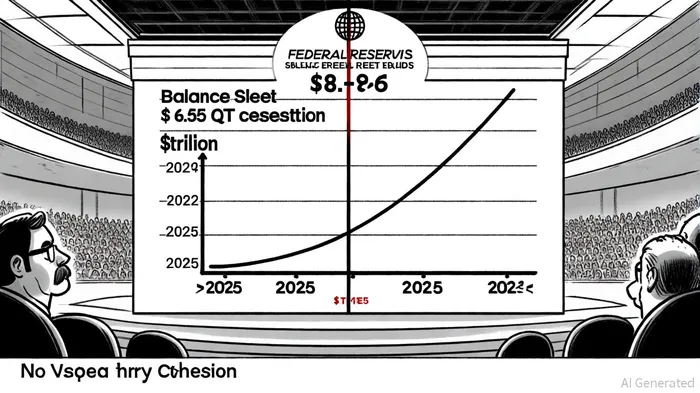
The Fed's decision to halt QT by late 2025 reflects growing concerns over tightening money markets. By removing a drag on liquidity, the central bank is indirectly supporting credit conditions, which could lower mortgage rates and stimulate housing demand, as the FinancialContent analysis noted. For equities, this means a more favorable environment for sectors sensitive to borrowing costs, such as real estate and construction.
Rate cuts, while modest for now (the federal funds rate now sits at 3.75–4%), are expected to continue into 2026. Analysts like Krishna Guha of Evercore ISI argue that the Fed's pivot is a response to a weakening labor market and inflation risks, with three potential 25-basis-point cuts projected in 2026, according to the American Action Forum. This gradual easing contrasts with the aggressive hikes of 2022–2023, which had pushed equity multiples down by nearly 30% during prior QT episodes, as noted in a Cambridge Associates analysis.
Equity Markets: Sector Rotations and Strategic Positioning
Historical patterns suggest that equity markets respond asymmetrically to rate cuts and QT cessation. During the 2017–2019 QT phase, sectors like technology and consumer discretionary outperformed as investors flocked to growth assets amid low volatility, a trend Cambridge Associates highlighted. In 2026, a similar rotation could emerge, with large-cap tech stocks benefiting from lower discount rates and improved liquidity.
BlackRock recommends prioritizing U.S. large-cap equities, which have historically outperformed in non-recessionary rate-cut environments. High-yield bonds also gain appeal as investors seek yield in a low-interest-rate world. For example, the Bloomberg High Yield Index has historically rallied by 5–7% in the 12 months following Fed easing cycles.
Risk Assets: BitcoinBTC--, the Dollar, and Global Opportunities
The end of QT and a weaker U.S. dollar path could supercharge risk assets like Bitcoin. Historically, Bitcoin has shown a strong inverse correlation with the dollar, rising 20–30% during periods of aggressive Fed easing, as reported by Coinotag. With QT's conclusion, the dollar's decline could further amplify Bitcoin's appeal, particularly if global investors rotate into non-U.S. assets.
However, risks remain. The Fed's balance sheet is still far larger than its pre-pandemic size, and restarting quantitative easing (QE) from this baseline could reignite inflationary pressures, according to Longbridge. Investors should hedge against this by diversifying into alternatives like gold or inflation-protected securities.
Hedging Strategies: Lessons from 2010–2020
Past QT cessation episodes, such as the 2019 pause, highlight the importance of liquidity management. During those periods, volatility spiked as thin order books amplified price swings, a pattern Longbridge also discussed. For 2026, investors should consider dynamic hedging: using options to protect against sudden rate hikes or sector-specific downturns. For example, buying put options on the S&P 500 or sector ETFs like XLF (financials) could mitigate downside risks if inflation surprises to the upside, as Cambridge Associates has observed.
The Political Overhang: Trump, Bessent, and Policy Uncertainty
The Fed's 2026 trajectory isn't just technical-it's political. President Trump's pressure for "aggressive" rate cuts and the selection of a new Fed Chair (with Scott Bessent as a potential nominee) introduce uncertainty, per reporting in Forbes. A more dovish Fed could accelerate rate cuts but risk inflation. Investors should monitor the FOMC's December 2025 meeting for clues on the new chair's stance.
Conclusion: Positioning for 2026
The Fed's 2026 pivot offers a mix of opportunities and risks. Equity markets may see a rotation into growth sectors and high-yield credits, while risk assets like Bitcoin could benefit from a weaker dollar. However, the path isn't without pitfalls-stagflation risks and political interference could disrupt the easing narrative. Strategic positioning requires a balance: leaning into large-cap equities and alternatives while hedging against volatility.
As the Fed navigates this new chapter, investors must stay agile. The end of QT and a gradual rate-cutting cycle may not be a magic bullet, but they provide a foundation for a more stable-and potentially profitable-2026.






Comentarios
Aún no hay comentarios