
The Fed's Rate Cuts and the Re-Emergence of Bitcoin as a Liquidity-Driven Inflation Hedge
Structural Scarcity vs. Fiat Debasement: A New Monetary Paradigm
Bitcoin's defining feature is its fixed supply cap of 21 million coins, enforced by its protocol and reinforced by periodic halving events that reduce the rate of new supply issuance by 50% roughly every four years, as Robert Kiyosaki outlines. This scarcity contrasts sharply with fiat currencies, which can be expanded indefinitely. For example, during the 2020–2021 quantitative easing (QE) cycle, the U.S. money supply (M2) grew by over 25%, injecting trillions into global markets, according to a CCN analysis. As central banks debase their currencies, Bitcoin's scarcity becomes a compelling counterpoint.
Proponents argue that Bitcoin's supply constraints make it an ideal hedge against inflation and currency erosion. The paper The Zero-Infinity Principle posits that Bitcoin's rise is mathematically inevitable due to its finite supply and the inflationary nature of fiat systems, as described in an SSRN paper. This logic is gaining traction as governments continue to run large deficits and expand money supplies to fund stimulus and debt.
Historical Performance: Bitcoin and Fed Easing Cycles
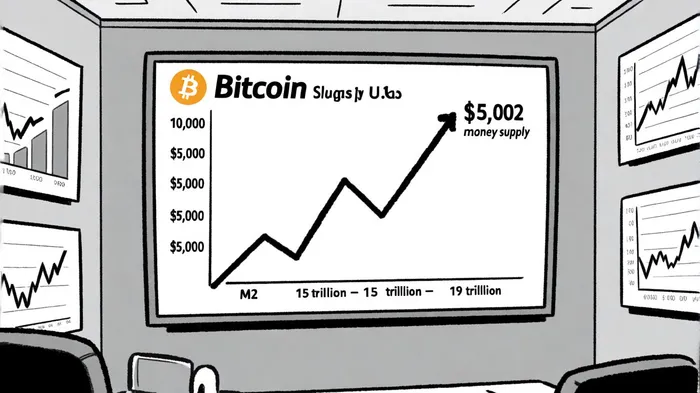
Bitcoin's price history during Fed easing cycles reveals a nuanced relationship with monetary policy. During the 2020–2021 QE phase, Bitcoin surged from under $10,000 to a record high of nearly $65,000, driven by liquidity injections and a weakened U.S. dollar, according to the CCN analysis. This period saw Bitcoin closely track global liquidity metrics, moving inversely to interest rates and in tandem with M2 growth.
However, Bitcoin's response to easing is not always linear. In September 2025, the Fed's 25-basis-point rate cut initially caused Bitcoin to dip 4% in 24 hours, suggesting market skepticism about the Fed's ability to balance inflation and employment, according to a Yahoo Finance article. Yet, this volatility also reflects Bitcoin's maturing profile. Institutional adoption-bolstered by U.S. spot Bitcoin ETFs and corporate holdings-has compressed volatility compared to its retail-driven past, as noted in the Yahoo Finance article.
Liquidity and Real Yields: The New Drivers of Bitcoin's Appeal
Bitcoin's recent resurgence is less about inflation per se and more about liquidity and real yields. As the Fed cuts rates and global central banks expand money supplies, Bitcoin's price is increasingly influenced by real interest rates and liquidity conditions. During the 2020–2021 easing cycle, Bitcoin's performance was driven by capital flows into high-beta assets amid a weakened dollar, a dynamic discussed in the CCN analysis. Similarly, the 2025 easing cycle has seen Bitcoin respond positively to liquidity support, even as its price occasionally dips due to short-term bearish pressures noted by Yahoo Finance.
This dynamic positions Bitcoin as a liquidity-sensitive asset rather than a traditional inflation hedge. While gold has historically served as a store of value during inflationary periods, Bitcoin's programmable scarcity and digital nature make it more responsive to changes in monetary policy and global liquidity.
Strategic Allocation in a Macro-Driven Market
For investors, the case for Bitcoin is evolving. In a world of fiat debasement and falling real yields, Bitcoin offers a unique combination of scarcity and liquidity sensitivity. Institutional adoption has further solidified its role as a strategic asset, with corporations and investment firms allocating capital to Bitcoin as part of diversified portfolios, a trend highlighted by Robert Kiyosaki.
However, Bitcoin's volatility remains a double-edged sword. While its long-term narrative as a store of value is compelling, short-term price swings can be jarring. Investors must weigh Bitcoin's potential against its risks, particularly in a macroeconomic environment where central bank policies remain unpredictable.
Conclusion
The Fed's easing cycle and Bitcoin's structural scarcity are converging to create a compelling case for crypto as a liquidity-driven inflation hedge. While Bitcoin's price behavior during easing cycles is complex, its correlation with global liquidity and real yields is undeniable. As central banks continue to expand money supplies, Bitcoin's role as a hedge against fiat debasement is likely to grow-offering investors a new tool in an increasingly uncertain macroeconomic landscape.






Comentarios
Aún no hay comentarios