
Fed Rate Cut Prospects Amid Weak U.S. Jobs Data: Market Implications and Strategic Entry Points
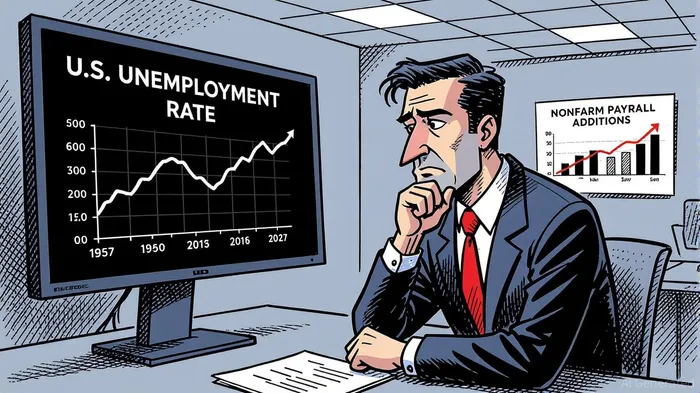
The U.S. labor market has entered a period of stagnation, with August 2025 nonfarm payrolls expanding by just 22,000 jobs—far below the projected 76,500—and the unemployment rate climbing to 4.3%, the highest since 2021 [1]. This weak data has intensified expectations for a Federal Reserve rate cut at its September 17 meeting, with some analysts predicting a 0.5 percentage point reduction to stimulate hiring [2]. The Fed’s dual mandate—balancing employment and inflation—now faces a delicate challenge as inflation remains at 2.9%, above the 2% target, while labor market deterioration accelerates [3].
Equity Market Implications: Sector Volatility and AI-Driven Resilience
Historical patterns suggest that equities often underperform during rate-cut cycles but rebound sharply afterward. For instance, during the 2007–2008 and 2019–2020 cycles, the S&P 500 posted negative returns during rate cuts but surged post-cutting phases [4]. However, 2025’s market dynamics are shaped by unique factors. The AI revolution has bolstered corporate earnings, with S&P 500 companies reporting an 8% year-over-year earnings increase [5]. Yet, sectors like automakers face headwinds from Trump-era tariffs, which have triggered earnings writedowns [5].
Sector-specific trends reveal divergent outcomes. Communication Services and Financials rebounded in Q2 2025 after a tariff-driven sell-off, buoyed by easing trade tensions and strong earnings [6]. Conversely, Healthcare lags due to drug pricing reform concerns and pharmaceutical tariffs [6]. Investors should prioritize sectors with AI integration, such as Technology and Communication Services, which have demonstrated resilience despite macroeconomic risks [6]. Small-cap stocks, which outperform in lower-rate environments, may also offer strategic entry points as borrowing costs decline [5].
Bond Market Dynamics: Yield Divergence and Strategic Opportunities
Bonds have historically thrived during rate cuts, as seen in the 2020 pandemic response, when 10-year Treasury yields plummeted amid quantitative easing [7]. The current cycle mirrors this trend: following the August jobs report, Treasury bonds rallied, gold hit record highs, and the U.S. dollar weakened [2]. However, yield movements have been uneven. The 2-year Treasury yield fell sharply after the Fed’s Jackson Hole signals, while 10-year yields declined more modestly, reflecting investor demand for long-term compensation amid inflation uncertainty [5].
The yield curve’s inversion—30-year yields rising while 2-year yields fall—signals caution. Historically, such divergences often precede economic slowdowns [7]. Investors may find value in intermediate-term bonds, which balance yield and liquidity, while avoiding overexposure to long-duration assets in a stagflationary environment [5].
Strategic Entry Points: Balancing Risk and Reward
For equities, a tactical approach is warranted. Defensive sectors like Utilities and Consumer Staples, which historically outperform in rate-cut cycles, could provide stability [4]. Meanwhile, AI-driven Technology stocks, despite volatility, offer long-term growth potential. Investors should consider dollar-cost averaging into these sectors to mitigate near-term risks.
In bonds, the key lies in duration management. Short- to intermediate-term Treasuries and high-quality corporate bonds are likely to outperform as the Fed cuts rates. Municipal bonds, which benefit from tax-exempt yields, may also attract investors seeking income amid inflation [5].
Conclusion: Navigating Uncertainty with Discipline
The Fed’s September rate cut is now a near-certainty, but its broader impact hinges on the pace of labor market deterioration and inflation. While equities face sector-specific risks, AI-driven growth and rate-cut tailwinds create opportunities for selective investors. Bonds, meanwhile, offer a safe haven, though yield curve dynamics demand caution. As Mohamed El-Erian notes, the Fed’s delayed response to labor market weakness may necessitate more aggressive cuts ahead [3]. Investors who act decisively now may position themselves to capitalize on the next phase of this evolving cycle.
Source:
[1] Employment Situation Summary - 2025 M08 Results [https://www.bls.gov/news.release/empsit.nr0.htm]
[2] US unemployment rate near 4-year high as labor market ... [https://www.reuters.com/business/us-unemployment-rate-near-4-year-high-labor-market-hits-stall-speed-2025-09-05/]
[3] The Fed got it wrong and is late again, top economist says ... [https://fortune.com/2025/09/06/fed-rate-cuts-jobs-report-jerome-powell-too-late-el-erian/]
[4] What History Reveals About Interest Rate Cuts [https://www.visualcapitalist.com/sp/what-history-reveals-about-interest-rate-cuts/]
[5] August 2025 in Review | Market Insights - Midland StatesMSBI-- Bank [https://www.midlandsb.com/resources-articles/articles/2025/09/03/august-2025-in-review]
[6] Research sector update: A return to fundamentals [https://www.janushenderson.com/en-us/investor/article/research-sector-update-a-return-to-fundamentals/]
[7] U.S. federal funds rate 1954-2025 [https://www.statista.com/statistics/187616/effective-rate-of-us-federal-funds-monthly/]







Comentarios
Aún no hay comentarios