
The Fed's Rate Cut Path: Market Optimism vs. Hawkish Caution
The Federal Reserve's December 2025 policy meeting has become a focal point for investors navigating a delicate balance between market optimism for rate cuts and the central bank's cautious approach to inflation risks. With a 90% probability of a 25-basis-point reduction in the federal funds rate priced into futures markets, the anticipated cut marks the third such easing this year. However, the Federal Open Market Committee (FOMC) remains divided, with some members advocating for further support to a softening labor market and others warning against reigniting inflationary pressures. This tension between dovish impulses and hawkish vigilance is shaping strategic positioning in both equity and bond markets ahead of the final 2025 decision.
Equity Markets: Defensive Rotations and Value Rebound
Investor behavior in equities reflects a shift toward defensive positioning as the market anticipates prolonged monetary easing. The S&P 500 Index recorded a modest 0.25% total return in November 2025, with leadership rotating away from AI-driven growth stocks to sectors perceived as more resilient in a slowing economy. Health Care, Materials, and Consumer Staples emerged as top performers, while the Information Technology sector lagged, signaling concerns over the monetization of AI investments.
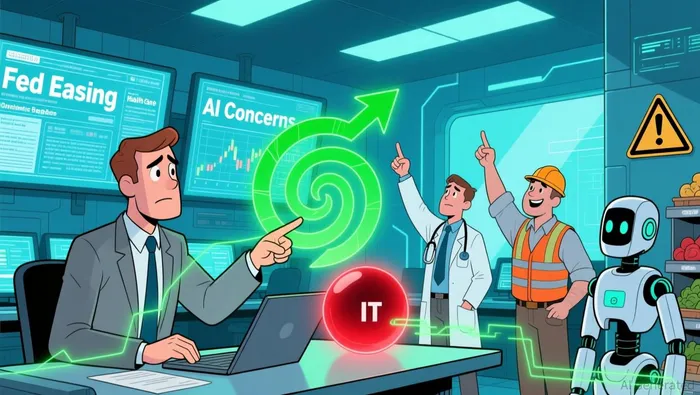
This sector rotation underscores a broader trend toward value-oriented equities. The Russell 1000 Value Index returned 2.7% in November, outpacing the Russell 1000 Growth Index, which declined by 1.8% according to market commentary. A late-month rally in the S&P 500 further reinforced this shift, as investors sought stability amid uncertainty over the Fed's path. The K-shaped economy-characterized by divergent performance across income groups and sectors-has amplified this divergence, with fixed-income strategies increasingly emphasizing active management.
Bond Markets: Yield Compression and Sector Divergence
In the bond market, expectations of rate cuts have driven Treasury yields lower across key maturities. Benchmark 10-year yields fell to 4.01% in November 2025, down from 4.09%, as investors priced in future monetary easing. The 2-year, 5-year, and 10-year yield curve steepened, reflecting growing confidence in a sustained period of accommodative policy. However, corporate bond markets have shown signs of fatigue, particularly in sectors funding AI initiatives, where elevated borrowing volumes have raised concerns about credit quality.
Sector-specific dynamics further highlight the complexity of bond positioning. Investment-grade bonds remained stable, while high-yield markets saw declining yields, suggesting selective optimism. Municipal bonds held steady, with M/T ratios ranging between 67% and 88% amid elevated issuance according to market analysis. Meanwhile, yield spreads in corporate markets narrowed slightly, with Tobacco, Pharmaceuticals, and Wirelines outperforming peers. In contrast, Sovereigns, Chemicals, and Metals and Mining lagged, illustrating the uneven impact of macroeconomic expectations according to market commentary.
The Fed's Dilemma: Cutting Rates vs. Guarding Against Inflation
The December meeting is expected to deliver a "hawkish cut," where the Fed reduces rates but signals a higher threshold for future reductions. This approach reflects internal debates within the FOMC, with officials like Stephen Miran and Jeffrey Schmid potentially dissenting over the appropriate pace of easing. The updated Summary of Economic Projections will provide critical insights into the central bank's outlook, particularly regarding inflation and growth forecasts.
Market participants are acutely aware of this balancing act. While equity and bond investors have positioned for continued rate cuts, they remain wary of a policy reversal should inflationary pressures resurface. The Fed's emphasis on "higher-for-longer" rates in previous communications has tempered expectations, with futures markets pricing in only one additional 25-basis-point cut in 2026. This cautious stance has led to a risk-on/risk-off tug-of-war, where investors alternately chase growth opportunities and retreat to defensive assets.
Strategic Implications for Investors
For investors, the December 2025 decision underscores the importance of adaptability. In equities, a diversified approach that balances exposure to defensive sectors with selective growth opportunities may offer resilience. Similarly, bond investors must navigate yield compression by prioritizing credit quality and sector-specific fundamentals. The Fed's dual mandate-combating inflation while supporting employment-will remain a key driver of market sentiment, with policy outcomes likely to dictate the trajectory of asset classes in 2026.
As the Fed prepares to unveil its final 2025 decision, the interplay between market optimism and institutional caution will continue to shape strategic positioning. Investors who closely monitor the FOMC's messaging and economic data may find opportunities to capitalize on the evolving landscape, even as uncertainties persist.







Comentarios
Aún no hay comentarios