
The Fed's Rate-Cut Path and Its Implications for Equities and Inflation-Linked Assets
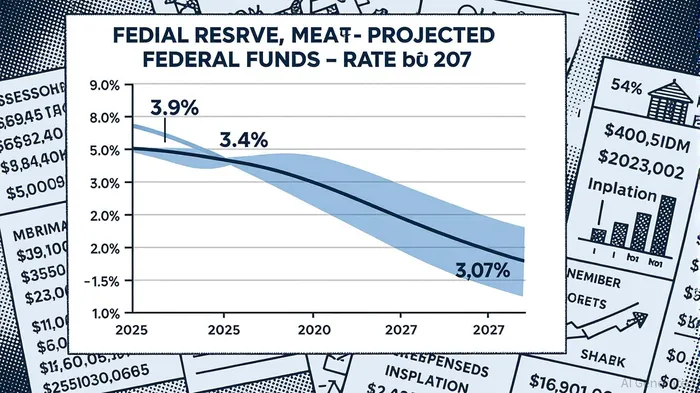
The Federal Reserve’s anticipated rate-cutting cycle in 2025 has sparked significant debate among investors, policymakers, and economists. With market expectations increasingly aligned on a 25-basis-point reduction in September 2025, the implications for equities and inflation-linked assets are becoming a focal point for strategic positioning. However, the interplay between the Fed’s monetary easing and Trump-era policy risks—such as tax cuts, deregulation, and expansive trade policies—introduces layers of complexity that demand careful analysis.
The Fed’s Rate-Cut Path: A Balancing Act
According to a report by J.P. Morgan Research, the Fed is projected to reduce the federal funds rate by 0.50 percentage points across two cuts in 2025, with the first expected in September [1]. The FOMC’s June 2025 projections reinforce this trajectory, forecasting a decline from 3.9% in 2025 to 3.4% by 2027 [2]. These cuts are driven by a slowing labor market and softening inflationary pressures, as highlighted by the New York Fed’s Staff Nowcast, which estimates Q3 2025 GDP growth at 2.1% [3]. Yet, lingering inflation concerns—albeit milder than in previous cycles—could temper the pace of reductions, underscoring the Fed’s delicate balancing act between supporting growth and maintaining price stability.
Strategic Implications for Equities
Historical patterns suggest that rate cuts often buoy equities, particularly in sectors sensitive to borrowing costs. For instance, during the 2019 Fed easing cycle under Trump-era trade tensions, the S&P 500 reached record highs, with defensive sectors like utilities and energy outperforming [4]. A similar dynamic may unfold in 2025, as lower rates reduce discount rates for future cash flows and incentivize risk-taking. However, the benefits are unlikely to be uniform. Sectors reliant on global supply chains, such as manufacturing and technology, could face headwinds from Trump’s proposed tariffs, which are projected to add 0.3 percentage points to core PCE inflation by 2026 [5]. Investors may need to prioritize companies with pricing power or diversified supply chains to mitigate these risks.
Inflation-Linked Assets: Navigating Uncertainty
Treasury Inflation-Protected Securities (TIPS) and other inflation-linked assets are poised to play a critical role in a near-term easing cycle. During the 2019 rate cuts, TIPS real yields fell by 60 basis points, reflecting heightened demand for inflation protection amid trade war uncertainty [6]. While current inflation expectations remain subdued—averaging below the Fed’s 2% target historically [7]—the potential for a resurgence in 2026 due to Trump-era tariffs and fiscal expansion necessitates a cautious approach. Shorter-duration TIPS and inflation-linked bonds may offer a better risk-reward profile than long-term instruments, which face greater volatility from shifting rate expectations.
Trump-Era Policy Risks: A Double-Edged Sword
The interplay between Trump’s fiscal policies and the Fed’s rate cuts introduces unique challenges. Tax cuts and deregulation could stimulate growth but may also exacerbate inflationary pressures, particularly if combined with accommodative monetary policy. For example, Trump’s proposed tariffs on Chinese imports are expected to create a modest supply shock, potentially delaying rate cuts in 2025 [8]. Conversely, the stimulative effect of tariff revenues being recycled via tax cuts could offset some of the economic drag [9]. Investors must also contend with the risk of higher long-term interest rates if market confidence in the Fed’s inflation credibility erodes due to political pressure [10].
Strategic Positioning Recommendations
- Equities: Overweight sectors with defensive characteristics (e.g., utilities, healthcare) and companies with strong balance sheets to weather trade policy uncertainties. Underweight cyclical sectors exposed to global supply chain disruptions.
- Fixed Income: Reallocate cash into shorter-duration, inflation-linked bonds to hedge against near-term inflation risks while minimizing duration exposure. Prioritize the "belly" of the yield curve (3–7 years) over long-term Treasuries [1].
- Diversification: Consider alternative assets like real estate and commodities, which historically perform well during periods of monetary easing and inflationary pressures.
Conclusion
The Fed’s rate-cutting path in 2025 presents both opportunities and risks for investors. While equities and inflation-linked assets stand to benefit from lower borrowing costs, the interplay with Trump-era policies necessitates a nuanced approach. By prioritizing sectors with resilience to trade tensions, leveraging inflation-linked instruments, and maintaining a diversified portfolio, investors can navigate the uncertainties of this easing cycle with greater confidence.
Source:
[1] J.P. Morgan Research, "What's The Fed's Next Move?" [https://www.jpmorganJPM--.com/insights/global-research/economy/fed-rate-cuts]
[2] FOMC Projections, June 18, 2025 [https://www.federalreserve.gov/monetarypolicy/fomcprojtabl20250618.htm]
[3] New York Fed Staff Nowcast [https://www.newyorkfed.org/research/policy/nowcast]
[4] BlackRockBLK--, "Fed Rate Cuts & Potential Portfolio Implications" [https://www.blackrock.com/us/financial-professionals/insights/fed-rate-cuts-and-potential-portfolio-implications]
[5] Deloitte, "United States Economic Forecast Q2 2025" [https://www.deloitte.com/us/en/insights/topics/economy/us-economic-forecast/united-states-outlook-analysis.html]
[6] TipsWatch, "Treasury Inflation-Protected Securities | TIPS: PerfectPERF--..." [https://tipswatch.com/]
[7] PIMCO, "Secular Outlook – The Fragmentation Era" [https://www.pimco.com/us/en/insights/the-fragmentation-era]
[8] Capita Economics, "Q3 2025 US Economic Outlook" [https://www.capitaleconomics.com/q3-2025-us-economic-outlook-trump-policy-mix-still-mildly-stagflationary]
[9] T. Rowe Price, "U.S. Policy Under Trump" [https://www.troweprice.com/en/us/insights/us-policy-under-trump-what-investors-need-to-know]
[10] Investopedia, "Why Trump's Push To Lower Interest Rates Could Backfire" [https://www.investopedia.com/why-trump-s-push-to-lower-interest-rates-could-backfire-11803844]





Comentarios
Aún no hay comentarios