
The Fed's Rate Cut Outlook and Market Implications in a High-Inflation Environment
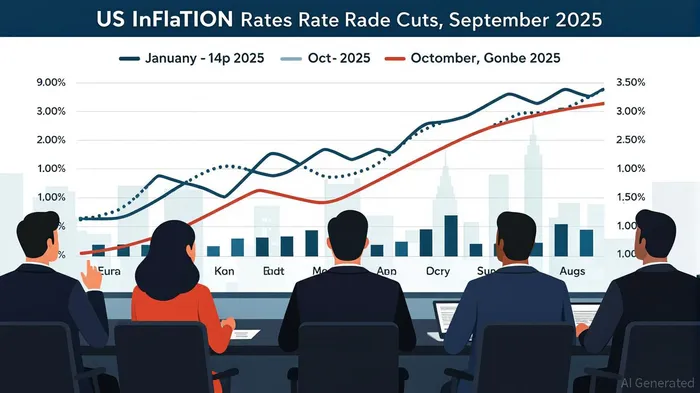
The Federal Reserve faces a delicate balancing act in September 2025 as it navigates persistent inflation and a cooling labor market. With the latest Consumer Price Index (CPI) data showing a year-on-year rate of 2.9% in August 2025[2], and core CPI holding steady at 3.1%[2], the Fed's 2% inflation target remains elusive. Yet, the August jobs report—showing a mere 22,000 nonfarm payrolls and an unemployment rate of 4.3%[5]—has shifted the central bank's focus toward supporting employment. This has led to widespread expectations of a 25-basis-point rate cut at the September meeting[3], with additional cuts likely in October and December[5].
Strategic Positioning in AI-Driven Tech Stocks
The anticipated rate cuts are poised to benefit AI-driven technology stocks, which have been constrained by high borrowing costs since 2022[6]. Lower interest rates reduce the cost of capital, enabling companies to invest more aggressively in AI infrastructure, a sector already experiencing rapid adoption. The U.S. Census Bureau reported that AI adoption rates surged to 9.2% in Q2 2025, up from 7.4% in the prior quarter[3], driven by demand for generative AI tools in enterprise operations.
NVIDIA, a key player in AI hardware, exemplifies this trend. Its revenue has grown significantly due to surging demand for GPUs in AI training[3], a trajectory likely to accelerate with cheaper financing. However, analysts caution that rate cuts may not directly address structural challenges such as supply chain bottlenecks or labor market constraints[2]. For instance, JPMorganJPM-- warns that the September 17 Fed meeting could trigger a selloff if investors "sell the news" after the rate cut, reassessing macroeconomic risks[2].
Financial Sector Adaptation and AI Integration
Financial institutions are also repositioning to capitalize on rate cuts and AI advancements. Lower borrowing costs could improve liquidity for firms reliant on floating-rate debt[6], while AI-driven tools are transforming risk modeling, fraud detection, and customer service[5]. For example, AI-powered algorithms now enable real-time analysis of market data, enhancing decision-making in asset management[5].
Yet, the sector faces headwinds. Tariff-driven inflation, particularly in goods like autos and furniture[2], could offset some of the benefits of rate cuts. Additionally, AI's potential to displace jobs—estimated to impact 15% of U.S. roles by 2026[4]—may dampen consumer spending, indirectly affecting financial stocks.
Analyst Recommendations: Diversification and Selectivity
Amid this uncertainty, analysts emphasize diversification and selective exposure. Morgan StanleyMS-- advises investors to allocate to real assets such as gold, REITs861104--, and commodities to hedge against inflation[1], while UBSUBS-- recommends high-quality fixed-income investments to lock in yields[5]. In equities, U.S. large-cap tech and consumer-oriented stocks are seen as beneficiaries of lower rates[1], with the S&P 500 projected to reach 6,600 by year-end if the Fed cuts 100 basis points[5].
Edward Jones forecasts a "soft landing," with economic growth cooling to 1.5% in H1 2025 before rebounding in H2, driven by rate cuts and pro-growth policies[6]. J.P. Morgan, meanwhile, highlights the importance of deregulation and tax cuts in offsetting tariff-related risks[6].
Conclusion: Navigating a Complex Landscape
The Fed's September rate cut is a pivotal event for investors. While AI-driven tech and financial stocks stand to gain from lower borrowing costs and innovation, structural risks—including inflationary pressures from tariffs and AI-driven job displacement—require caution. A diversified strategy, emphasizing quality assets and sector-specific opportunities, remains critical. As the Fed's policy path unfolds, market participants must balance optimism about AI's transformative potential with vigilance against macroeconomic volatility.





Comentarios
Aún no hay comentarios