
Fed Rate Cut Divergence: Implications for Risk Assets and Market Volatility in 2026
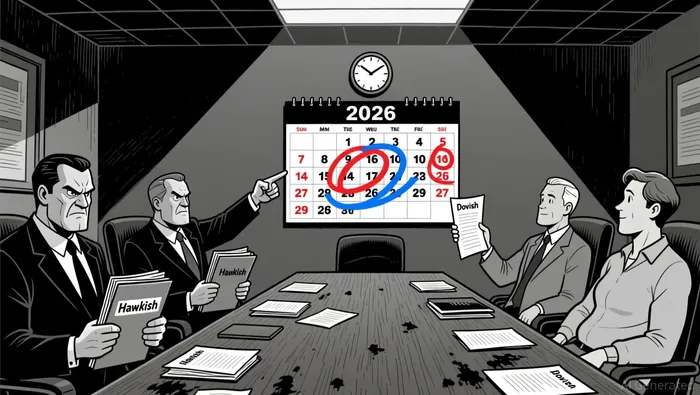
The Federal Reserve's December 2025 rate cut decision, marked by a stark 9-3 vote, has exposed deep fissures among policymakers over the trajectory of monetary policy in 2026. This divergence-between those advocating for aggressive easing to stabilize the labor market and hawks prioritizing inflation control-has created a fog of uncertainty, directly influencing investor positioning and asset allocation strategies. As the Fed navigates a delicate balance between its dual mandate of price stability and full employment, the implications for risk assets and market volatility in 2026 are profound.
Policy Divergence: Doves vs. Hawks
The December 2025 FOMC minutes revealed a stark split in views. While the majority supported a 25-basis-point cut to address cooling labor market conditions and easing inflation, dissenters like Fed Governor Stephen Miran pushed for a larger 50-basis-point reduction, arguing that more aggressive action was needed to counter persistent inflationary pressures. Conversely, Chicago Fed President Austan Goolsbee and Kansas City Fed President Jeff Schmid voted to maintain rates, emphasizing the need for more data before committing to further cuts.
This divergence is reflected in the updated Summary of Economic Projections, which shows a median forecast of one 25-basis-point cut in 2026 but with significant disagreement among policymakers. Some officials project no further cuts through 2027, while others foresee rates falling as low as 2.4%. Chair Jerome Powell's post-meeting comments further muddied the waters, as he struck a cautious tone on inflation while hinting at growth concerns- a classic "dovish action with a hawkish outlook".
Market Reactions: Volatility and Positioning Shifts
The market's response to this policy uncertainty has been mixed. While the S&P 500 rallied in the immediate aftermath of the December cut-reflecting optimism about a potential pause in tightening- volatility metrics like the VIX remained elevated, signaling lingering investor anxiety. Fixed income markets have priced in a more aggressive easing path than the Fed's official projections, with traders currently anticipating three 25-basis-point cuts in 2026, driven by fears of a softening labor market and political pressures from President Trump's tariff policies.
Investor positioning has also shifted in response to the Fed's ambiguity. Equity markets have seen a rotation toward value stocks and cyclicals, as investors bet on a potential economic rebound supported by easier monetary conditions. Meanwhile, the AI-driven growth narrative has matured, with capital now favoring companies demonstrating tangible productivity gains over speculative hype. In fixed income, the yield curve has steepened, reflecting expectations of a neutral Fed policy and a search for yield in a low-inflation environment.
Global Divergence and Capital Flows
The Fed's policy uncertainty is compounded by divergent approaches from other central banks. While the ECB and Bank of Canada have opted to hold rates steady, the Bank of Japan is expected to hike by 50 basis points in 2026, creating a fragmented global monetary landscape. This divergence has amplified capital flows, with investors reallocating assets to markets where central banks are perceived as more dovish. The U.S. dollar, despite the Fed's easing stance, remains bearish, while the euro and emerging market currencies have gained traction.
Implications for 2026: Scenarios and Strategies
The Fed's path in 2026 will hinge on incoming economic data. If inflation remains stubbornly above 2% or the labor market deteriorates further, the Fed may be forced to adopt a more dovish stance, potentially surprising markets with additional cuts. Conversely, a stronger-than-expected recovery could lead to a prolonged pause, reinforcing hawkish sentiment.
For investors, the key takeaway is adaptability. J.P. Morgan and Goldman Sachs recommend overweighting U.S. equities and high-yield bonds in a non-recessionary easing scenario, while hedging against downside risks with Treasuries and gold in a recessionary context. Active management across asset classes will be critical, as the AI-driven supercycle continues to create winners and losers in a fragmented market.
Conclusion
The Fed's policy divergence in 2026 is not merely an academic debate-it is a live force shaping market dynamics. As policymakers grapple with the dual mandate, investors must remain agile, balancing exposure to growth drivers like AI with defensive positions to mitigate volatility. The coming year will test the resilience of both the Fed's strategy and the markets' ability to navigate uncertainty.







Comentarios
Aún no hay comentarios