
Fed's Rate Cut Debate Intensifies as Officials Clash Over Inflation and Jobs
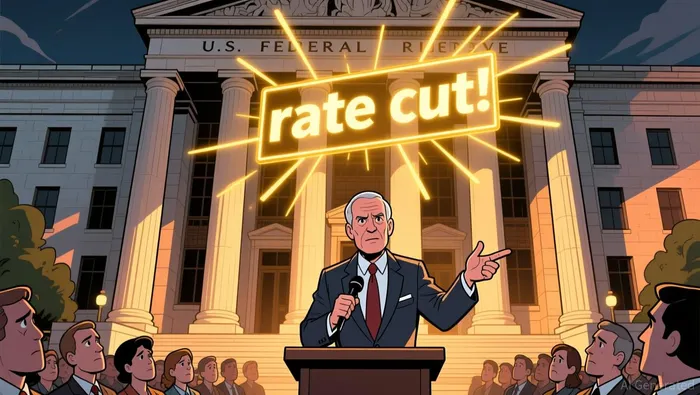
The U.S. Federal Reserve's December interest rate cut is now firmly back in focus after New York Fed President John Williams signaled openness to further reductions, shifting market expectations and reigniting debate among policymakers. Futures markets now price a 75.5% chance of a cut at the Dec. 9-10 meeting, up sharply from 30% last week, as traders interpret Williams' remarks as a green light for easing policy.
Williams, a key figure on the rate-setting Federal Open Market Committee (FOMC), stated in a Chile speech that the Fed could adjust rates "in the near term" to address a cooling labor market and moderating inflation risks. "Monetary policy is modestly restrictive, and I see room to move closer to neutral," he said, emphasizing the need to balance employment and inflation goals. His comments contrasted with earlier skepticism from officials like Dallas Fed President Lorie Logan, who argued for a pause until inflation shows clearer progress toward the 2% target.
 The pivot reflects evolving economic dynamics. While inflation remains above the Fed's target-Williams estimates it at 2.75%, including a 0.5-0.75 percentage point boost from tariffs-underlying price pressures are easing. Meanwhile, labor market data, delayed by the recent government shutdown, suggests softening conditions, with unemployment rising to 4.4% in September, a level seen before the pandemic. "Downside risks to employment have increased," Williams noted, shifting the FOMC's calculus toward accommodative policy.
Market reactions have been swift. Asian-Pacific equities rebounded, with South Korea's Kospi and Hong Kong's Hang Seng index rising 1.5% and 1.47%, respectively, as investors anticipated cheaper money according to market analysis. U.S. futures also climbed, with Nasdaq 100 contracts up 0.46% premarket, reflecting optimism about a rate cut's stimulative effect. However, divisions within the FOMC persist. Boston Fed President Susan Collins and others have stressed the need for caution, warning that premature cuts could undermine inflation control.
The Fed's dilemma underscores broader uncertainties. While Williams expects tariffs' inflationary impact to wane by mid-2027, the path to 2% remains uneven. Morgan Stanley recently downgraded its December cut outlook, citing these risks, but other analysts, including Goldman Sachs' Jan Hatzius, argue the September jobs report -a key data point- could lock in a 25-basis-point reduction.
With the FOMC meeting approaching, the central bank faces pressure to unify its stance. A cut would mark the third rate reduction this year, following October's move, and could signal a shift toward a more accommodative cycle. Yet, as Pantheon Macroeconomics' Samuel Tombs noted, Williams' alignment with Chair Jerome Powell-whose September "dot plot" projected three cuts- suggests a majority may support action.
For now, markets are betting on a December easing. The Fed's challenge will be to navigate its dual mandate without fueling new economic imbalances - a task that remains as complex as ever according to market analysis.







Comentarios
Aún no hay comentarios