
The End of Fed QT and Its Implications for U.S. Treasury Markets: Strategic Positioning for Capital Gains Amid Shifting Monetary Policy
The Fed's QT Timeline and Rationale
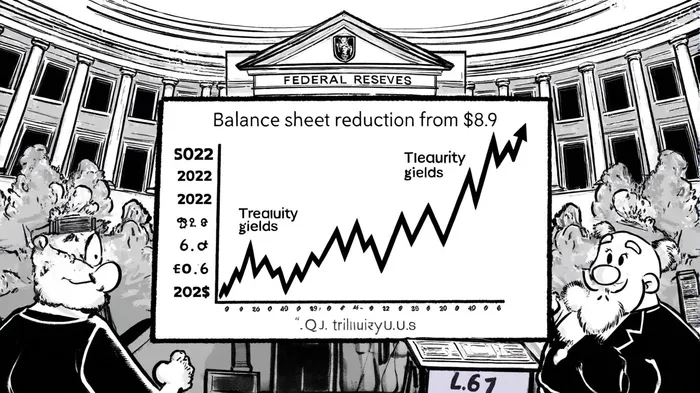
The Fed's QT program, initiated in June 2022, aimed to curb inflation by allowing maturing securities to expire without reinvestment, shrinking its balance sheet from a peak of $8.9 trillion to $6.6 trillion by October 2025, according to a FinancialContent article. However, the pace of runoff has slowed in 2025, with monthly reinvestment caps reduced to $5 billion for Treasuries and $2 billion for mortgage-backed securities. This adjustment reflects concerns over liquidity in the interbank lending market and the Fed's desire to avoid a repeat of the 2019 liquidity crunch, as noted in a Northern Trust commentary.
Chair Jerome Powell has emphasized that QT will end when reserve balances reach a level deemed "ample" to ensure smooth functioning of money markets. With reserves now at $2.93 trillion-the lowest since January 2025-the Fed is nearing its threshold, according to a Futunn preview. The termination of QT will inject liquidity back into the system, easing funding pressures and potentially lowering Treasury yields, though the impact may be muted due to the gradual normalization of the balance sheet, as Northern TrustNTRS-- has observed.
Implications for U.S. Treasury Markets
The end of QT will alter the dynamics of Treasury markets in three key ways:
Liquidity and Yield Movements:
The Fed's balance sheet reduction has historically tightened liquidity, pushing investors toward higher-yielding assets like Treasuries. As QT concludes, the Fed's reinvestment of maturing securities will stabilize liquidity, potentially easing upward pressure on Treasury yields. However, the Treasury's ongoing issuance to finance federal deficits may still drive yields higher, particularly if private demand for Treasuries remains constrained, as noted in an Econ Review analysis.Repo Market Sensitivity:
During QT, repo rates became more sensitive to Treasury supply as liquidity tightened. While current repo rate sensitivity remains low, the termination of QT could reintroduce volatility. Investors must monitor the interplay between Treasury coupon securities (which increase repo demand) and bills (which compete with repo financing) to anticipate rate fluctuations, according to a Kitco report.Investor Behavior and Risk Management:
The Treasury Market Practices Group (TMPG) has issued best practices to mitigate risks in the repo market, including phased implementation of haircuts and margining requirements by June 2026, as outlined in Kansas City Fed research. Aligning with these guidelines will enhance resilience for investors navigating post-QT volatility.
Strategic Positioning for Capital Gains
Major asset managers are already adjusting their strategies to capitalize on the post-QT environment. Here are three key approaches:
Duration and Yield Curve Positioning:
With the Fed likely to maintain an "ample reserves" framework, investors may favor longer-duration Treasuries to capture higher yields. JPMorgan and Bank of America have advised clients to overweight long-end bonds, anticipating a flattening yield curve as short-term rates stabilize, according to a KPMG primer.Liquidity Buffers and Diversification:
The decline in overnight reverse repurchase (ON RRP) volumes-now near pre-pandemic levels-highlights the need for robust liquidity management. Investors should diversify financing sources and maintain buffers to withstand potential repo rate spikes, as noted by Northern Trust.Structural Shifts in Investor Demand:
The growing participation of domestic investors and hedge funds in Treasury markets has increased volatility. Asset managers must account for this by hedging against liquidity strains and leveraging derivative strategies to manage counterparty risks, as the Kansas City Fed points out.
Conclusion
The Fed's termination of QT represents a critical inflection point for U.S. Treasury markets. While the immediate impact on yields may be muted, the long-term implications for liquidity, repo rates, and investor behavior will shape capital gains opportunities. By adopting strategic positioning-such as duration extension, liquidity diversification, and adherence to risk management best practices-investors can navigate this evolving landscape with confidence.







Comentarios
Aún no hay comentarios