
The Fed's Political Independence at Risk: Implications for Global Markets and Safe-Haven Assets
The Federal Reserve's political independence, long considered a cornerstone of U.S. economic stability, is under unprecedented strain. A criminal investigation into Fed Chair Jerome Powell by the Justice Department, coupled with escalating tensions between the Trump administration and the central bank, has sparked fears of politicized monetary policy. This erosion of autonomy risks destabilizing not just the U.S. economy but global financial markets, which have long relied on the Fed as a model of institutional independence. For investors, the implications are clear: a shift in central bank behavior demands a reevaluation of asset allocation strategies, particularly in the context of safe-haven assets and inflation hedging.
The Erosion of Fed Independence
The Federal Reserve's independence has historically insulated it from short-term political pressures, allowing it to focus on long-term economic stability. However, recent developments threaten this separation. According to a CNBC report, the DOJ's investigation into Powell-framed by experts as a politically motivated attempt to undermine the Fed's credibility-has raised alarms about the potential for direct political interference in monetary policy decisions. This mirrors historical precedents, such as Richard Nixon's influence over Arthur Burns in the 1970s, which some economists argue contributed to inflationary spirals.
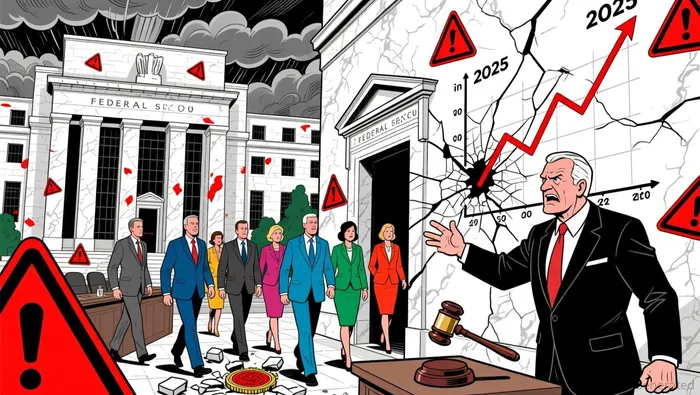
The Congressional Research Service (CRS) has warned that subordinating the Fed to political leadership could "erode the institution's credibility with market participants and unanchor inflation expectations" according to CRS analysis. Brett House, an economics professor at Columbia Business School, echoes this, noting that politicized central banks tend to make suboptimal decisions, leading to "higher rates, greater volatility, and uncertainty for consumers" as CNBC reports. These risks are amplified by the Fed's role as a global anchor: as the Atlantic Council notes, central bankers worldwide are closely monitoring the U.S. situation, as the Fed's independence has long served as a benchmark for other nations.
Market Reactions and Safe-Haven Assets
The uncertainty surrounding the Fed's independence has already triggered shifts in investor behavior. Safe-haven assets, traditionally seen as stable during periods of economic or political turmoil, have become focal points for hedging against volatility. Gold, for instance, surged 50% in 2025, defying typical correlations with bond yields and rising even as Treasury yields remained elevated. This surge is driven by structural demand from central banks-particularly in emerging markets-as well as a loss of confidence in the U.S. dollar, which has weakened amid fiscal challenges and trade policy shifts according to LSEG analysis.
U.S. Treasuries, another traditional safe haven, have also seen renewed interest. Investors are flocking to short-dated Treasuries as a hedge against growth risks, with forecasts revising 10-year yield targets to 4%. However, the dollar's declining status as the global reserve currency complicates its role as a safe haven. Morgan Stanley notes that investors are increasingly positioning for inflation-linked strategies, including real assets and inflation-protected government securities, to mitigate risks from potential stagflation as Morgan Stanley reports.
Strategic Asset Allocation in a Politicized Era
For asset managers, the evolving landscape demands a nuanced approach to portfolio construction. The politicization of central bank policies has introduced a new layer of uncertainty, prompting a shift toward defensive positioning. According to BNP Paribas analysis, investors are reducing exposure to small-cap and unprofitable tech stocks while increasing allocations to quality large-cap stocks, real assets, and international equities. This trend reflects a broader recognition that traditional growth drivers may falter in an environment of heightened inflation and geopolitical instability.
Gold's meteoric rise in 2025 underscores its evolving role as a strategic asset. While it has historically been viewed as a panic hedge, its recent performance-driven by central bank diversification and geopolitical anxiety-suggests a more permanent place in diversified portfolios as the CFA Institute notes. Similarly, real assets such as commodities and real estate offer protection against inflationary pressures, which are likely to persist if the Fed's independence is further compromised according to BNP Paribas research.
Conclusion
The Federal Reserve's political independence is not just a domestic issue-it is a global concern. As central banks worldwide watch the U.S. experiment with politicized monetary policy, the ripple effects on capital flows, inflation expectations, and market volatility will be profound. For investors, the key takeaway is clear: traditional safe-haven assets are no longer reliable in isolation. A diversified, adaptive strategy that incorporates inflation-linked securities, real assets, and a reevaluation of currency exposure is essential. In an era where central bank credibility is under siege, the ability to anticipate and hedge against systemic risks will separate resilient portfolios from those left vulnerable.







Comentarios
Aún no hay comentarios