
Fed Policy Uncertainty Amid Missing October PPI and CPI Data
The Federal Reserve faces an unprecedented challenge in its December 2025 interest rate decision, as critical inflation data-specifically the October 2025 Consumer Price Index (CPI) and Producer Price Index (PPI)-remains unreleased due to a government shutdown. The Bureau of Labor Statistics (BLS) confirmed it could not retroactively collect survey data for October, leaving the Fed without key metrics to assess inflation trends. This data gap has forced policymakers into a precarious position, compounding risks to their interest rate strategy and market stability.
Immediate Impact on Fed Policy
The absence of October data has created a fog of uncertainty for the Federal Open Market Committee (FOMC). Fed Chair Jerome Powell likened the situation to "driving in the fog," emphasizing the need for caution as the central bank navigates its next move. The December 10 rate decision will rely on partial or delayed data, including the November CPI (scheduled for December 18) and PPI (January 14, 2026), which lack October-to-November comparisons. This delay has sparked internal divisions: while officials like New York Fed President John Williams suggest "room for a further adjustment in the near term," others, such as Governor Christopher Waller, argue sufficient data remains to justify decisions.
Historical Precedents and Market Reactions
The 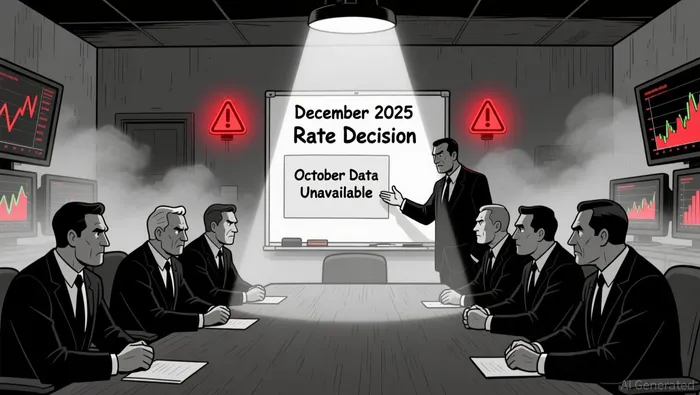 Fed has historically relied on CPI and PPI data to anchor its monetary policy. During the 2020 pandemic, for instance, the Fed's aggressive interventions-such as large-scale asset purchases-were critical to stabilizing markets amid data gaps. However, the current context differs: the October 2025 data void occurs amid a mixed economic landscape. The New York Fed's October 2025 Survey of Consumer Expectations revealed median inflation expectations at 3.2% for the one-year horizon, down from previous levels, while labor market expectations showed declining job-finding probabilities, particularly among younger and more-educated respondents.
Markets have reacted with nuanced sensitivity to the Fed's data-dependent approach. For example, the October 2025 rate cut, announced amid data gaps and slowing economic momentum, led to a slight easing of Treasury yields and modest equity gains, reflecting anticipation of further easing. Similarly, the September 2025 rate cut-largely anticipated-saw rising market odds for additional cuts as weak manufacturing and payroll data signaled the need for action. However, the absence of October CPI/PPI data may compel the Fed to rely more heavily on alternative indicators, such as real-time consumer surveys and forward-looking models.
Compounded Risks to Strategy and Stability
The compounding risks stem from the Fed's reliance on incomplete data and the potential for divergent policy outcomes. If the Fed opts for a cautious stance, delaying rate cuts until more data becomes available, it risks exacerbating market volatility. Conversely, premature cuts based on partial data could undermine inflation control, reigniting price pressures. This uncertainty is amplified by the fact that November CPI and PPI data will not include October benchmarks, limiting the Fed's ability to assess month-over-month trends.
Moreover, the Fed's communication strategy will be pivotal. In previous periods of data scarcity, such as the post-pandemic era (2022–2024), markets exhibited heightened sensitivity to core CPI surprises, reflecting a shift in investor attention to inflation volatility. The Fed's ability to manage expectations through clear messaging will be critical to maintaining market stability.
Conclusion
The missing October 2025 PPI and CPI data underscores the fragility of the Fed's data-dependent framework. While historical precedents suggest the Fed can navigate such gaps, the current environment-marked by mixed labor market signals and elevated uncertainty-heightens the stakes. Investors should closely monitor the Fed's December 10 decision, its reliance on alternative indicators, and the broader implications for rate strategy. As Powell emphasized, the central bank must proceed cautiously, but the path forward remains fraught with compounded risks to both policy efficacy and market confidence.







Comentarios
Aún no hay comentarios