
Fed Policy Uncertainty and Market Volatility: How Weak Labor Market and Moderating Inflation Could Spur Aggressive Rate Cuts in 2026
The U.S. economy enters 2026 amid a delicate balancing act: a labor market showing early signs of strain and inflation inching closer to the Federal Reserve's 2% target. These dynamics are fueling speculation about aggressive rate cuts, with implications that could reshape equity and bond markets. As policymakers grapple with the dual mandate of price stability and maximum employment, investors must navigate a landscape of uncertainty and divergent forecasts.
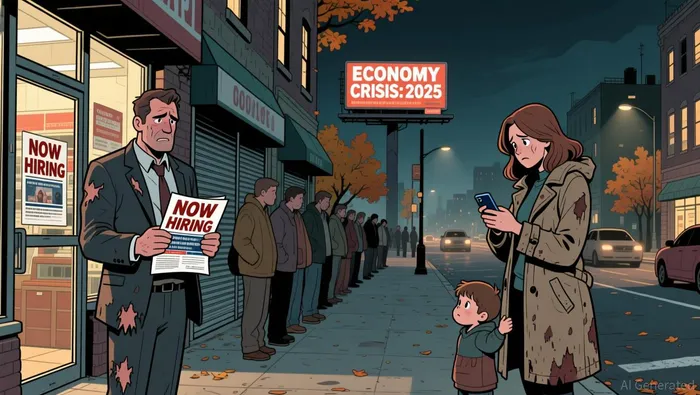
Labor Market Weakness: A Catalyst for Policy Easing
The labor market, once a pillar of economic resilience, has shown signs of softening. The Federal Reserve's December 2025 projections suggest an average unemployment rate of 4.5% for 2025, with a central tendency of 4.5–4.6%. Meanwhile, the Philadelphia Fed's Survey of Professional Forecasters anticipates a slightly lower annual average of 4.2%. These discrepancies highlight growing unease about job market momentum.
Recent data underscores this trend. Nonfarm payrolls growth has slowed, and the unemployment rate edged upward in late 2025. Federal Reserve Governor Stephen Miran has explicitly tied this weakness to the case for rate cuts, advocating for 150 basis points of easing in 2026 to stimulate job creation. Such aggressive action would mark a departure from the Fed's historically cautious approach, reflecting the urgency to avert a prolonged slowdown.
Inflation Moderation: A Mixed Signal for Policy
Inflation, while still above target, has shown a consistent downward trajectory. The Consumer Price Index (CPI) rose 2.7% year-over-year in November 2025, down from 3.0% in September. Core CPI, which excludes volatile food and energy, followed a similar pattern, rising 2.6% annually. The Personal Consumption Expenditures (PCE) price index, the Fed's preferred gauge, stood at 2.58% year-over-year in December 2025, signaling a moderation that aligns with the central bank's inflation-fighting goals.
However, the path to 2% remains uneven. Energy and food prices, which surged 4.2% and 2.6% respectively in the 12 months through November 2025, remain sticky. The Bureau of Economic Analysis (BEA) has even resorted to averaging September and November CPI data to estimate October readings, a methodological workaround for data gaps caused by a government shutdown. These irregularities complicate the Fed's ability to assess inflation with precision, adding to policy uncertainty.
The Fed's 2026 Rate Cut Outlook: Gradual vs. Aggressive Scenarios
The Federal Reserve's official projections for 2026 call for a gradual reduction in the federal funds rate, aiming to bring it down from the current 3.50–3.75% range to near 3% by year-end. This trajectory assumes a "soft landing" scenario, where inflation continues to trend downward without triggering a recession. However, market expectations and analyst forecasts suggest a more aggressive approach may be warranted.
Economist Mark Zandi, for instance, predicts three 25-basis-point rate cuts in the first half of 2026, while Morningstar's Preston Caldwell anticipates two cuts, one in each half of the year. These forecasts reflect growing confidence that inflation will stabilize without requiring a sharp trade-off in employment. If realized, such a policy shift would signal a significant pivot from the Fed's 2023–2024 tightening cycle, which saw rates rise to multi-decade highs.
Market Reactions: Bonds and Equities in a Policy Crosshairs
The bond market has already priced in approximately 50 basis points of easing in 2026, with a 45% probability of a cut by April and another by September. Yet, long-term yields remain stubbornly high. The 10-year U.S. Treasury yield, for example, has climbed to 4.15% despite the Fed's rate cuts since September 2024. This divergence reflects investor concerns about inflation persistence and economic uncertainty, which are keeping demand for long-term safe assets subdued.
Equity markets, meanwhile, are split between optimism and caution. J.P. Morgan Global Research expects a constructive outlook for global equities, driven by AI-driven technological expansion and potential policy easing. However, risks such as sticky inflation and geopolitical tensions could limit gains. In the U.S., large-cap and growth stocks are expected to outperform, while international markets may benefit from improved trade conditions and fiscal stimulus.
Strategic Implications for Investors
For bond investors, the key challenge lies in navigating the "steepening" yield curve. Short-term rates are likely to decline with Fed easing, but long-term yields may remain elevated due to inflation expectations. This dynamic could pressure mortgage rates and corporate borrowing costs, limiting the stimulative impact of rate cuts. A diversified approach-balancing short-duration bonds with inflation-linked securities-may offer better risk-adjusted returns.
Equity investors should focus on sectors poised to benefit from rate cuts, such as financials and cyclical industries, while hedging against inflation risks in sectors like energy and commodities. The dominance of AI-related stocks and large-cap equities suggests a continuation of the "Magnificent 7" trend, but volatility from policy uncertainty and global macroeconomic shifts could create opportunities for value-oriented strategies.
Conclusion
The interplay of a weakening labor market and moderating inflation is setting the stage for a pivotal year in Fed policy. While the central bank's official stance leans toward gradualism, the growing chorus for aggressive rate cuts underscores the fragility of the current economic consensus. For investors, the path forward requires vigilance in monitoring both data and sentiment, as markets react not just to policy outcomes but to the uncertainty surrounding them.







Comentarios
Aún no hay comentarios