
Fed Policy Uncertainty and Its Impact on 2026 Investment Strategies: Navigating the Era of Silent Dissenters
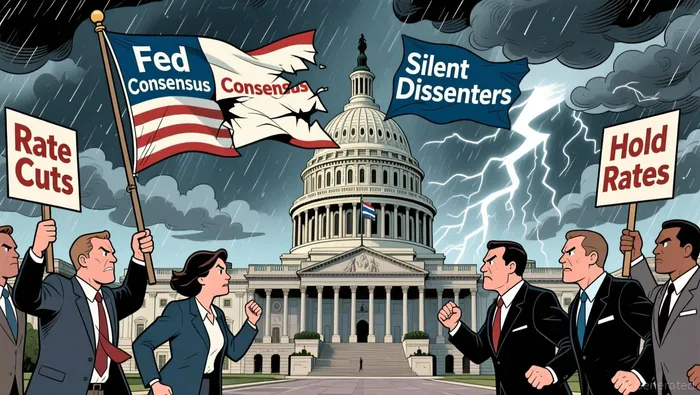
The Federal Reserve's internal divisions in 2025 have created a unique and volatile backdrop for investors. While Chair Jerome Powell has publicly defended rate cuts as a response to a cooling labor market and persistent inflation, the growing number of "silent dissenters" within the Federal Open Market Committee (FOMC) signals deepening ideological rifts. These dissenters-policymakers who express disagreement without formal dissent votes-highlight a critical shift in the Fed's decision-making process, reducing policy predictability and complicating market expectations. As 2026 approaches, investors must adapt to this uncertainty by prioritizing sectors resilient to inflation and policy ambiguity.
The Rise of Silent Dissenters and Policy Fragmentation
According to a Bloomberg report, the Fed's 2025 rate-cut decision faced significant internal resistance, with six policymakers signaling in the FOMC's quarterly projections that the federal funds rate should remain unchanged in the 3.75% to 4% range. While only two officials-Kansas City Fed President Jeff Schmid and Chicago Fed President Austan Goolsbee-formally dissented, eight regional bank presidents likely opposed the cut. This divergence reflects a broader ideological divide: regional bank presidents, often more hawkish, have historically prioritized inflation control, while Washington-based governors lean toward accommodative policies to support growth.
The implications of these divisions are profound. As stated by a Bloomberg op-ed, "Silent dissenters reveal a lack of consensus, which undermines the Fed's ability to project a unified policy path." This fragmentation increases the risk of abrupt policy shifts, particularly in 2026, when a new Fed chair will inherit a fractured FOMC. Investors must now contend with a central bank that is less predictable and more susceptible to external economic shocks.
Market Responses to Policy Uncertainty
The Fed's 2025 policy trajectory-marked by a 75-basis-point rate cut-was driven by a complex economic environment. Inflation, temporarily stalled at 2.75%, due to trade policies and global supply chain shifts, remains above the 2% target. Meanwhile, the labor market's weakening trends have forced the Fed to balance inflation control with growth support. By December 2025, the federal funds rate had dropped to 3.50%–3.75%, with further cuts anticipated in 2026 if inflation converges to 2% and labor market deterioration persists.
This uncertainty has already reshaped market dynamics. Fixed income markets have benefited from central bank rate cuts and global financial easing, delivering positive total returns across most categories. International stocks, meanwhile, have gained traction as valuations remain more attractive than U.S. equities, supported by accelerating global economic growth. AI-driven sectors, in particular, have shown resilience, with earnings growth and transformative potential driving optimism despite broader macroeconomic risks.
Proactive Portfolio Positioning for 2026
Given the Fed's evolving policy landscape, investors should prioritize sectors insulated from inflation and policy ambiguity:
Fixed Income: With central banks likely to continue rate cuts in 2026, fixed income remains a defensive play. Data from Schwab's 2026 outlook highlights that falling rates and a weakening labor market create a favorable environment for bond investors. Long-duration bonds and Treasury Inflation-Protected Securities (TIPS) could offer both yield and inflation protection.
International Equities: Global markets, particularly in Asia and Europe, present opportunities as valuations remain undemanding compared to U.S. benchmarks. The New York Fed notes that international economies are better positioned to adapt to shifting inflation targets and trade policies. Sectors like renewable energy and advanced manufacturing may benefit from global growth tailwinds.
AI-Driven Industries: Artificial intelligence continues to redefine productivity across sectors. As highlighted by Lord Abbett's 2026 investment outlook, AI-related equities have demonstrated resilience amid macroeconomic volatility, supported by strong earnings and transformative potential. Firms in semiconductors, cloud computing, and automation are prime candidates for long-term growth.
Risks and Mitigation Strategies
While these sectors offer resilience, investors must remain cautious. Elevated U.S. debt levels and persistent inflation driven by tariffs pose risks to market stability. Additionally, the Fed's delayed response to inflationary pressures could prolong volatility. A diversified portfolio with exposure to both defensive and growth-oriented assets-coupled with regular rebalancing-can mitigate these risks.
Conclusion
The Fed's "silent dissenters" are more than a policy curiosity; they are a harbinger of a new era marked by fragmented decision-making and reduced predictability. As 2026 unfolds, investors must navigate this uncertainty by focusing on sectors that thrive in ambiguous environments. By prioritizing fixed income, international equities, and AI-driven industries, portfolios can remain agile in the face of evolving monetary policy and macroeconomic challenges.







Comentarios
Aún no hay comentarios