
Fed Policy Uncertainty and Equity Market Positioning: Navigating Rate-Cut Outcomes in Q3 2025
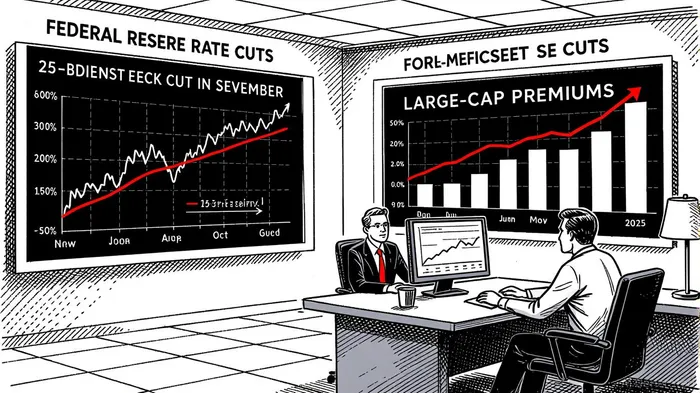
The Federal Reserve's monetary policy trajectory in Q3 2025 remains a focal point for investors, with diverging signals between market expectations and institutional warnings creating a complex landscape for equity positioning. While traders and economists anticipate a measured 25-basis-point rate cut at the September 16-17 meeting, Omar Aguilar of Charles SchwabSCHW-- has sounded a cautionary note: a 50-basis-point cut could signal deeper economic distress[1]. This divergence underscores the need for strategic asset allocation, particularly as small-cap and cyclical stocks emerge as potential beneficiaries of Fed easing—or casualties of policy missteps.
Schwab's Warning vs. Market Expectations
According to a report by Reuters, the Federal Reserve is projected to reduce the federal funds rate by 25 basis points in September, with a second cut expected in October[1]. This aligns with the Fed's historical preference for incremental adjustments. However, Schwab's Aguilar has highlighted a critical caveat: a 50-basis-point cut, as suggested by Standard Chartered following weak jobs data[2], would likely reflect deteriorating labor market conditions and heightened inflationary pressures[1]. Such a move, Aguilar argues, would deviate from the Fed's stated goal of balancing growth and price stability, instead signaling a reactive response to economic distress[2].
This tension between measured and aggressive cuts reflects broader uncertainties. While the Fed initially projected two rate cuts by year-end, revised data has increased the likelihood of a third cut by December[1]. Yet, the probability of a fourth cut in early 2026 has waned, complicating forecasts for equity markets. Investors must weigh whether the Fed's actions will stabilize growth or exacerbate volatility through mixed signals.
Small-Cap and Cyclical Stocks: A High-Risk, High-Reward Play
Amid this uncertainty, the shift toward small-cap and cyclical stocks has gained traction. Morningstar's Q3 2025 equity market outlook emphasizes a preference for value over growth and small caps over large caps, citing favorable policy measures and lower interest rates as tailwinds[3]. Small-cap stocks, historically sensitive to monetary easing, trade at a 17% discount to fair value compared to large caps' 2% premium[3]. This valuation gap, coupled with strong corporate financial health, positions them to outperform if the Fed delivers on its easing path[4].
However, Q3 2025 performance data reveals mixed signals. While the S&P 600 posted a 4.90% gain for the quarter, it still trails large-cap benchmarks with a year-to-date decline of -4.46%[5]. Cyclical sectors like Energy (-8.56%) and Health Care (-7.18%) underperformed due to regulatory uncertainties and structural headwinds[5]. In contrast, AI-driven sectors such as Information Technology (+23.71%) and Communication Services (+18.49%) dominated returns[5]. This divergence highlights the dual-edged nature of cyclical positioning: while rate cuts could revive sectors tied to economic reacceleration, trade policy risks and stagflationary pressures remain significant headwinds[5].
Strategic Positioning: Balancing Valuation and Volatility
The case for small-cap and cyclical stocks hinges on two factors: the Fed's ability to engineer a soft landing and the resolution of trade policy uncertainties. Fidelity's Q3 2025 economic outlook notes that while U.S. growth is slowing, a severe downturn is unlikely, and corporate balance sheets remain robust[6]. This suggests that small-cap stocks, with their higher growth potential and undervaluation, could benefit from a Fed-driven rebound.
Yet, investors must remain cautious. The market's sensitivity to trade headlines—exemplified by a sharp selloff in April and a partial recovery following tariff pauses—demonstrates how external shocks can amplify volatility[5]. Schwab's Aguilar's warning about a 50-basis-point cut as a distress signal adds another layer of risk: if the Fed is forced into aggressive easing, it could trigger a flight to quality, further underperforming small-cap and cyclical assets[1].
Conclusion
Fed policy uncertainty in Q3 2025 demands a nuanced approach to equity positioning. While market expectations favor a measured 25-basis-point cut, Schwab's Aguilar cautions that a 50-basis-point move could signal deeper economic challenges. For investors, the shift toward small-cap and cyclical stocks offers both opportunity and risk: these assets are poised to benefit from rate cuts but remain vulnerable to trade policy shocks and inflationary pressures. A disciplined strategy—leveraging valuation discounts while hedging against policy missteps—will be critical in navigating this volatile environment.





Comentarios
Aún no hay comentarios