
Fed Policy Tightens: Goolsbee's Inflation Focus Signals Prolonged Hawkish Stance
Fixed Income: Resilience Amid Structural Uncertainty
Prolonged hawkish policy has created a mixed landscape for fixed income markets. Treasuries, investment-grade corporates, and high-yield bonds have shown gains in 2025, supported by favorable technical conditions such as strong investor inflows and light new issuance, according to a Nuveen commentary. However, the broader economic context introduces caution. Tariff-driven headwinds on consumer spending and business investment remain a drag, though a U.S. recession is not the base case, the NuveenSPXX-- commentary noted.
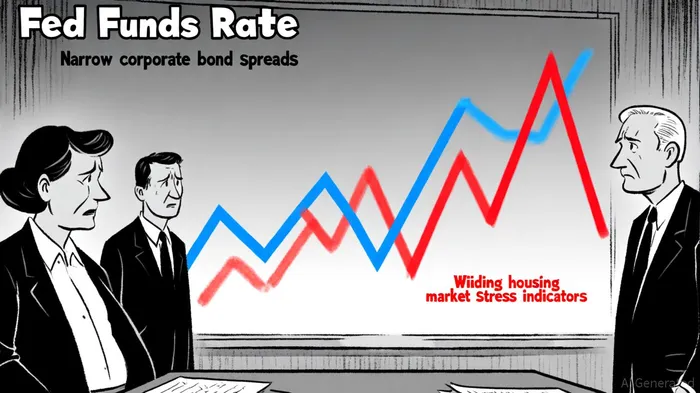
High-yield bonds, in particular, have thrived under accommodative financial conditions, with narrow credit spreads and robust issuance volumes, according to MarketScreener. Yet, Federal Reserve officials like Governor Stephen Miran have warned that buoyant corporate and equity markets may obscure underlying vulnerabilities in sectors such as housing and private credit, as MarketScreener reports. This duality-resilient technicals versus structural risks-underscores the need for selective exposure in fixed income portfolios.
Equities: Valuation Divergence and Sectoral Shifts
The equity market's response to a slower rate-cutting scenario has been marked by stark divergences. Large-cap growth stocks, particularly the "Magnificent Seven" tech giants, have enjoyed multiple expansions, driven by speculative fervor around AI and robust earnings, as noted in a FinancialContent piece. The S&P 500 now trades at 22.5 times next-12-months (NTM) earnings, a premium to international benchmarks like Europe and emerging markets, which trade at a 40% discount.
Conversely, value and small-cap stocks face headwinds. Small-cap equities, representing just 1.2% of U.S. market capitalization, trade at historically low valuations despite stronger fundamentals such as higher free cash flow and dividend growth, according to a Pzena commentary. This underperformance reflects investor flight to perceived safe havens in a high-rate environment. However, active management strategies focusing on small-cap firms with strong balance sheets-such as those in the Alger Mid Cap Focus Fund-have outperformed, driven by AI-driven fintechs like Robinhood and energy infrastructure plays like Talen Energy, per an Alger Mid Cap review.
Policy Divergence and Market Implications
The Fed's internal debate over policy signals further complicates the outlook. While Goolsbee and others prioritize inflation control, officials like Kansas City Fed President Jeffrey Schmid note accommodative conditions in equity and credit markets, a point also raised by MarketScreener. This divide, exemplified by the recent 10-2 policy vote, highlights the challenge of balancing inflation risks with economic stability.
For investors, the implications are clear: a prolonged hawkish stance favors intermediate-duration bonds and large-cap equities but demands caution in long-duration assets. In equities, sectoral rotation toward AI-driven tech and energy infrastructure may outperform, while small-cap value could offer compelling long-term opportunities if valuation gaps correct, the Pzena commentary argues.
Conclusion
As the Fed navigates a delicate path between inflation control and economic resilience, markets must adapt to a slower rate-cutting scenario. Fixed income investors should prioritize quality and selectivity, while equity strategies must account for divergent valuation trends. The coming months will test the Fed's resolve-and investors' ability to balance risk and reward in an evolving policy landscape.







Comentarios
Aún no hay comentarios