
The Fed's Policy Tightening and Its Impact on Bank Earnings: Assessing BofA and Morgan Stanley's Resilience
The Federal Reserve's tightening cycle has long been a double-edged sword for banks: higher rates can boost net interest margins (NIMs) but also dampen loan demand and economic growth. As the Fed's policy trajectory shifts in 2025, major banks like Bank of AmericaBAC-- (BofA) and Morgan StanleyMS-- are navigating a complex landscape of opportunities and risks. With the Fed now signaling a more aggressive easing cycle-potentially including four consecutive 25-basis-point rate cuts by early 2026-investors must assess how these institutions are adapting to evolving monetary conditions[1].
BofA's Resilience: Balancing NIMs and Strategic Efficiency
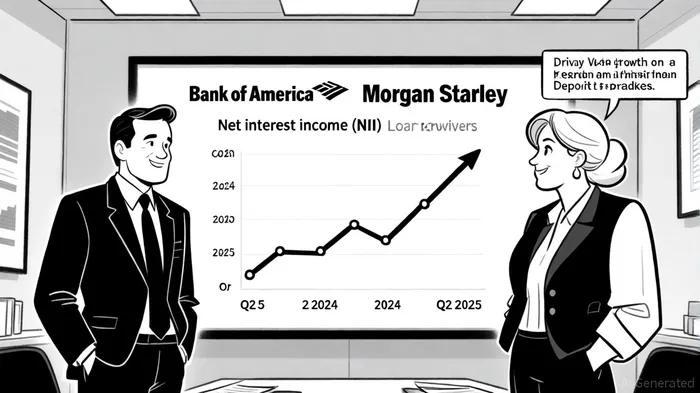
Bank of America's Q2 2025 results underscored its ability to weather macroeconomic headwinds. Despite revenue falling slightly short of expectations at $26.61 billion, the bank reported a 7% year-over-year increase in net interest income (NII) to $14.8 billion, driven by a 3% rebound in loan growth and disciplined expense management[2]. This resilience is partly attributable to BofA's focus on digital transformation and AI-driven operational efficiency, which CEO Brian Moynihan highlighted as critical to maintaining profitability amid tighter monetary policy[3].
However, BofA's success is not without caveats. While its NII growth outpaced expectations, the Fed's anticipated rate cuts-starting in September 2025-threaten to compress margins in the near term. Morgan Stanley's forecast of four consecutive 25-basis-point reductions by January 2026 could erode the benefits of asset repricing, particularly if loan growth slows again[1]. BofA's ability to offset this risk will depend on its capacity to maintain low-cost deposits and expand fee-based income streams, such as wealth management and global markets.
Morgan Stanley's Momentum: Trading and Wealth Management Outperform
Morgan Stanley's Q2 2025 performance was a standout, with earnings per share of $2.13 (beating estimates of $1.98) and revenue surging 17.42% year-over-year to $16.8 billion[4]. The firm's institutional securities division saw trading revenue jump to $7.64 billion, while wealth management contributed $7.76 billion in net revenues. These results reflect a strategic pivot toward capital-efficient businesses and a favorable environment for equity markets, which BofA Global Research predicts will continue to rally in 2025[5].
Yet, Morgan Stanley's optimism is tempered by the same Fed rate cuts it helped forecast. While lower borrowing costs could boost equity valuations and mortgage activity, the firm warns that mortgage rates remain tethered to Treasury yields rather than the fed funds rate. This disconnect means that even with rate cuts, the housing market's recovery may lag, limiting the bank's exposure to a key growth sector[1]. Additionally, the firm's stock dipped 1.77% in premarket trading following its earnings report, suggesting investor skepticism about sustaining momentum amid a shifting policy landscape[4].
The Fed's Tightrope: Rate Cuts and Market Reactions
The Fed's revised easing path-triggered by softening labor markets and milder inflation-has created a paradox for banks. On one hand, lower rates could stimulate economic activity and loan demand. On the other, they risk compressing NIMs, a core metric for profitability. BofA's 7% NII growth in Q2 2025, for instance, was partly fueled by a steeper yield curve and unexpected loan growth, but these tailwinds may reverse if rate cuts accelerate[3].
Morgan Stanley's analysis highlights another layer of complexity: the potential for a market rotation. As rate cuts shift focus to labor and growth data, defensive sectors and large-cap stocks may outperform in the short term[6]. This could benefit banks with diversified revenue streams, like Morgan Stanley, but pose challenges for those reliant on high-margin lending, such as BofA.
Looking Ahead: Strategic Adaptation and Investor Considerations
For both banks, the path forward hinges on strategic agility. BofA's emphasis on AI-driven productivity and capital returns positions it to weather margin pressures, while Morgan Stanley's strength in trading and wealth management offers a buffer against rate-driven volatility. However, investors should remain cautious. The Fed's terminal rate target of 2.75%-3% by mid-2026[1] implies a prolonged period of low-yield environments, which could test the resilience of even the most diversified banks.
Conclusion
The Fed's tightening cycle has entered a new phase, and banks like BofA and Morgan Stanley are recalibrating their strategies to align with the shifting landscape. While both institutions have demonstrated resilience-through NII growth, trading momentum, and operational efficiency-their long-term success will depend on how effectively they navigate the dual pressures of rate cuts and economic uncertainty. For investors, the key takeaway is clear: diversification, capital discipline, and adaptability will be critical as the Fed's policy pivot reshapes the banking sector.





Comentarios
Aún no hay comentarios