
Fed Policy Shifts and Their Catalytic Effect on Q4 2025 Crypto Rally
The Federal Reserve's 2025 policy shifts have emerged as a pivotal catalyst for the Q4 2025 crypto rally, driven by a combination of macroeconomic tailwinds and surging institutional adoption. As the Fed navigates a delicate balance between inflation control and labor market stability, its accommodative stance has created fertile ground for cryptocurrencies to thrive.
Macroeconomic Tailwinds: Liquidity, Inflation, and Dollar Dynamics
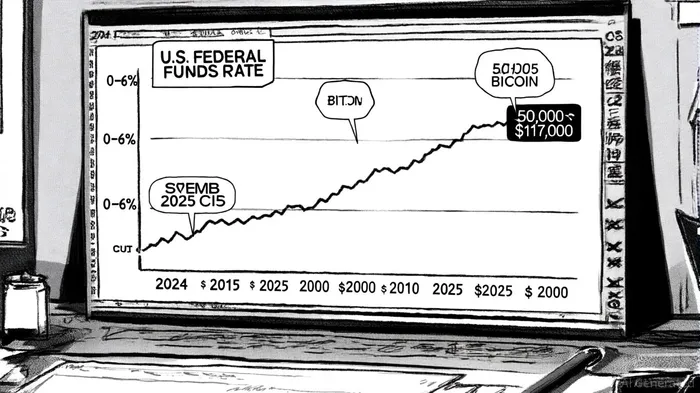
The Fed's September 2025 rate cut of 25 basis points, lowering the federal funds rate to 4.00%–4.25%, marked a strategic pivot toward easing monetary policy, according to the FOMC statement. Lower rates reduce borrowing costs, incentivizing capital reallocation from low-yield assets to riskier, higher-growth investments like cryptocurrencies, as noted in a Crypto.com analysis.
A weaker U.S. dollar, a typical byproduct of rate cuts, has further amplified crypto's appeal. Bitcoin's surge to $117,000 post-September cut underscores this dynamic, as investors increasingly view crypto as a hedge against fiat devaluation, an Analytics Insight piece argued. However, the Fed's cautious tone—emphasizing a "data-dependent" approach—has tempered enthusiasm, with stagflation risks and uneven inflation trends (3.4% in the Eurozone, over 6% in emerging markets) creating uncertainty, a CoinDesk analysis noted.
Institutional Adoption: A New Era of Crypto Integration
Institutional adoption has surged in Q3 2025, with public companies holding BitcoinBTC-- increasing by 38% to 172 firms, collectively holding 1.02 million BTC ($118 billion at current prices), according to Cointelegraph. This trend is bolstered by the rise of spot Bitcoin ETFs, which recorded $48.7 billion in net inflows year-to-date, signaling a shift in traditional finance's perception of crypto as a core asset class, a BiteMyCoin report showed.
Derivatives markets also highlight institutional confidence. CME Group report data indicated Q3 2025 crypto futures and options volume exceeding $900 billion, with open interest peaking at $39 billion. Altcoins like SolanaSOL-- (SOL) and XRPXRP-- saw significant participation, with SOLSOL-- futures open interest surpassing $2.1 billion. These figures reflect a broader diversification of institutional exposure beyond Bitcoin, though altcoins remain more volatile and sensitive to macroeconomic shifts, a BeInCrypto analysis warned.
Divergent Regulatory Paths: U.
S. vs. EU
The U.S. and EU have taken contrasting approaches to crypto regulation in 2025. Under the Trump administration, digital assets are now a national priority, with policies favoring blockchain innovation and stablecoins over CBDCs. Initiatives like the Strategic Bitcoin Reserve and U.S. Digital Asset Stockpile underscore a lighter regulatory touch and strategic government involvement, as outlined in a Grant Thornton outlook.
Conversely, the EU's Markets in Crypto-Assets Regulation (MiCAR) has imposed bank-like rules on crypto, prioritizing financial stability and consumer protection. The EU's preference for CBDCs (e.g., the digital euro) over private cryptocurrencies highlights a regulatory divergence that could shape transatlantic market dynamics, an Atlantic Council analysis argued.
Future Outlook: Navigating Volatility and Policy Uncertainty
While the Fed's rate cuts provide a tailwind for crypto, risks persist. Stagflation concerns and potential inflation surprises could trigger corrections, particularly in altcoins. Retail investors are advised to maintain low leverage and diversify portfolios, as crypto's correlation with traditional markets tightens, according to an IE blog post.
Looking ahead, the Fed's trajectory, labor market data, and inflation trends will be critical. If the Fed follows through on its projected three rate cuts by year-end, Bitcoin could test $130,000–$150,000 levels by December 2025, assuming sustained institutional inflows and macroeconomic stability, according to a Dzilla analysis.
Conclusion
The Fed's 2025 policy shifts have catalyzed a crypto rally driven by liquidity injections, inflationary pressures, and institutional adoption. While challenges like stagflation and regulatory divergence remain, the alignment of crypto with macroeconomic indicators suggests a maturing asset class. Investors must balance optimism with caution, leveraging tools like Bitcoin ETFs and diversified exposure to navigate the evolving landscape.






Comentarios
Aún no hay comentarios