
The Fed's Policy Shift and Its Ripple Effects on Solana (SOL)
The Federal Reserve's recent pivot toward a more cautious stance on interest rate cuts has sent ripples through global markets, with cryptocurrencies-particularly SolanaSOL-- (SOL)-experiencing a complex interplay of volatility and institutional interest. As policymakers grapple with stubborn inflation and a fragile labor market, the implications for altcoin valuations and on-chain activity are becoming increasingly pronounced.
A Fed in Transition: Rising Uncertainty on Rate Cuts
Two prominent Federal Reserve officials, Susan Collins of the Boston Fed and Raphael Bostic of the Atlanta Fed, have publicly opposed a rate cut at the December 2025 meeting, signaling a potential shift in the central bank's approach. Bostic, who announced his retirement in February 2026, emphasized that inflation remains "stubbornly high" and that the Fed should maintain its current rate until there is "clear evidence" of progress toward the 2% target. Collins echoed this sentiment, noting that the government shutdown has disrupted key economic data, complicating the Fed's ability to assess the economy's trajectory. These remarks have fueled uncertainty about the timing and magnitude of future rate cuts, with the Fed's dot plot projections now appearing more ambiguous than ever.
Solana's TVL Surge: A Macro-Driven Phenomenon
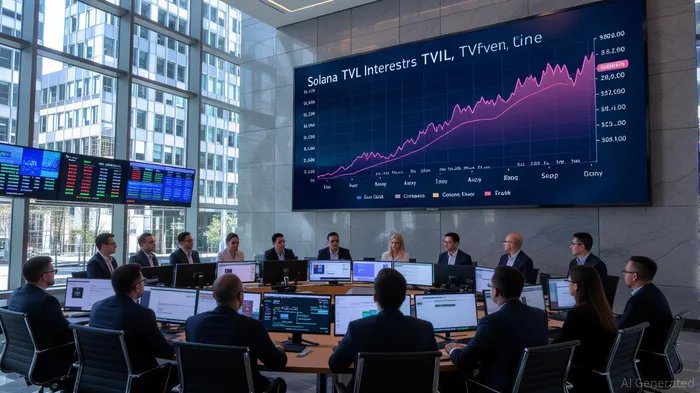
Amid this uncertainty, Solana's ecosystem has experienced explosive growth in total value locked (TVL), rising from $3 billion in December 2023 to $35 billion in 2025. Stablecoins now account for 43% of Solana's TVL, while liquid staking protocols and lending platforms have attracted over $11 billion in assets. This surge coincides with the Fed's dovish policy shifts, including a 25-basis-point rate cut in October 2025 and a commitment to $35 billion in monthly Treasury purchases. Lower borrowing costs have incentivized institutional investors to allocate capital to high-yield, high-throughput blockchains like Solana, which boasts a 3,800 TPS speed and a $10.3 billion DeFi TVL.
Expert Insights: Macroeconomic Signals and On-Chain Activity
The correlation between Fed policy and Solana's on-chain metrics is not coincidental. Experts argue that the Fed's liquidity injections have amplified demand for risk assets, with Solana benefiting from its technical efficiency and institutional adoption. For instance, the Bitwise Solana ETF raised $417 million in its debut week, capitalizing on the network's speed and DeFi infrastructure. However, the October 2025 rate cut triggered a 20% price correction for Solana, underscoring the market's sensitivity to Fed communication. Analysts like Peter Chung note that while rate cuts are bullish in the long term, short-term volatility is driven by Powell's messaging and the Fed's dot plot expectations.
The Road Ahead: Balancing Macro Risks and Institutional Appetite
The Fed's potential decision to keep rates steady-coupled with Bostic's impending retirement-introduces new variables for crypto markets. If inflation persists above 2%, the Fed may prioritize price stability over liquidity expansion, potentially dampening altcoin valuations. Conversely, a resolution of inflationary pressures could reignite institutional interest in Solana, particularly as regulated ETFs and derivatives broaden access to the asset class.
For now, Solana's ecosystem appears resilient. Despite the October sell-off, the network attracted $2.1 billion in inflows over nine weeks, demonstrating the stickiness of institutional strategies aligned with macroeconomic signals. As the Fed navigates its next steps, Solana's performance will likely serve as a barometer for broader crypto sentiment, reflecting the delicate balance between macroeconomic risks and technological innovation.






Comentarios
Aún no hay comentarios