
The Fed's Policy Shift and Its Impact on Equities
The Federal Reserve's September 2025 rate cut and evolving balance sheet strategy signal a pivotal shift in monetary policy, creating a tailwind for risk assets and extending the current equity bull market. By lowering borrowing costs and signaling flexibility in its approach to inflation and employment, the Fed has positioned itself to support financial markets while managing downside risks.
Rate Cuts: A Catalyst for Equities
The Fed's 0.25 percentage point rate cut in September 2025, bringing the federal funds rate to a range of 4.00% to 4.25%, reflects a proactive stance to cushion the economy against a slowing labor market and global uncertainties[1]. This move, described by Chair Jerome Powell as a “risk management” decision, aims to stabilize employment and prevent a sharper economic slowdown[2]. For equities, lower interest rates reduce the discount rate applied to future corporate earnings, making stocks more attractive relative to bonds. Historically, rate cuts have correlated with improved market sentiment, as seen in the 2009 and 2020 recoveries.
The FOMC's projections for two additional rate cuts in 2025 and further reductions in 2026[4] suggest a sustained easing cycle. While inflation remains above the 2% target at 3%, the Fed's willingness to prioritize employment underscores a policy pivot that could boost corporate profits. Sectors sensitive to borrowing costs, such as technology and consumer discretionary, are likely to benefit as access to capital improves and consumer spending stabilizes[5].
Balance Sheet Strategy: From QT to Liquidity Stability
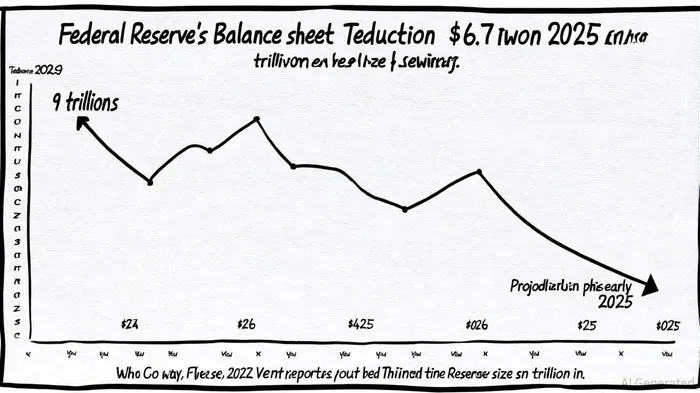
The Fed's balance sheet reduction, part of its quantitative tightening (QT) program, has shrunk its holdings by over $2 trillion since 2022, bringing the total to $6.7 trillion as of early 2025[6]. This cautious unwinding of post-pandemic liquidity injections has been designed to avoid destabilizing markets while maintaining “ample reserves” to support short-term interest rate control[7]. However, the Fed's emphasis on liquidity management—such as slowing the pace of Treasury security runoff to $5 billion per month in March 2025—highlights its commitment to preventing market stress[8].
Analysts project that QT will conclude by mid-2025 or early 2026 once reserve levels align with the “ample reserves” framework[9]. This transition could stabilize long-term interest rates and reduce volatility in money markets, indirectly supporting risk assets. While the Fed has not explicitly signaled a return to quantitative easing (QE), its 2025 review of monetary policy emphasized flexibility in addressing economic shocks[10]. If downside risks materialize—such as a sharper-than-expected rise in unemployment or a prolonged inflation overshoot—the Fed may consider targeted asset purchases to inject liquidity, echoing its 2008 and 2020 interventions[11].
Market Implications: A Prolonged Bull Market
The combination of rate cuts and a potential shift from QT to liquidity-neutral policies creates a favorable environment for equities. Lower borrowing costs will likely spur corporate investment and consumer spending, while a stable Fed balance sheet will reduce uncertainty in financial markets. Sectors such as technology, real estate, and small-cap stocks—historically strong performers during easing cycles—are poised to outperform.
Moreover, the Fed's focus on maintaining ample reserves ensures that short-term interest rates remain anchored, preventing the kind of liquidity crunches seen in 2019[13]. This stability could extend the current bull market, as investors grow confident in the Fed's ability to support growth without triggering inflationary spirals.
Conclusion
The Fed's policy shift in 2025 represents a calculated balance between inflation control and economic support. By cutting rates and managing its balance sheet with precision, the central bank is laying the groundwork for a prolonged equity bull market. While the path to full recovery remains contingent on global economic conditions, the Fed's flexibility and commitment to risk management provide a strong foundation for risk assets. Investors should position portfolios to capitalize on sectors most sensitive to lower rates and improved liquidity, while remaining mindful of potential volatility from external shocks.







Comentarios
Aún no hay comentarios