
Fed Policy Response to Downward Jobs Revisions and Its Impact on Equity Markets
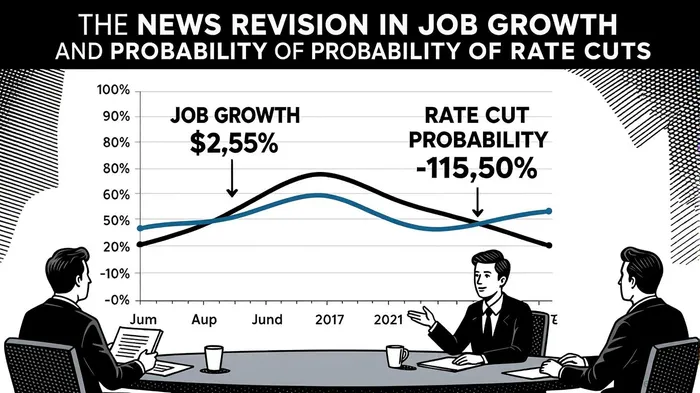
The U.S. labor market has undergone a dramatic reassessment in 2025, with revised employment data revealing a steeper-than-expected decline in job creation. According to a report by The New York Times, the economy added approximately 911,000 fewer jobs from April 2024 to March 2025 than initially reported, signaling a significant slowdown in labor market momentum . This downward revision, coupled with August's weak jobs report—adding just 22,000 jobs and pushing the unemployment rate to 4.3%—has intensified expectations for a Federal Reserve rate cut .
Fed Policy Pivots: Timing and Magnitude
The Federal Reserve's response to this labor market softening has been cautious but increasingly accommodative. Fed Governor Christopher J. Waller explicitly cited the revised data as a key justification for a rate cut at the central bank's September 2025 meeting, emphasizing that private-sector employment likely contracted over the previous three months . While a 25-basis-point (bp) cut is nearly certain, the possibility of a more aggressive 50-bp reduction has gained traction if further downward revisions exceed 800,000 jobs .
The Fed's dual mandate—balancing price stability and maximum employment—has created a delicate policy dilemma. Although inflation has eased to 2.7% in July 2025, producer price inflation remains elevated due to tariff-related supply chain disruptions . This has led to a split within the Federal Open Market Committee (FOMC), with dissenting members like Vice Chair Michelle W. Bowman advocating for earlier cuts to hedge against labor market fragility . By year-end 2025, markets are pricing in two to three rate cuts, with the policy rate projected to fall to 3.25–3.5% by early 2026 .
Sector-Specific Impacts on Equity Markets
The anticipated rate cuts are expected to have divergent effects across equity sectors, shaped by both monetary policy and structural economic shifts. Defensive sectors such as utilities and energy have outperformed in 2025, driven by rising power demand from data center expansion and investor preference for stable returns in a high-interest-rate environment . Conversely, traditionally high-growth sectors like information technology and communication services have faced volatility, though they have rebounded on expectations of Fed easing .
Interest rate-sensitive sectors, including real estate and consumer staples, are poised to benefit from lower borrowing costs. For example, homebuilders and mortgage-related stocks could see a boost as 30-year Treasury yields decline, reducing long-term financing costs . However, sectors reliant on capital expenditures—such as manufacturing and retail—remain under pressure. Apollo's Torsten Sløk highlighted that these industries, already battered by tariff-driven input costs, continue to experience negative employment growth .
Growth-oriented equities, particularly in the technology sector, may see a valuation lift from rate cuts, as lower discount rates improve the present value of future earnings. Yet, Morgan Stanley's Mike Wilson cautions that a lack of earnings momentum could limit the market's upside, especially if trade tensions escalate or inflation reaccelerates . Meanwhile, gold has emerged as a safe-haven asset, with prices approaching record highs amid expectations of lower real yields and geopolitical uncertainties .
Investor Positioning and Strategic Considerations
Investors are recalibrating portfolios to navigate the shifting macroeconomic landscape. Fixed income remains a key beneficiary, with Treasury yields falling and medium-duration bonds offering mid-single-digit returns. Gold, too, has gained traction as a hedge, with central bank purchases and de-dollarization trends supporting its case .
For equities, a sector rotation toward defensive and rate-sensitive industries is advisable. U.S. Bank Asset Management Group notes that utilities and energy stocks historically perform well during rate-cut cycles . Conversely, cyclical sectors like industrials and financials face headwinds from sticky inflation and earnings volatility .
Source:
[1] Employers Added Fewer Jobs Than Believed, Updated ..., [https://www.nytimes.com/2025/09/09/business/jobs-revisions-economy-fed.html]
[2] U.S. Labor Market Stalled This Summer, With August Data, [https://www.nytimes.com/live/2025/09/05/business/jobs-report-august-economy]
[3] Speech by Governor Waller on the Economic Outlook, [https://www.federalreserve.gov/newsevents/speech/waller20250828a.htm]
[4] Markets Eye Labor Data Revisions, [https://www.admis.com/markets-eye-labor-data-revisions/]
[5] Why a Fed Rate Cut Might Not Help the Stock Market, [https://finance.yahoo.com/news/why-a-fed-rate-cut-might-not-help-the-stock-market-080026277.html]
[6] Analysis: Dissenting Federal Reserve Policy Statements, [https://www.linkedin.com/pulse/analysis-dissenting-federal-reserve-policy-statements-faisal-amjad-bou3f]
[7] What's The Fed's Next Move? | J.P. Morgan Research, [https://www.jpmorganJPM--.com/insights/global-research/economy/fed-rate-cuts]
[8] How Do Changing Interest Rates Affect the Stock Market?, [https://www.usbank.com/investing/financial-perspectives/market-news/how-do-rising-interest-rates-affect-the-stock-market.html]
[9] Fed Rate Cut Guaranteed? What's in Store for Markets..., [https://www.fxempire.com/forecasts/article/fed-rate-cut-guaranteed-whats-in-store-for-markets-after-weak-u-s-labor-numbers-1547114]
[10] Why a Fed Rate Cut Might Not Help the Stock Market, [https://finance.yahoo.com/news/why-a-fed-rate-cut-might-not-help-the-stock-market-080026277.html]
[11] Fed Rate Cut? Not So Fast, [https://www.morganstanley.com/insights/articles/fed-rate-cut-september-2025-forecast]
[12] Slower Job Growth Likely Solidifies September Rate Cut, [https://www.invesco.com/us/en/insights/slower-job-growth-september-rate-cut-gold.html]
[13] Daily: Positioning Portfolios as Fed Rate-Cuts Approach, [https://www.ubsUBS--.com/global/en/wealthmanagement/insights/chief-investment-office/house-view/daily/2025/latest-13082025.html]
[14] How Do Changing Interest Rates Affect the Stock Market?, [https://www.usbank.com/investing/financial-perspectives/market-news/how-do-rising-interest-rates-affect-the-stock-market.html]
[15] Markets Eye Labor Data Revisions, [https://www.admis.com/markets-eye-labor-data-revisions/]







Comentarios
Aún no hay comentarios