
The Fed's Policy Pivot and the Housing Market's Quiet Reawakening in Q3 2025
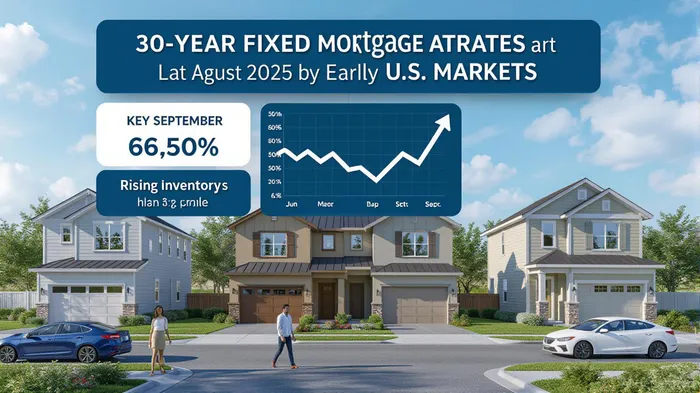
The U.S. housing market in Q3 2025 is poised for a subtle but significant reawakening, driven by the Federal Reserve's anticipated policy shift and its cascading effects on mortgage rates and real estate dynamics. After months of high rates and constrained demand, the market is now navigating a delicate balance between affordability pressures and the potential for renewed buyer activity. For investors, this environment presents both challenges and opportunities, particularly in the (MBS) sector, where strategic positioning could yield outsized returns.
The Fed's September Pivot: A Catalyst for Mortgage Rate Dips
The Federal Reserve's decision to maintain rates at 4.25–4.50% through July 2025 masked a growing market consensus for a rate cut. By September, the Fed's policy stance is expected to pivot decisively, with an 89% probability of a 25-basis-point reduction priced into the CME FedWatch tool. This shift has already triggered a decline in mortgage rates, , 2025, . The 10-year Treasury yield, a critical benchmark for mortgage rates, , reflecting broader expectations of easing monetary policy.
The Fed's pivot is not merely a technical adjustment but a signal of its willingness to prioritize economic stability over rigid inflation control. Weak data, , has eroded confidence in the central bank's ability to achieve a “soft landing.” As a result, investors are pricing in a total of four rate cuts by year-end, .
Housing Market Reawakening: Affordability vs. Inventory Gains
The housing market's response to these developments is nuanced. , , a level that continues to suppress demand. However, the anticipated rate cuts are already influencing buyer behavior, particularly in secondary markets like Austin and Tampa, where geographic arbitrage is driving demand. These markets are seeing a shift toward multifamily properties, which offer more stable cash flows in a high-rate environment.
Inventory levels are also trending upward, with existing-home inventory reaching a four-month supply and new-home inventory exceeding eight months. This shift is gradually creating a more buyer-friendly environment, though affordability challenges persist in high-cost areas. The median home price in May 2025 stood at $422,800, , underscoring the structural imbalance between supply and demand.
MBS Market Dynamics: Barbell Strategies and Prepayment Risks
For MBS investors, the Fed's rate-cutting trajectory introduces both opportunities and risks. , which are backed by government-sponsored entities, have gained traction due to their yield stability and relative safety. These securities currently offer yields exceeding Treasuries, making them a defensive asset in a volatile macroeconomic climate. , while riskier, present wider spreads and improving credit fundamentals, particularly in sectors with strong cash flow visibility.
A key concern for MBS investors is . , reducing prepayment speeds in the short term. However, as the Fed's rate cuts translate into lower mortgage rates in 2026, refinancing demand is expected to surge, accelerating prepayment speeds and compressing total returns for MBS holders. To mitigate this, , balancing yield capture with duration management.
such as interest rate swaps and Treasury futures are also being deployed to manage portfolio volatility. For example, seasoned MBS currently trading at discounts due to low prepayment speeds present compelling entry points for long-term investors, .
Strategic Investment Recommendations
- Agency MBS as a Defensive Core: Investors should overweight agency MBS for yield stability, . These securities offer a predictable cash flow stream and are less sensitive to refinancing volatility.
- Barbell Strategy for MBS Portfolios: A combination of short-term and long-dated MBS can help balance yield and duration risk. Short-term MBS benefit from higher yields in a rising rate environment, .
- Geographic Diversification in Real Estate: Focus on secondary markets like Austin and Tampa, . Multifamily properties, in particular, offer defensive characteristics in a high-rate environment.
- Active Hedging and Credit Selection: Use interest rate swaps and Treasury futures to manage duration risk. In non-agency MBS, prioritize securities with credit enhancements (e.g., .
Conclusion: Navigating the Fed's Policy Crossroads
The Fed's anticipated rate-cutting cycle in 2025–2026 creates a pivotal moment for residential real estate and MBS investors. , the dual risks of prepayment volatility and macroeconomic uncertainty require disciplined strategies. By adopting a barbell approach to MBS, focusing on defensive real estate allocations, and leveraging hedging tools, .
As the September CPI report and subsequent Fed decisions unfold, the path forward will hinge on the central bank's ability to balance inflation control with economic growth. For now, , strategic positioning can unlock value.







Comentarios
Aún no hay comentarios