
Fed Policy Normalization: Navigating the Near-Neutral Rate and Its Economic Implications
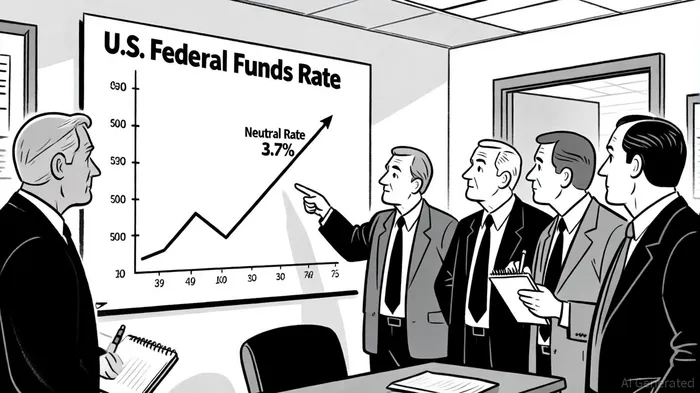
The Federal Reserve's journey toward policy normalization has entered a critical phase. As of September 2025, the federal funds rate stands at 4.00%-4.25% after a 25 basis point cut, with the FOMC projecting further reductions in 2026 and 2027 to approach a long-run neutral rate of 3% [3]. This trajectory reflects a delicate balancing act: easing restrictions to avoid stifling growth while maintaining enough restraint to keep inflation anchored. The concept of a “neutral rate”—the level at which monetary policy neither stimulates nor dampens economic activity—has become central to this calculus.
The Neutral Rate: A Moving Target
The neutral interest rate (r-star) is not a fixed number but a dynamic construct shaped by structural forces. According to a report by the Cleveland Federal Reserve, the medium-run nominal neutral rate in the U.S. was estimated at 3.7% in 2025:Q2, with a 68% confidence interval of 2.9%-4.5% [1]. This suggests that the current federal funds rate of 4.25%-4.5% places monetary policy in restrictive territory [1]. However, the neutral rate itself has been trending downward over decades, influenced by factors such as aging populations, slowing productivity growth, and global savings imbalances [2]. These trends complicate the Fed's task, as they imply that even a “neutral” policy today may require lower rates in the future.
Economic Implications: Inflation, Employment, and Stability
The proximity to a neutral rate carries significant implications. When the real federal funds rate exceeds the neutral rate, as it does now, the policy is restrictive, exerting downward pressure on inflation and employment [3]. Data from the Federal Reserve Bank of San Francisco underscores that demographic shifts—such as the aging U.S. workforce—have historically reduced the neutral rate by lowering capital returns and increasing savings [2]. This dynamic suggests that the Fed's current restrictive stance could temper wage growth and hiring, even as it curbs inflationary pressures.
Market stability also hangs in the balance. A near-neutral rate may reduce the Fed's capacity to respond to shocks, as the margin for error narrows. For investors, this means heightened sensitivity to data releases and policy signals. The bond market, for instance, has already priced in a rapid unwinding of tightening, with Treasury yields reflecting expectations of a 3% terminal rate by 2027 [3]. Equity markets, meanwhile, face a dual challenge: lower discount rates could lift valuations, but slower economic growth could weigh on earnings.
Structural Headwinds and the Path Forward
The Fed's normalization path must contend with persistent structural headwinds. Global demographic trends, such as declining birth rates and rising life expectancy, continue to depress long-term real interest rates [2]. Additionally, fiscal policy—particularly the U.S. government's reliance on debt financing—has introduced upward pressure on yields, creating a tug-of-war between monetary and fiscal forces . These factors suggest that the Fed's “neutral” rate in 2025 may not remain neutral for long.
For investors, the key takeaway is clarity: the Fed is prioritizing a measured approach to rate cuts, with two more reductions expected before year-end [3]. However, the path to normalization is not without risks. A miscalibrated pivot could reignite inflation or trigger a market correction if growth disappoints. The Fed's challenge lies in aligning its policy with a neutral rate that itself is in flux—a task requiring both precision and humility.
Conclusion: Strategic Considerations for Investors
As the Fed edges toward a near-neutral stance, investors should focus on sectors resilient to rate volatility, such as utilities and consumer staples, while maintaining a hedge against inflation through TIPS or short-duration bonds. Equities in cyclical industries, like financials and industrials, may benefit from a softer landing narrative but remain exposed to earnings volatility. The coming months will test the Fed's ability to navigate a landscape where the definition of “neutral” is anything but.







Comentarios
Aún no hay comentarios