
Fed Policy Implications of Mixed November Jobs Data: Why Labor Market Weakness Signals a Near-Term Rate Cut
The U.S. labor market in November 2025 presented a paradox: job growth outpaced expectations, yet the unemployment rate hit a four-year high of 4.6%. This duality, compounded by distortions from a government shutdown and shifting economic dynamics, has placed the Federal Reserve in a delicate balancing act. While the headline 64,000 nonfarm payroll increase suggests resilience, deeper fissures-such as October's 105,000 job losses and the erosion of federal employment due to deferred buyouts according to the report-signal a labor market under strain. For investors, these mixed signals underscore a critical takeaway: the Fed is increasingly likely to prioritize labor market weakness over inflation, setting the stage for near-term rate cuts.
Labor Market Weakness: A Closer Look
The November jobs report revealed a fragile foundation beneath the surface-level gains. While the 64,000 jobs added exceeded forecasts according to the report, this figure masks a sharp reversal in October, where payrolls contracted by 105,000 according to the data. The government shutdown, which delayed data collection and forced revisions to prior months' numbers, further muddied the picture. Meanwhile, the rise in unemployment to 4.6% according to the report reflects broader economic anxieties, including the impact of stringent immigration policies and tariffs that have inflated consumer prices and dampened hiring according to the analysis.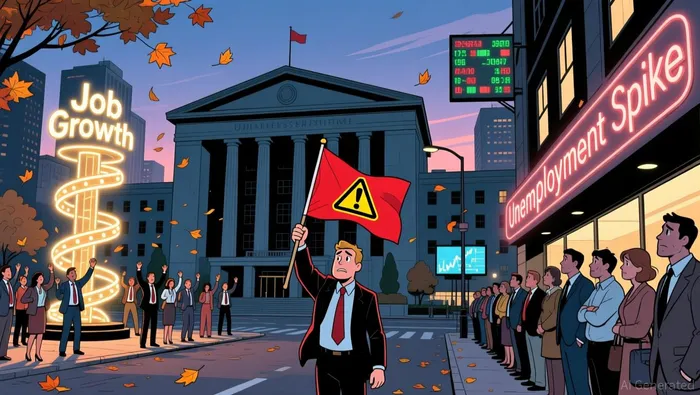
The labor market's cooling trend is also evident in sector-specific trends. Federal government employment, a key component of the report, has been disproportionately affected by deferred buyouts according to the report, creating a ripple effect across related industries. These structural shifts, combined with the uncertainty surrounding immigration-driven labor supply, suggest that the headline job growth may not reflect a sustainable recovery.
The Fed's Calculus: Jobs Over Inflation
The Federal Reserve's December 2025 rate cut-its first reduction in a year-signals a pivot toward labor market concerns. A quarter-point cut was announced at the December meeting, with Fed Chair Jerome Powell emphasizing the need to "interpret the data with caution" due to the government shutdown's distortions according to the analysis. Yet, the central bank's projections for core PCE inflation, which anticipates a return to the 2% target by 2028, indicate that inflation is no longer the primary constraint on policy.
This shift in focus is rooted in the Fed's dual mandate: price stability and maximum employment. With the unemployment rate at a four-year high according to the data and wage growth stagnating, the central bank faces mounting pressure to act. Powell's acknowledgment that the labor market "has shown signs of cooling" according to the report aligns with a broader recognition that the risks of inaction-such as a prolonged rise in unemployment-now outweigh the risks of premature easing.
Investment Implications and the Path Ahead
For investors, the Fed's likely trajectory toward further rate cuts offers both opportunities and risks. A near-term reduction in borrowing costs could provide a short-term boost to equity markets, particularly in sectors sensitive to interest rates, such as real estate and consumer discretionary. However, the delayed data and structural headwinds-like immigration policy uncertainty and tariff-driven inflation-mean that the Fed's actions may lag the actual economic trajectory.
The key takeaway is that the labor market's fragility has become the dominant force in the Fed's decision-making. While the central bank remains cautious about overreacting to distorted data according to the analysis, the rising unemployment rate and uneven job growth according to the report suggest that additional rate cuts are probable in early 2026. Investors should prepare for a policy environment where monetary easing is prioritized to avert a deeper labor market downturn, even as inflation remains a long-term concern according to the projections.
Source
[1] US job growth beats expectations in November [https://www.reuters.com/sustainability/sustainable-finance-reporting/us-job-growth-beats-expectations-november-unemployment-rate-46-2025-12-16/]
[2] Employment Situation News Release - 2025 M11 Results [https://www.bls.gov/news/release/archives/empsit_12162025.htm]
[3] US lost 105000 jobs in October and added 64000 ... [https://www.theguardian.com/business/2025/dec/16/jobs-report-october-november]
[4] Jobs report November 2025 [https://www.cnbc.com/2025/12/16/jobs-report-november-2025-.html]
[5] How strong is the US economy? We just got a much better ... [https://www.cnn.com/business/live-news/us-jobs-report-november-retail-sales]
[6] U.S. Unemployment Rate Rises, a Warning Sign for Economy [https://www.nytimes.com/live/2025/12/16/business/jobs-report-economy]
[7] The Fed - December 10, 2025: FOMC Projections materials ... [https://www.federalreserve.gov/monetarypolicy/fomcprojtabl20251210.htm]







Comentarios
Aún no hay comentarios