
Fed Policy Divergence and the Road to Asset Reflation: High-Growth Equities and Emerging Markets in the Crosshairs
The Federal Reserve's September 2025 rate cut-its first since December 2024-marked a pivotal shift in monetary policy, signaling a tentative pivot toward easing amid softening labor market conditions and persistent inflation. By reducing the federal funds rate by 0.25 percentage points to a target range of 4.00%-4.25%, the Fed acknowledged the need to recalibrate its stance while maintaining a cautious approach to inflation risks, according to the Fed's FOMC projections. However, the policy divergence within the Federal Open Market Committee (FOMC) has become a defining feature of this cycle, with Governor Stephen Miran's advocacy for more aggressive cuts underscoring broader market expectations for accelerated asset reflation.
Policy Divergence: Miran's Case for Aggressive Easing
Governor Miran, a Trump administration appointee, has emerged as a vocal proponent of steep rate reductions, arguing that the Fed's current policy is overly restrictive. In a speech to the Economic Club of New York on September 22, 2025, Miran contended that structural changes-including reduced immigration, increased national savings, and deregulation-have lowered the neutral interest rate (r*), making the current 4.00%-4.25% range "excessively restrictive," as he outlined in his Economic Club speech. He estimates the appropriate federal funds rate should be around 2.0%-2.5%, nearly 2 percentage points lower than the Fed's current target, a point he reiterated in a Markets report.
This stance contrasts sharply with the majority of FOMC members, who have opted for a measured approach, projecting two more 0.25-point cuts in 2025 to reach a year-end range of 3.5%-3.75%, as reported by Yahoo Finance. Miran's position reflects broader political pressures, as President Trump has repeatedly urged the Fed to adopt a more dovish stance to stimulate economic growth ahead of the 2026 midterm elections, a dynamic covered in CNBC's coverage of the decision. Yet, Fed Chair Jerome Powell has emphasized the central bank's independence, framing the decision as a balancing act between supporting employment and curbing inflation, a point highlighted in his remarks covered by CBS News.
Market Implications: Reflation and Capital Reallocation
The Fed's rate-cutting cycle, while modest by historical standards, has already begun to reshape capital flows. Lower interest rates reduce discount rates for equities, directly benefiting high-growth stocks-particularly in the technology sector. According to an iShares report, U.S. large-cap equities have historically outperformed during Fed easing cycles, with valuation multiples expanding as investors prioritize future earnings over near-term cash flows. This dynamic is amplified by Miran's vision of a lower neutral rate, which could justify even more aggressive reflation if the Fed aligns with his stance.
Emerging markets, meanwhile, stand to gain from a weaker U.S. dollar and a global shift toward accommodative policies. As the Fed moves into a rate-cutting phase, other central banks-particularly in Asia and Latin America-are likely to follow suit, creating a more favorable environment for growth, a pattern noted in a Julius Baer analysis. Historical data from Julius Baer shows that emerging market equities have outperformed developed markets by an average of 27% in non-recessionary Fed easing cycles, a trend that could repeat in 2025-2026 provided geopolitical risks remain contained-a finding supported by Capital Group research.
However, the path is not without risks. Geopolitical tensions, U.S. election-related uncertainties, and uneven global growth could dampen the reflationary impulse. For instance, trade barriers and supply chain disruptions may limit the extent to which capital flows to emerging markets, even with lower U.S. rates, as Matthews Asia warns.
Strategic Investment Opportunities
Investors positioned for a more aggressive Fed easing cycle should focus on sectors poised to benefit from lower discount rates and increased liquidity. Technology and innovation-driven industries-such as artificial intelligence, renewable energy, and biotechnology-are prime candidates, as their cash flows are heavily weighted toward the future, a point made in a recent Markets analysis. Similarly, emerging market equities, particularly in countries with strong fiscal discipline and export-oriented economies, could attract inflows as the dollar weakens.
For fixed-income investors, the reflationary environment may favor high-yield corporate bonds and emerging market debt, which offer higher returns in a low-rate world. However, credit risk remains a concern, necessitating careful due diligence.
Conclusion: Navigating the Divergence
The Federal Reserve's policy divergence-between Miran's aggressive easing and the FOMC's cautious approach-highlights the tension between political pressures and economic fundamentals. While the Fed's official projections suggest a measured path, market pricing reflects a stronger appetite for reflation, with three 2025 rate cuts already priced in, as Reuters reported. This gap between policy and market expectations creates both opportunities and risks for investors.
As the Fed navigates this complex landscape, the coming months will test its resolve to balance its dual mandate. For now, the signals are clear: a shift toward accommodative policy is underway, and its ripple effects are already reshaping global capital flows.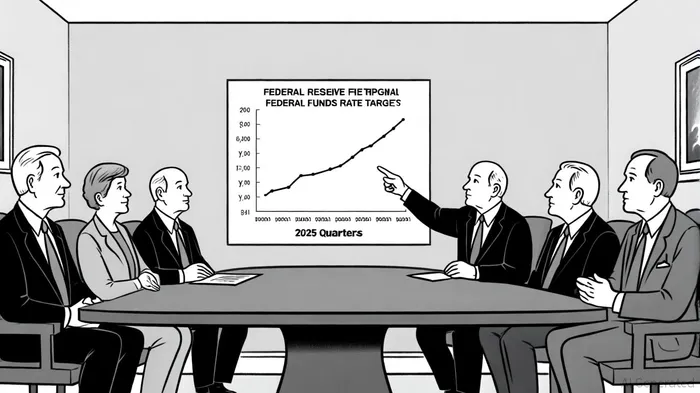







Comentarios
Aún no hay comentarios