
Fed Policy Divergence and Its Impact on Risk Assets: Assessing Market Reactions to the December 2025 FOMC Dot Plot
The Federal Reserve's December 2025 FOMC meeting has emerged as a pivotal event for global markets, with policymakers grappling with divergent views on monetary policy amid a fragile economic backdrop. The meeting, scheduled for December 9-10, is expected to feature a critical decision on whether to implement a rate cut-a move that could reshape risk asset dynamics in equities and cryptocurrencies. This analysis examines the Fed's internal divisions, the implications of the dot plot projections, and the market's mixed responses to policy uncertainty.
The FOMC's Dilemma: Hawks, Doves, and the Path of Rates
The December 2025 FOMC meeting is marked by stark policy divergence. Market expectations, as reflected in fed funds futures, suggest an 80% probability of a 25-basis-point rate cut, bringing the target federal funds rate to 3.50%-3.75%. This aligns with dovish signals from officials like New York Fed President John Williams and Governor Christopher Waller, who argue that easing policy is necessary to address labor market softness. However, hawkish dissenters, including Boston Fed President Susan Collins, caution against premature action, emphasizing the need for inflation stability.
The December dot plot, released as part of the Summary of Economic Projections (SEP), reveals a median projection of 3.9% for the federal funds rate in 2025, with a gradual decline to 3.4% in 2026 and 3.1% in 2027. Yet, the wide dispersion of individual FOMC member projections-ranging from 3.6% to 4.4% for 2025-underscores the committee's lack of consensus. This divergence reflects the Fed's balancing act between supporting employment and curbing inflation, compounded by delayed government data from a recent shutdown. 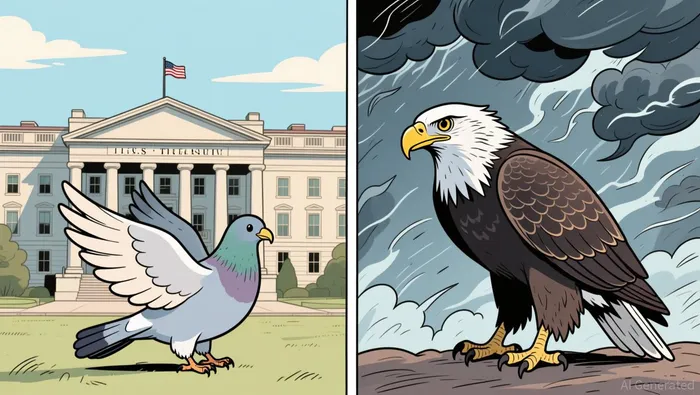
Equity Markets: Rally Amid Divergence, but Risks Loom
Equity markets have shown resilience despite the Fed's policy uncertainty. The Nasdaq 100, buoyed by AI-driven earnings and speculative demand, has surged, outperforming traditional benchmarks. However, bond yields remain stubbornly high, with 30-year Treasury notes climbing to levels that signal market anxiety about inflation and fiscal sustainability. This divergence between short-term monetary easing and long-term bond market signals has sparked debate: some analysts interpret it as confidence in avoiding a recession, while others view it as a warning of eroding Fed credibility.
JPMorgan Research notes that while non-recessionary rate-cutting cycles historically benefit equities and high-yield bonds, the current rally could stall if the Fed's December decision disappoints expectations. The S&P 500's performance, for instance, hinges on the Fed's ability to navigate conflicting signals from the labor market and inflation data.
Crypto Markets: Divergence, Volatility, and Regulatory Shifts
The crypto market's response to the Fed's policy divergence has been equally complex. BitcoinBTC--, which previously mirrored the Nasdaq 100's trajectory, has diverged sharply, dropping over 30% from its October 2025 peak. This break in correlation is attributed to crypto-specific factors, including leveraged liquidations, ETF outflows of $3.5 billion in November, and internal market fatigue after the post-halving rally. Meanwhile, gold and silver have surged, returning 60% and 86% respectively, as investors hedge against inflation and policy missteps.
The Fed's delayed December decision and shifting guidance have exacerbated crypto volatility. For example, comments from officials like John Williams and Lorie Logan caused a 40-point swing in the probability of a rate cut, peaking at 70%. This uncertainty has compounded Bitcoin's sensitivity to macro shocks, with its price stabilizing in a narrow range of $94,000 to $82,000 for over two weeks.
Regulatory developments, however, have injected some clarity. The approval of generic listing standards for commodity ETFs and the GENIUS Act's passage have attracted capital to EthereumETH-- and altcoins like SolanaSOL-- and XRPXRP--, despite Bitcoin ETF outflows. These shifts highlight a broader diversification away from Bitcoin, driven by regulatory and macroeconomic pressures.
Implications for Investors: Navigating Policy Uncertainty
The December 2025 FOMC meeting underscores the challenges of investing in a world of policy divergence. For equities, the key risk lies in the Fed's ability to manage expectations without triggering market corrections. A "hawkish cut"-a smaller-than-expected rate reduction-could signal caution, potentially dampening risk-on sentiment. Conversely, a larger cut might reignite equity rallies but could also fuel inflationary fears.
In crypto, investors must contend with Bitcoin's macroeconomic sensitivity and the sector's inherent volatility. Institutions are increasingly hedging with altcoins and tokenized assets, while regulatory clarity will remain pivotal in shaping capital flows. The Fed's December decision, coupled with potential leadership changes under a Trump-aligned successor to Chair Powell, introduces further uncertainty.
Conclusion
The December 2025 FOMC meeting epitomizes the Fed's struggle to balance its dual mandate in a fragmented economic landscape. While the dot plot and market expectations point to a rate cut, the internal divisions and delayed data underscore the risks of policy missteps. For risk assets, the path forward will depend on the Fed's ability to navigate these challenges-and investors must remain agile in the face of evolving macroeconomic and regulatory dynamics.






Comentarios
Aún no hay comentarios