
The Fed's Pivotal Shift: Assessing the Case for a September Rate Cut and Its Implications for Fixed Income and Equities
Federal Reserve Chair Jerome Powell's Jackson Hole 2025 speech has crystallized a pivotal shift in monetary policy, signaling a growing openness to rate cuts amid a fragile labor market and evolving inflation dynamics. With the September 17 FOMC meeting now a focal point for market participants, the implications for fixed income and equities demand a strategic reevaluation of asset allocation. This article unpacks the Fed's risk-balancing calculus, the sectors poised to benefit from a 50-basis-point easing cycle, and how investors can position portfolios to capitalize on the shifting landscape.
Powell's Risk-Balancing Pivot: A September Cut in the Cards?
Powell's remarks at Jackson Hole underscored a delicate balancing act: while inflation has moderated from post-pandemic peaks, the labor market's “curious kind of balance” has introduced new vulnerabilities. The unemployment rate remains low at 4.2%, but labor force growth has slowed sharply due to declining immigration, creating a precarious equilibrium. Powell warned of “sharply higher layoffs and rising unemployment” if downside risks materialize—a clear signal that the Fed is no longer dismissing the possibility of a soft landing turning into a stumble.
The central bank's dual mandate now faces a tug-of-war. Inflation risks remain tilted upward, particularly from tariff-driven price pressures, while employment risks are increasingly downside-oriented. Powell's acknowledgment that the Fed's restrictive policy stance “may warrant adjustment” has pushed the probability of a September rate cut to 91%, according to market pricing. This pivot reflects a shift from rigid data dependency to a more forward-looking approach, prioritizing preemptive action to avert a labor market deterioration.
Labor Market Dynamics: A Structural Shift in Supply and Demand
The labor market's slowdown is not merely cyclical but structural. Both employers and workers are adapting to a new normal: automation and AI are reducing labor demand in sectors like manufacturing and services, while immigration policy uncertainty has curtailed labor supply growth. This dual slowdown has created a “breakeven” scenario where job creation no longer needs to outpace population growth to maintain low unemployment. However, the risk of a sudden shift—triggered by a surge in layoffs or a prolonged labor force exodus—remains acute.
For investors, this dynamic suggests a need to hedge against volatility in sectors tied to labor-intensive industries. Conversely, sectors leveraging automation and AI, such as industrial robotics or cloud computing, may see sustained demand as firms seek to offset labor shortages.
Inflation: A Temporary Headache, Not a Permanent Threat
While Powell downplayed the risk of a wage-price spiral, he acknowledged that tariffs are already pushing up prices in specific goods categories. However, he emphasized that these effects are likely short-lived, with inflation expectations remaining anchored at 2%. This distinction is critical: the Fed is not signaling a return to aggressive tightening but rather a cautious easing to prevent a self-fulfilling prophecy of deflationary pressures.
The key takeaway for fixed income investors is that long-duration bonds remain vulnerable to inflation surprises, even if the Fed's current stance suggests a temporary pause in price pressures.
Strategic Asset Allocation: Fixed Income in a 50-Basis-Point Easing Cycle
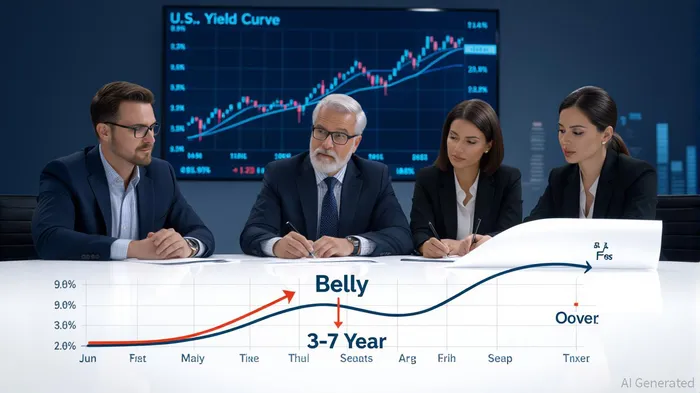
A 50-basis-point rate cut by year-end would reshape the fixed income landscape. Historically, intermediate-term bonds (3-7 years) have outperformed in such environments, as they balance yield with reduced sensitivity to rate volatility. The “belly” of the yield curve—where yields are most attractive relative to risk—is particularly compelling.
High-yield corporate bonds and structured credit also emerge as strong candidates. With spreads tightening and credit fundamentals improving, these instruments offer a yield premium over Treasuries without the duration risk of long-term bonds. Municipal bonds, meanwhile, gain appeal as tax-advantaged income sources in a low-yield environment, though their performance will hinge on broader economic stability.
Investors should avoid long-duration Treasuries and office-backed CMBS, which face headwinds from potential rate hikes and fiscal policy risks. Instead, a laddered approach to maturities and a focus on high-quality, short-duration bonds will enhance portfolio resilience.
Equity Sectors: Defensives, Cyclical Winners, and the AI Paradox
Equity investors must navigate a bifurcated landscape. Defensive sectors like consumer staples (e.g., Procter & GamblePG--, Coca-Cola) and utilities (e.g., NextEra Energy) have historically outperformed in rate-cutting cycles, as lower borrowing costs bolster cash flows for stable, low-leverage firms. Similarly, real estate investment trusts (REITs) stand to benefit from reduced mortgage rates, particularly in the residential sector.
Cyclical sectors such as housing and small-cap equities also present opportunities. The 30-year mortgage rate is projected to fall below 6% by year-end, spurring demand for homebuilders and construction materials. Small-cap stocks, which are more sensitive to interest rate changes, could see a rebound as financing costs decline.
However, the AI-driven tech sector presents a paradox. While large-cap tech firms (e.g., MicrosoftMSFT--, NVIDIA) have shown resilience to high rates due to their cash reserves and growth prospects, smaller tech companies with high debt loads may struggle. Investors should prioritize quality over hype, favoring firms with strong balance sheets and recurring revenue streams.
The Barbell Strategy: Balancing Growth and Income
A barbell approach to asset allocation—combining defensive yield with cyclical value—offers a robust framework for navigating the Fed's easing cycle. This strategy involves:
1. Inflation Hedges: Allocating 15-20% to TIPS, gold, and copper to offset potential inflationary surprises.
2. Global Diversification: Increasing exposure to European and emerging market equities, which have outperformed U.S. markets in 2025.
3. Liquidity Buffers: Maintaining 10-15% in cash or short-duration bonds to capitalize on tactical opportunities as the Fed's policy evolves.
Conclusion: Positioning for a Nuanced Easing Cycle
The Fed's September rate cut is not a binary event but a signal of a broader shift toward a more accommodative stance. Investors must avoid overcommitting to long-duration assets or cyclical sectors without hedging against downside risks. Instead, a strategic focus on intermediate bonds, defensive equities, and high-quality small-cap stocks will position portfolios to thrive in a 50-basis-point easing cycle.
As Powell emphasized, the Fed's path forward will remain data-dependent, but the current balance of risks favors action. By aligning portfolios with the expected easing trajectory while maintaining flexibility, investors can navigate the uncertainties of a changing monetary policy landscape with confidence.







Comentarios
Aún no hay comentarios