
Fed Pauses Rates Amid Growth Slowdown and Inflation Surge
Generado por agente de IACharles Hayes
jueves, 20 de marzo de 2025, 8:17 am ET4 min de lectura
The Federal Reserve's decision to keep interest rates unchanged at its March 2025 meeting has sent ripples through the financial markets, as policymakers grapple with a slowing economy and rising inflation. The central bank's cautious stance reflects the growing uncertainty surrounding President Trump's economic policies, particularly his aggressive approach to tariffs and trade agreements.
The Fed's latest economic projections, released on December 18, 2024, painted a picture of a more subdued economic outlook. The median projection for real GDP growth in 2025 was revised down to 2.1% from 2.5% in the September projection. This downward revision indicates a more cautious outlook on economic growth, which can influence investment strategies by prompting financial institutionsFISI-- to adopt a more conservative approach.
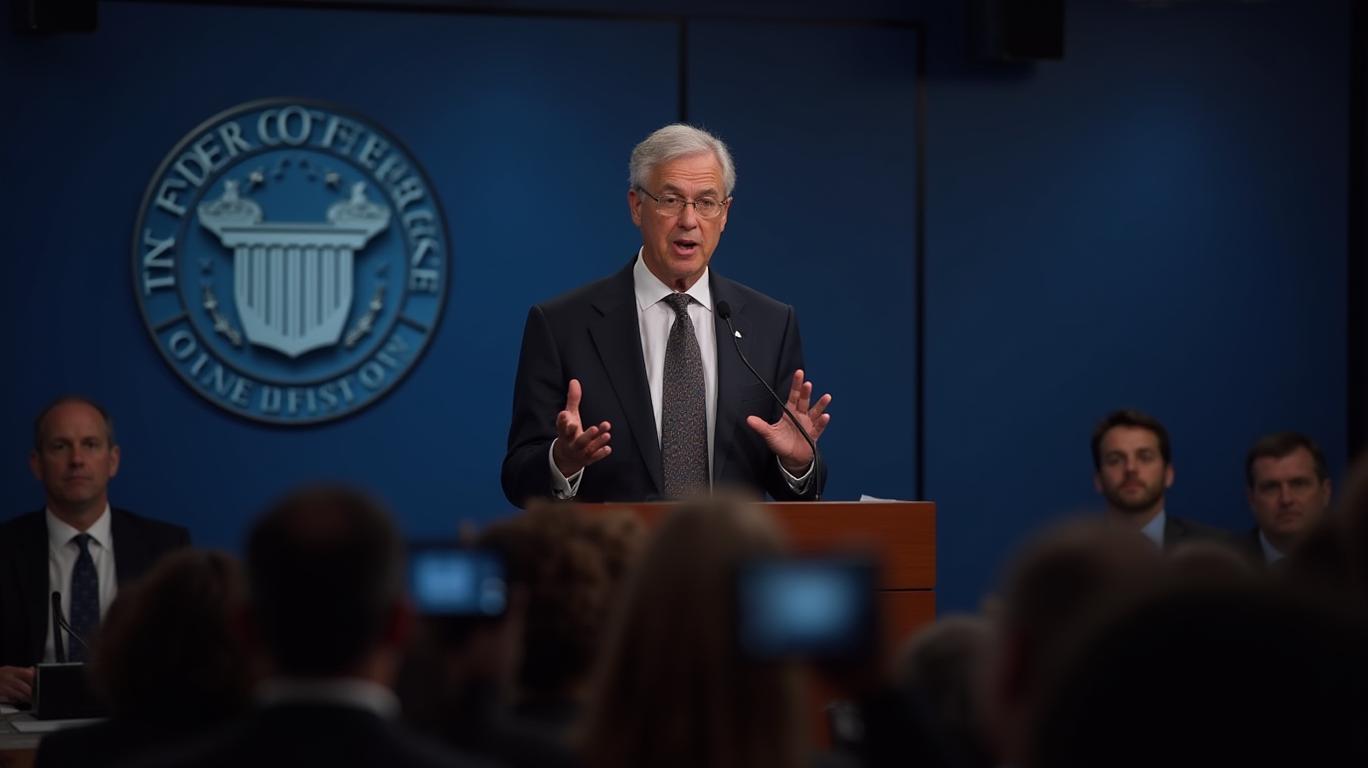
The Fed's decision to keep interest rates unchanged while decreasing its forecasts for economic growth and increasing its estimate of inflation indicates a wait-and-see approach. This approach is likely to influence investment strategies by encouraging financial institutions to remain flexible and adaptable to changing economic conditions. For example, the Fed's dot plot, which tracks what officials expect will happen with interest rates, revealed that the Fed kept its longer-run federal funds rate projection at 3% and its end-of-2025 midpoint federal funds rate forecast at 3.9%, still calling for a pair of rate cuts this year. This suggests that financial institutions may need to be prepared for potential rate cuts in the future, which could impact the performance of their fixed-income portfolios.
The Fed's cautious stance on interest rates, as evidenced by its decision to keep the target federal funds rate unchanged at 4.25% to 4.5% during its March 2025 meeting, has several potential implications for the broader financial markets. This stance reflects the Fed's concern over increased uncertainty around the economic outlook, particularly in light of President Trump's aggressive trade policies and their potential impact on inflation and growth.
Firstly, the Fed's decision to maintain interest rates at their current level suggests a wait-and-see approach, which can lead to volatility in financial markets. Investors may interpret this as a sign of the Fed's reluctance to act decisively, leading to increased market uncertainty. For instance, the Fed's statement that "uncertainty around the economic outlook has increased" underscores this point, as it indicates that the central bank is closely monitoring incoming data for signs of progress on inflation and potential cracks in the labor market.
Secondly, the Fed's cautious stance may affect investor sentiment by creating a sense of uncertainty. This is evident in the comments made by Fed Chairman Jerome Powell, who noted that the Fed is "attentive to the risks to both sides of its dual mandate," referring to its role in keeping prices stable and the labor market healthy. This cautious tone can lead investors to adopt a more defensive posture, potentially reducing their appetite for riskier assets and increasing demand for safer havens like government bonds.
Thirdly, the Fed's decision to keep interest rates unchanged may influence portfolio allocations. With the Fed's dot plot indicating a median forecast for real GDP growth to be 1.7% by the end of 2025, down from the December forecast of 2.1%, investors may adjust their portfolios to reflect a more conservative outlook. This could involve shifting allocations away from equities and towards fixed-income securities, as lower growth expectations may reduce the attractiveness of riskier investments.
Additionally, the Fed's decision to slow the pace of decline of its securities holdings, as indicated by the reduction of the monthly redemption cap on Treasury securities from $25 billion to $5 billion beginning in April, may have implications for liquidity in the financial markets. This move could lead to increased demand for Treasury securities, potentially driving up their prices and lowering yields. This, in turn, could affect the cost of borrowing for businesses and consumers, influencing their spending and investment decisions.
The uncertainties surrounding President Trump's economic policies, particularly tariffs and trade agreements, significantly impact the Federal Reserve's decision-making process and its ability to achieve its dual mandate of maximum employment and price stability. The Federal Reserve's summary of economic projections and the statements from its meetings highlight several key points:
1. Increased Uncertainty: The Federal Reserve has acknowledged that "uncertainty around the economic outlook has increased" due to the new administration's policies. This uncertainty makes it challenging for the Fed to predict the future trajectory of the economy accurately. As stated in the materials, "The Committee is attentive to the risks to both sides of its dual mandate" (Federal Reserve, March 19, 2025).
2. Impact on Inflation: Trump's tariffs are expected to lead to higher consumer prices, at least in the near term. This is evident from the Fed's increased estimate of inflation for 2025 to 2.7% from 2.5% in December. The core PCE, the Fed’s favorite measure, is seen at 2.8% this year, also up from 2.5% in its December projection. This increase in inflation expectations complicates the Fed's efforts to maintain price stability (Federal Reserve, March 19, 2025).
3. Potential Economic Slowdown: The Fed has downgraded its forecast for economic growth this year to 1.7% from 2.1% in December. This revision indicates that the Fed is concerned about the potential negative impact of tariffs on economic activity. The Organization for Economic Cooperation and Development (OECD) also lowered its global economic forecast, predicting growth of 2.2% and 1.6% for the U.S. this year and in 2026, respectively (OECD, March 18, 2025).
4. Labor Market Concerns: The Fed has increased its projected unemployment rate for the year to 4.4% from 4.3% at its December forecast. This suggests that the Fed is concerned about the potential impact of tariffs on employment. The Anderson School of Management at UCLA issued a "recession watch" that acknowledged the current strength of the economy but warned that Trump’s economic policies could produce a downturn (Anderson School of Management, UCLA, March 12, 2025).
5. Monetary Policy Adjustments: The Fed's decision to keep interest rates unchanged while decreasing its forecasts for economic growth and increasing its estimates for inflation shows that it is in a wait-and-see mode. The Fed is closely tracking incoming data for signs that progress on inflation is picking back up or that the labor market is starting to crack. The Fed's dot plot, which tracks what officials expect will happen with interest rates, revealed that the Fed kept its longer-run federal funds rate projection at 3% and kept its end-of-2025 midpoint federal funds rate forecast at 3.9%, still calling for a pair of rate cuts this year (Federal Reserve, March 19, 2025).
In summary, the uncertainties surrounding President Trump's economic policies, such as tariffs and trade agreements, create challenges for the Federal Reserve in achieving its dual mandate. The Fed must navigate increased uncertainty, higher inflation expectations, potential economic slowdowns, and labor market concerns while adjusting its monetary policy accordingly.



Divulgación editorial y transparencia de la IA: Ainvest News utiliza tecnología avanzada de Modelos de Lenguaje Largo (LLM) para sintetizar y analizar datos de mercado en tiempo real. Para garantizar los más altos estándares de integridad, cada artículo se somete a un riguroso proceso de verificación con participación humana.
Mientras la IA asiste en el procesamiento de datos y la redacción inicial, un miembro editorial profesional de Ainvest revisa, verifica y aprueba de forma independiente todo el contenido para garantizar su precisión y cumplimiento con los estándares editoriales de Ainvest Fintech Inc. Esta supervisión humana está diseñada para mitigar las alucinaciones de la IA y garantizar el contexto financiero.
Advertencia sobre inversiones: Este contenido se proporciona únicamente con fines informativos y no constituye asesoramiento profesional de inversión, legal o financiero. Los mercados conllevan riesgos inherentes. Se recomienda a los usuarios que realicen una investigación independiente o consulten a un asesor financiero certificado antes de tomar cualquier decisión. Ainvest Fintech Inc. se exime de toda responsabilidad por las acciones tomadas con base en esta información. ¿Encontró un error? Reportar un problema


SOBRE NOSOTROS
Nuestra historiaAutores de noticiasBase de conocimientosPolítica de privacidadTérmino de usoDescargo de responsabilidad de corretaje de tercerosTérminos de uso de AIMEDivulgaciones de riesgos de AInvest AICarrerasCONTÁCTENOS
Email: support@ainvest.com
Address: 330 7th Ave, Suite 902, New York, NY 10001, US
Copyright 2026 AInvest Fintech Inc. All rights reserved.


Comentarios
Aún no hay comentarios