
The Fed's July Rate Cut Signal: A Strategic Opportunity in the Bond Market?
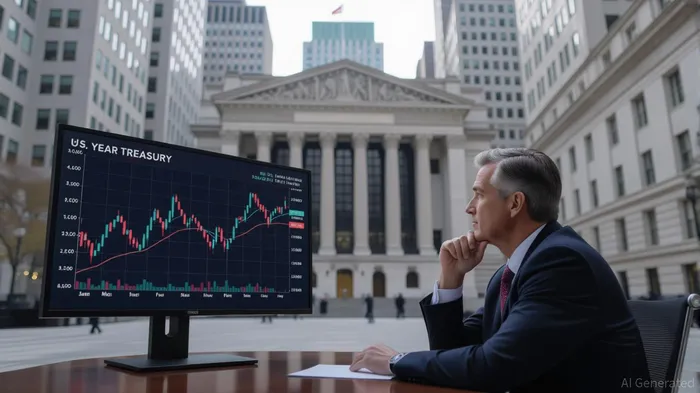
The Federal Reserve's July 2025 policy meeting has become a focal point for investors, particularly in the bond market, as Governor Christopher Waller's dovish stance gains traction. Waller, a vocal advocate for a 25-basis-point rate cut, has argued that the Fed should act preemptively to address a slowing labor market and transitory inflationary pressures from tariffs. His position, combined with technical conditions in the bond market, has created a potential inflection point for Treasury investors.
Waller's Dovish Case: A Policy Shift in the Making
Waller's rationale for a rate cut hinges on three pillars: a weakening labor market, transitory inflation, and the need to recalibrate monetary policy to a neutral stance. He has highlighted that real GDP growth in the first half of 2025 averaged just 1%, significantly below the Fed's long-term potential. Private-sector hiring, he notes, is “near stall speed,” with June's data revisions suggesting minimal gains. Meanwhile, the unemployment rate for recent college graduates has hit a decade high, signaling broader labor market strain.
On the inflation front, Waller dismisses concerns that Trump-era tariffs will trigger persistent inflation. He argues that these price-level increases are one-off shocks and unlikely to unanchor inflation expectations, which have stabilized at 4.4% for the next 12 months (per the University of Michigan survey). His confidence is bolstered by slowing wage growth and the Fed's credibility in managing expectations.
Technical Conditions: A Market Pricing in Dovish Pivots
The bond market has already priced in a shift, with 10-year Treasury yields retreating to 4.318% and the 30-year yield briefly surpassing 5%. This divergence reflects a tug-of-war between inflation risks and rate-cut expectations. The yield curve has steepened, with the 10-year/2-year spread narrowing to 0.44%, signaling investor optimism about a Fed pivot.
Key technical indicators underscore this shift:
- Yield Volatility: The 10-year Treasury's implied volatility (V10Y) has surged to 1.5%, reflecting heightened uncertainty.
- Inflation Breakevens: Five-year breakeven inflation rates hit a three-month high of 2.476%, suggesting markets are still hedging against potential second-round effects from tariffs.
- Capital Flows: Investors are rotating into long-duration assets, with the 30-year Treasury ETF (TLT) seeing inflows of $2.1 billion in July.
Strategic Opportunities for Investors
For bond investors, the July meeting presents a unique opportunity to capitalize on a potential dovish pivot. Here's how to position portfolios:
- Long-Duration Treasuries: A rate cut would likely steepen the yield curve further, boosting demand for 10- and 30-year bonds. Investors should consider overweighting the 30-year Treasury, which offers a yield of 5.011% and is trading at a 20-year average.
- TIPS and Inflation Hedges: While breakeven rates suggest inflation risks are priced in, TIPS (e.g., IEF) remain a defensive play if tariffs reignite price pressures.
- Corporate and Municipal Bonds: With Treasury yields peaking, high-quality corporate bonds (e.g., AGG) and tax-advantaged munis (e.g., MUB) offer attractive spreads of 150-200 basis points over Treasuries.
The Path Forward: Navigating Uncertainty
The Fed's July decision will hinge on two critical factors:
- Labor Market Data: If August's nonfarm payrolls show private-sector hiring stagnating, the case for a cut strengthens.
- Inflation Resilience: A surprise uptick in core PCE (e.g., 2.8% y/y) could delay easing, pushing the first cut to September.
Investors should monitor the CME FedWatch Tool, which currently prices a 70% probability of a September cut. A dovish July meeting would accelerate this timeline, while a hawkish outcome risks further yield volatility.
Conclusion: Positioning for the Dovish Scenario
Waller's advocacy has created a policy crossroads. While the Fed remains cautious, the bond market is pricing in a 70% chance of a rate cut by September. For investors, the key is to balance exposure to long-duration Treasuries with inflation hedges and high-quality credits. The July meeting is not just a policy event—it's a strategic inflection point for fixed-income portfolios.
In this environment, patience and tactical positioning will separate successful investors from those caught off guard. The Fed's next move could redefine the bond market's trajectory—and opportunity awaits for those ready to act.







Comentarios
Aún no hay comentarios