
The Fed's Final 2025 Rate Decision: Implications for Global Equities and Commodities
The Federal Reserve's November 2025 rate decision marked a pivotal moment in its ongoing balancing act between inflation control and labor market stability. By cutting the federal funds rate by 25 basis points to 3.50%-3.75%, the central bank signaled a cautious pivot toward easing, albeit with significant internal dissent. This decision, the third of the year, reflects a broader acknowledgment of a "low-hire, low-fire" labor market equilibrium and inflation that, while declining, remains stubbornly above the 2% target. For investors, the Fed's trajectory-projecting one more cut in 2026 and another in 2027-presents a window of opportunity in assets poised to benefit from monetary easing: gold, silver, and emerging market (EM) equities.
Gold: A Structural Bull Cycle Gains Momentum
Gold's performance during Fed easing cycles is well-documented. Historically, the metal has averaged 11% returns in the year following rate cuts, driven by reduced opportunity costs for non-yielding assets and a weaker U.S. dollar. The 2025 decision, coupled with the Fed's projected path, reinforces this dynamic. Structural drivers-such as central bank and retail demand, ETF inflows, and global debt concerns-suggest gold's bull cycle could extend into 2026 according to analysts.
Recent data underscores this optimism. Gold prices surged ahead of the November decision, while silver hit a milestone of $60.74/oz, reflecting robust investor confidence. These movements align with historical patterns: during the 2007–2009 financial crisis, gold gained 39% over 24 months as the Fed slashed rates. With inflation expected to remain elevated until 2028 according to the Federal Reserve, gold's role as a hedge against monetary debasement appears increasingly compelling.
Silver: Industrial Demand and Monetary Easing Converge
Silver's performance during rate-cutting cycles is more nuanced than gold's, owing to its dual role as both a precious and industrial metal. While monetary easing reduces the opportunity cost of holding silver, industrial demand-particularly from solar energy and electrification-has emerged as a critical driver according to market analysis.
Historical data reveals silver's potential for outsized returns. During the 1970s stagflation era, silver delivered a 1,546% return, outpacing gold. More recently, the 2008 financial crisis saw silver surge 387% as industrial demand waned but speculative interest surged according to Sprott. In 2024, prices reached $31.16/oz, with year-to-date gains of 30.95% fueled by energy transition trends according to Sprott. The Fed's anticipated rate cuts, combined with structural industrial demand, position silver as a high-conviction play for 2026.
Emerging Market Equities: A Weaker Dollar and Diversification Appeal
Emerging market equities have historically thrived during Fed easing cycles, particularly when global risk appetite rises and the U.S. dollar weakens. The MSCI EM index gained 25% in 2024 amid rate-cut expectations, while August 2025 saw a 2.7% surge following the Fed's hawkish pivot. These trends reflect a broader shift in capital toward higher-growth opportunities in EM markets, where valuations remain attractive.
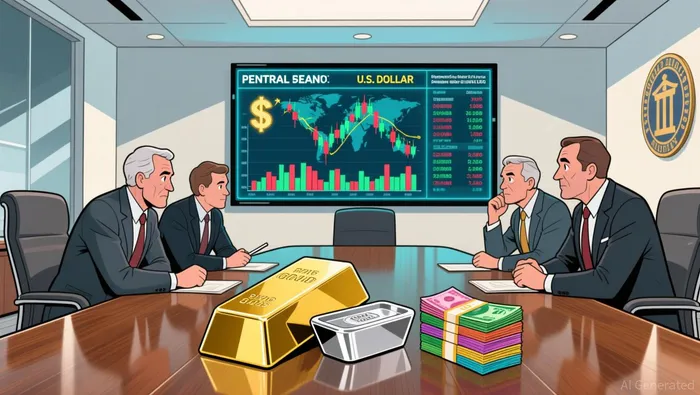 The Fed's rate cuts also alleviate pressure on EM economies, which often face capital outflows during tightening cycles. With the U.S. dollar projected to weaken further in 2026, EM equities could benefit from improved access to cheaper dollar-denominated debt and stronger export competitiveness. However, investors must remain mindful of geopolitical risks and domestic policy divergences, which could create volatility.
Tactical Positioning: Balancing Risk and Reward
For investors seeking tactical exposure, the Fed's 2025 decision offers a clear framework. Gold and silver, with their inflation-hedging properties and structural demand, are best suited for defensive portfolios or as hedges against prolonged easing. EM equities, while more cyclical, offer growth potential in a weaker dollar environment but require careful diversification across sectors and regions.
The Fed's internal divisions-evidenced by dissenting votes on the size and timing of cuts-highlight the uncertainty ahead. A "hawkish" bias in the December 2025 statement, emphasizing data-dependent policy, suggests that further cuts may be contingent on inflation progress. Investors should remain agile, adjusting allocations as new economic data emerges and the Fed's dual mandate evolves.
Conclusion
The Fed's November 2025 rate cut, while modest, signals a shift toward easing that could reshape global asset markets. Gold and silver, bolstered by historical performance and structural drivers, offer compelling long-term opportunities. Emerging market equities, meanwhile, stand to gain from a weaker dollar and global diversification trends. As the Fed navigates its "challenging" position between inflation and employment according to the Federal Reserve, tactical positioning in these assets may prove critical for capitalizing on the next phase of monetary policy.





Comentarios
Aún no hay comentarios