
The Fed's Evolving Communication Strategy and Its Implications for Market Volatility
The Federal Reserve's communication strategy has long been a linchpin of monetary policy, but its role in shaping market volatility has grown increasingly complex in 2025. As the Fed navigates a landscape of trade fragmentation, geopolitical uncertainty, and divergent global monetary policies, its messaging has become both a stabilizing force and a catalyst for turbulence. For investors, the implications are profound: strategic asset allocation in this high-uncertainty environment demands a nuanced understanding of how Fed communication interacts with macroeconomic dynamics and investor psychology.
The Fed's Communication Evolution: From Secrecy to Strategic Transparency
Since the 2007-2008 Global Financial Crisis, the Federal Reserve has shifted from a secretive approach to one emphasizing transparency through tools like post-meeting statements, forward guidance, and press conferences according to a 2025 FOMC report. This evolution reached a critical juncture in 2025, when the Fed completed its second periodic review of communication practices, culminating in a revised Statement on Longer-Run Goals and Monetary Policy Strategy as reported by the New York Fed. The review, informed by the "Fed Listens" initiative and academic collaboration, underscored the importance of credible, consistent messaging to anchor market expectations.
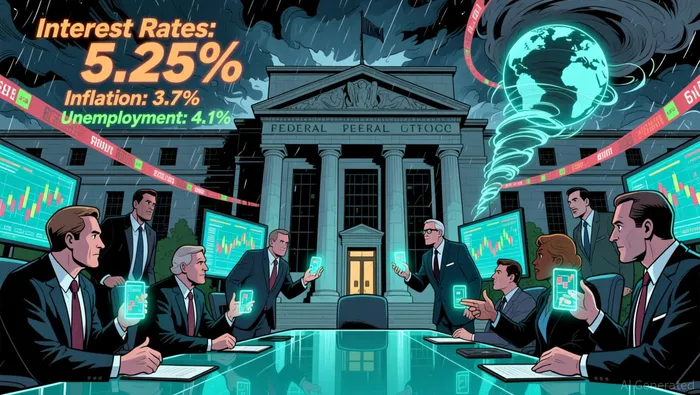
However, this transparency has not eliminated volatility. In 2025, the Fed's communication often amplified uncertainty rather than mitigating it. For instance, the aggressive imposition of U.S. tariffs in early 2025-paired with ambiguous Fed signals-triggered sharp sell-offs in technology and healthcare sectors. Conversely, Chair Jerome Powell's Jackson Hole speech in August 2025, which hinted at potential rate cuts, spurred a market rebound as investors recalibrated expectations. These examples highlight how the Fed's messaging, while intended to stabilize, can inadvertently heighten volatility when economic conditions are already fragile.
Market Volatility and the Fed's Dual Mandate in a Fragmented World
The Fed's dual mandate-price stability and maximum employment-has become increasingly challenging to balance in 2025. The U.S. remains an outlier in maintaining higher interest rates compared to the Eurozone and UK, which have adopted more accommodative policies. This divergence has exacerbated global capital reallocation, with investors seeking alternatives to the U.S. market. For example, the U.S.-China trade agreement to reduce tariffs in late 2025 eased fears but also exposed the fragility of market confidence in the face of shifting geopolitical signals.
The Fed's forward guidance has further complicated this landscape. At the September 2025 FOMC meeting, the median GDP growth projection was revised to 1.6%, with the federal funds rate expected to fall to 3.6% by year-end. Yet, as Chair Powell emphasized, the Fed's data-dependent approach left room for policy adjustments, creating a "wait-and-see" environment that amplified market swings. This uncertainty was compounded by the Fed's October 2025 rate cut-a 25 basis point reduction to 3.75%-4.00%-which, while easing borrowing costs, failed to fully resolve inflation concerns.
Strategic Asset Allocation in a High-Volatility Regime
Investors in 2025 have responded to this volatility by rethinking traditional asset allocation strategies. The historically negative correlation between stocks and bonds has weakened due to persistent inflation and policy uncertainty, undermining diversification benefits. As a result, allocations to alternative assets-such as gold, Treasury Inflation-Protected Securities (TIPS), and international equities-have surged.
Gold, for instance, reached near $4,000 per ounce in October 2025, driven by central bank purchases, de-dollarization trends, and investor demand for safe-haven assets. TIPS also saw robust inflows, with data from Q4 2025 indicating a 74% probability of a December rate cut priced into markets. Meanwhile, international equities benefited from a weaker U.S. dollar, which boosted foreign returns and diversified portfolios away from U.S.-centric risks as reported by iShares.
Digital assets, particularly BitcoinBTC--, have also gained traction. Q3 2025 saw $7.8 billion in net inflows into Bitcoin spot ETFs, with institutions continuing to accumulate during price corrections. The Fed's rate cuts and regulatory clarity around crypto ETFs further fueled this trend, despite sharp corrections in December 2025 linked to inflation concerns.
Navigating the Fed's Communication and Geopolitical Risks
The Fed's communication strategy must now contend with not only domestic economic data but also global capital flows and geopolitical risks. Governor Cook's November 2025 speech emphasized the need for proactive monitoring of financial stability risks, including elevated asset valuations and the structural shift in private lending. These risks, while manageable, underscore the Fed's challenge in balancing transparency with market stability.
For investors, the key takeaway is clear: strategic asset allocation in 2025 requires a dynamic approach. Traditional portfolios must incorporate non-traditional assets like gold, TIPS, and digital currencies to hedge against inflation and policy uncertainty. International equities and liquid alternatives also offer diversification benefits in a world where U.S. monetary policy diverges from global trends as highlighted by iShares.
Conclusion: Adapting to a New Era of Fed Communication
The Federal Reserve's evolving communication strategy has become a double-edged sword in 2025. While transparency remains essential for anchoring expectations, the interplay between Fed messaging, trade policy, and global capital flows has created a volatile environment. Investors who adapt by prioritizing inflation hedges, alternative assets, and global diversification are better positioned to navigate this uncertainty. As the Fed continues to refine its communication tools-such as stress test scenarios and forward guidance-market participants must remain agile, recognizing that the path to stability lies not in predicting policy but in preparing for its consequences.







Comentarios
Aún no hay comentarios