
The Fed's Eroding Independence and Its Impact on Monetary Policy and Markets
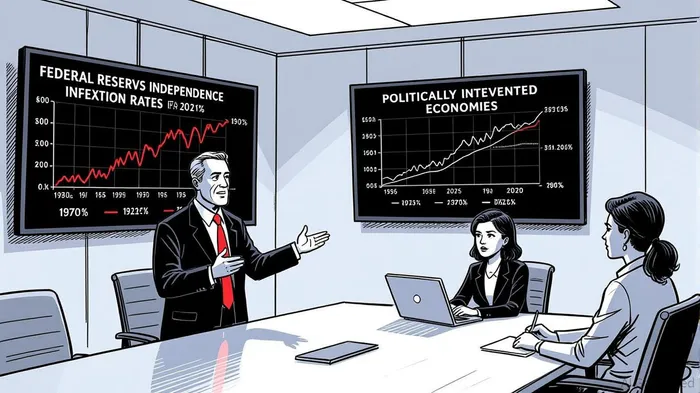
The Federal Reserve’s independence has long been a cornerstone of U.S. economic stability, enabling it to insulate monetary policy from short-term political pressures. However, recent developments under President Donald Trump—specifically his controversial removal of Fed Governor Lisa Cook and nomination of Stephen Miran—have reignited debates about the central bank’s autonomy. These actions, coupled with historical precedents of political interference, raise critical questions about the Fed’s ability to maintain credibility and stabilize markets. For investors, the erosion of institutional independence could signal heightened risks in asset allocation strategies and market volatility.
Trump’s Moves and the Legal Battlefield
President Trump’s August 2025 decision to fire Lisa Cook, a Fed Governor, on allegations of mortgage fraud has sparked a constitutional and legal showdown. According to a report by The New York Times, Trump cited a criminal referral from the Federal Housing Finance Agency as justification, invoking the “for cause” clause in the Federal Reserve Act [2]. Cook, however, has challenged the legality of her removal in court, arguing that the allegations pertain to private conduct and lack the legal basis required for removal [3]. The case hinges on whether the executive branch can unilaterally interpret “for cause” to justify firing a Fed official—a precedent that could empower future presidents to reshape the central bank at will [1].
Simultaneously, Trump’s nomination of Stephen Miran—a current White House Council of Economic Advisers chair—to the Fed Board has drawn sharp criticism. As detailed by Reuters, Miran plans to retain his White House role on an unpaid leave of absence if confirmed, a dual appointment that Senate Democrats argue undermines the Fed’s independence [4]. Senator Elizabeth Warren has warned that such arrangements risk politicizing monetary policy, as Miran’s decisions could be influenced by administration priorities rather than economic data [5].
Historical Precedents and the Cost of Interference
Political interference in the Fed is not unprecedented. During the 1970s, President Richard Nixon exerted behind-the-scenes pressure on Fed Chair Arthur Burns to lower interest rates ahead of the 1972 election, contributing to a surge in inflation [6]. Similarly, Trump’s public criticism of the Fed in the 2010s—via tweets and media statements—was found to influence market expectations, according to a study by Econofact [7]. These episodes underscore a recurring tension: while the Fed was designed with structural safeguards (e.g., 14-year governor terms), political leaders often find ways to exert influence through appointments, rhetoric, or legal challenges.
The consequences of politicization are stark. Research from the International Monetary Fund (IMF) highlights that in economies like Turkey and Argentina, where central banks lost independence, inflation spiraled, and investor confidence collapsed [8]. In the U.S., a loss of Fed credibility could similarly erode the dollar’s status as a global reserve currency and destabilize financial markets.
Implications for Monetary Policy and Markets
A politically compromised Fed faces two primary risks: policy instability and loss of institutional credibility. When central banks prioritize short-term political goals over long-term economic health, they risk creating inflationary pressures or asset bubbles. For instance, if the Fed were to lower interest rates to boost pre-election growth, it could exacerbate inflation, forcing abrupt reversals later—a pattern seen in the 1970s [6].
Market volatility would likely follow. A 2022 IMF study on Latin America found that central bank independence is inversely correlated with inflation volatility; politically driven policies, by contrast, lead to erratic monetary decisions and investor uncertainty [9]. In such an environment, asset allocation strategies may shift toward safer havens like U.S. Treasuries or gold, while riskier assets (e.g., equities, emerging market bonds) face heightened sell-offs.
Asset Allocation in an Era of Uncertainty
Investors must now navigate a landscape where Fed credibility is in question. According to a report by SUERF, artificial intelligence (AI) tools are increasingly used to detect systemic risks and optimize portfolio rebalancing in volatile markets [10]. For example, algorithmic strategies in emerging markets like India have incorporated ESG-linked hybrid portfolios to hedge against policy-driven uncertainties [11]. However, these tools are only as effective as the stability of the institutions they rely on. If the Fed’s independence continues to erode, even advanced AI models may struggle to mitigate the fallout from erratic monetary policy.
Conclusion
The Federal Reserve’s independence is not just a legal or institutional issue—it is a linchpin of global financial stability. Trump’s actions against Lisa Cook and Stephen Miran’s nomination highlight a broader trend of political encroachment that could undermine the Fed’s ability to anchor inflation expectations and manage economic cycles. For investors, the lesson is clear: in an era of eroding institutional credibility, diversification and dynamic risk management are no longer optional but essential. As the Senate Banking Committee prepares to vote on Miran’s nomination, markets will be watching closely—a reminder that the Fed’s independence is as much a political question as it is an economic one.
Source:
[1] How Trump's dismissal of a Fed governor could redefine presidential power if courts agree that he alone can interpret vague laws [https://theconversation.com/how-trumps-dismissal-of-a-fed-governor-could-redefine-presidential-power-if-courts-agree-that-he-alone-can-interpret-vague-laws-264566]
[2] Trump Says He Is Firing Lisa Cook From Fed Board [https://www.nytimes.com/2025/08/25/us/politics/lisa-cook-fired-trump-fed.html]
[3] Federal Reserve Governor Lisa Cook’s legal challenge [https://thehill.com/regulation/court-battles/5483375-lisa-cook-fights-trump-firing]
[4] Fed nominee Miran must resign from White House, Democratic lawmakers say [https://www.reuters.com/business/finance/fed-nominee-miran-must-resign-white-house-democratic-lawmakers-say-2025-09-08/]
[5] Sen. Warren says banking panel should focus on Trump's threats to Fed independence [https://www.opb.org/article/2025/09/04/sen-warren-trump-threatens-fed-s-independence/]
[6] Decades of political interference with the Fed [https://www.financialpipeline.com/expert/from-truman-to-trump-a-history-of-political-interference-with-the-fed/]
[7] How immune is the Federal Reserve from political pressure? [https://econofact.org/how-immune-is-the-federal-reserve-from-political-pressure]
[8] Central Bank Independence and Inflation in Latin America [https://www.elibrary.imf.org/view/journals/001/2022/186/article-A001-en.xml]
[9] The Fed in Election Years—Three Observations from Recent History [https://www.westernasset.com/us/en/research/blog/the-fed-in-election-years-three-observations-from-recent-history-2024-03-20.cfm]
[10] How central banks can meet the financial stability challenges arising from artificial intelligence [https://www.suerf.org/publications/suerf-policy-notes-and-briefs/how-central-banks-can-meet-the-financial-stability-challenges-arising-from-artificial-intelligence/]
[11] Managing Market Volatility Through Portfolio Rebalancing [https://www.researchgate.net/publication/393106817_Managing_Market_Volatility_Through_Portfolio_Rebalancing_Challenges_and_Opportunities_in_Emerging_Markets_With_India_As_the_Focal_Case_Study]







Comentarios
Aún no hay comentarios