
Fed's Employment Pivot: How Policy Shifts Are Reshaping Equity Markets in 2025
The Federal Reserve's evolving policy priorities in 2025 have ignited a seismic shift in equity markets, driven by a recalibration of its dual mandate toward employment. As officials like Governor Christopher Bowman advocate for rate cuts to mitigate labor market fragility, investors are witnessing a reallocation of capital across sectors. This analysis unpacks how the Fed's pivot is reshaping equity dynamics, supported by historical precedents and real-time data.
The Employment Mandate Reemerges
In July 2025, Governor Bowman dissented from the Fed's decision to hold rates steady, arguing for a 25-basis-point cut to address slowing job growth and rising unemployment risks[1]. Her stance reflects a broader FOMC acknowledgment of labor market deterioration: job gains have moderated, wage growth has softened, and the unemployment rate has edged upward[2]. By September, the Fed delivered a 50-basis-point rate cut—a stark departure from its earlier hawkish posture—signaling a pivot toward employment support[3].
This shift is not without controversy. While inflation has neared the 2% target, officials like Bowman warn that delayed action risks a deeper labor market correction[4]. The September 2025 rate cut, the first in a projected series, underscores the Fed's willingness to prioritize employment amid economic uncertainty[5].
Sector Rotations in Action
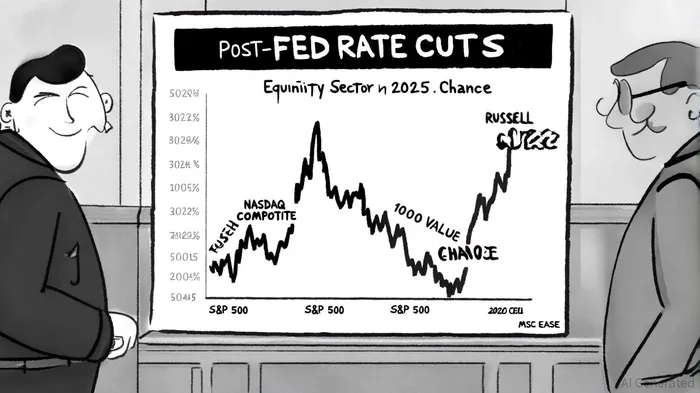
The Fed's dovish pivot has triggered immediate sector rotations. Growth stocks, particularly in technology, initially rallied post-rate cuts but have since underperformed due to lingering inflation concerns and political pressures[6]. Conversely, value stocks and international equities have surged, with the Russell 1000 Value Index and MSCI EAFE up 1.89% and 11.21%, respectively, as investors seek yield in a lower-rate environment[7].
Technology and AI Infrastructure: Lower discount rates have historically boosted valuations for growth stocks reliant on future cash flows. However, recent volatility reflects mixed signals: while rate cuts reduce borrowing costs, political rhetoric (e.g., Trump's tariff policies) and inflationary tail risks have dampened enthusiasm[8].
Financials and Banks: Traditional banks face headwinds as net interest margins compress. With the Fed's funds rate now at 4–4.25%, the spread between loan rates and deposit costs narrows, squeezing profitability[9].
Healthcare and Utilities: Defensive sectors have gained traction as labor market uncertainty persists. These sectors, less sensitive to interest rates, have historically outperformed during Fed easing cycles[10].
Small-Cap and International Equities: A weaker U.S. dollar, spurred by rate cuts, has boosted emerging markets and small-cap stocks. The Russell 2000 surged post-September 2025 cuts, reflecting renewed appetite for risk-on assets[11].
Historical Precedents and Policy Parallels
The 2025 rate cuts echo historical patterns. During the 2008–2009 crisis, Fed interventions (e.g., near-zero rates, asset purchases) catalyzed a 57% rebound in the S&P 500 from its March 2009 trough[12]. Similarly, rate cut cycles since 1980 have averaged 14.1% returns for the S&P 500 in the 12 months following the first cut[13].
However, the 1970s stagflation era offers cautionary lessons. When the Fed prioritized employment over inflation control, it exacerbated stagflation, leading to prolonged market volatility[14]. Today's policymakers are navigating a delicate balance: supporting jobs without reigniting inflationary pressures.
Investment Implications and the Road Ahead
For investors, the Fed's pivot demands active portfolio management. While growth stocks may rebound if inflation stabilizes, value and international equities appear better positioned for a prolonged easing cycle. Defensive sectors like healthcare and utilities offer downside protection, while small-cap stocks could benefit from further rate cuts[15].
Yet risks remain. Political pressures, including Trump's criticism of the Fed's independence, introduce uncertainty. Additionally, if inflation surprises to the upside, the Fed may reverse its dovish stance, triggering market corrections[16].
Conclusion
The Fed's 2025 employment pivot is a double-edged sword: it supports equity markets through lower rates but introduces volatility as policymakers juggle inflation and jobs. Investors must stay agile, leveraging sector rotations while hedging against policy missteps. As Bowman's dissent illustrates, the Fed's evolving priorities will continue to shape market dynamics—monitoring these shifts is key to navigating the next phase of the cycle.







Comentarios
Aún no hay comentarios