
The Fed's Easing Path and Its Impact on Equity Valuations
The Federal Reserve's monetary policy trajectory in late 2025 and beyond has become a focal point for investors navigating a complex macroeconomic landscape. With the central bank's recent 25-basis-point rate cut in October 2025 reducing the federal funds rate to a range of 3.75%-4.00%, the debate over the timing and magnitude of further easing has intensified. This analysis explores the Fed's projected easing path, its implications for equity valuations, and the strategic positioning of rate-sensitive sectors to capitalize on the evolving policy environment.
The Fed's Easing Path: Uncertainty and Conditional Cuts
The October 2025 FOMC meeting minutes reveal a divided committee, with some members advocating for rate cuts to address inflationary pressures and others resisting due to lingering economic resilience. While the market anticipates a 25-basis-point cut at the December meeting, Fed Chair Jerome Powell has explicitly cautioned that this outcome is not guaranteed. The government shutdown, which has delayed critical economic data releases, has further clouded the Fed's decision-making calculus.
Looking ahead, J.P. Morgan Research forecasts two additional rate cuts in 2025 and a third in 2026, assuming a non-recessionary easing scenario. Goldman SachsGS-- Research aligns with this view, projecting a terminal rate of 3-3.25% by 2026. However, the path is contingent on softening labor market conditions and signs of economic moderation. For instance, Goldman notes that underlying job growth has slowed to 39,000 per month as of September 2025, while unemployment for college-educated workers is rising. These trends suggest the Fed may adopt a measured approach, with further cuts dependent on data rather than a preordained schedule. 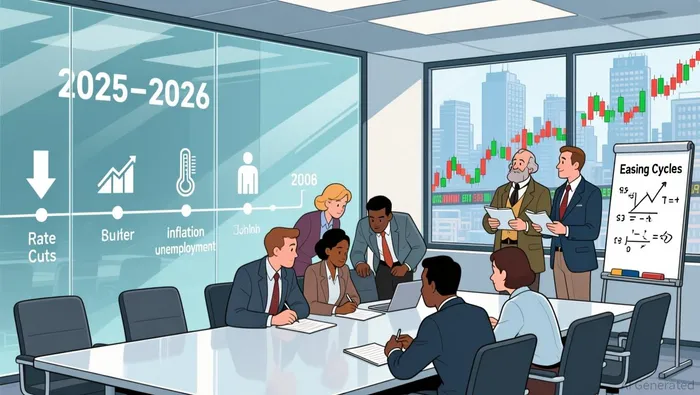 .
.
Rate-Sensitive Sectors: Tailwinds and Constraints
Historically, sectors such as utilities, consumer staples, and healthcare have thrived during Fed easing cycles due to their inelastic demand and sensitivity to lower borrowing costs. During the 2025 first quarter, these sectors outperformed the broader market, with healthcare rising 6.5%, consumer staples up 5.2%, and utilities gaining 4.9%. This performance mirrors patterns observed during the 2008-2009 financial crisis and the 1995 rate-cutting cycle, where defensive sectors provided stability amid market volatility.
However, the broader economic context introduces headwinds. The OECD projects global growth to ease to 2.9% in 2025 and 2026, while the U.S. labor market's softening could dampen consumer spending-a key driver for consumer staples and healthcare. Additionally, the Fed's conditional stance on further cuts implies that policy pauses could limit the duration of sector-specific gains. utilities and consumer staples benefit from reduced refinancing costs. For example,
Strategic Positioning: Balancing Opportunity and Risk
Investors seeking to capitalize on the Fed's easing path should prioritize sectors with structural advantages. Utilities and consumer staples, with their stable cash flows and low volatility, offer defensive appeal in a low-rate environment. Healthcare, meanwhile, benefits from both inelastic demand and the potential for margin expansion as refinancing risks decline according to Morningstar analysis.
Yet, positioning must account for macroeconomic uncertainties. A non-recessionary easing scenario, as outlined by J.P. Morgan, favors equities like the S&P 500 and high-yield bonds, but a prolonged policy pause or data-driven tightening could erode gains. Diversification into alternative assets-such as gold, which historically benefits from lower rates-may provide additional hedging according to Goldman Sachs research.
Conclusion: Navigating the Fed's Easing Cycle
The Fed's easing path in 2025-2026 remains conditional on economic data, with rate-sensitive sectors poised to benefit if cuts materialize. However, investors must balance the tailwinds of lower rates against the risks of a slowing global economy and a cautious Fed. By focusing on defensive sectors with historical resilience and maintaining flexibility to adapt to shifting policy signals, portfolios can navigate this complex environment with a strategic edge.







Comentarios
Aún no hay comentarios