
The Fed's Dual Dilemma: Weakening Labor Market and Inflation Fuel Rate-Cut Uncertainty
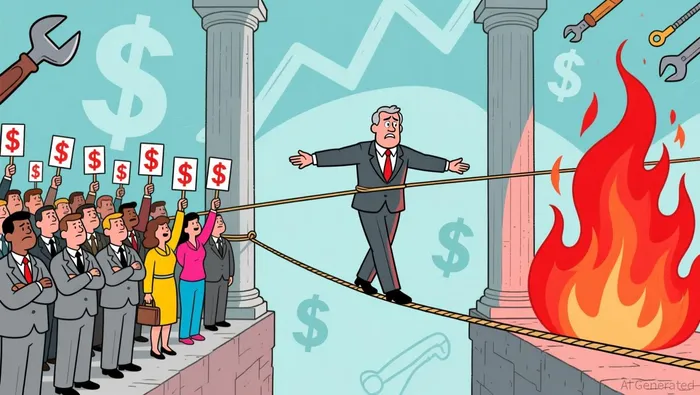
The Federal Reserve faces a mounting challenge in balancing its dual mandate of maximizing employment and stabilizing prices. As 2025 draws to a close, the U.S. labor market and inflation data present a paradox: a cooling job market coexists with stubborn inflation, creating uncertainty about the timing and magnitude of future rate cuts. For investors, this duality demands a nuanced approach to asset allocation, one that accounts for both the risks of overreacting to volatile data and the opportunities emerging from shifting monetary policy.
Labor Market: A Tale of Two Months
The November 2025 nonfarm payrolls report revealed a 64,000-job gain, surpassing economists' forecasts of 45,000. Yet, the unemployment rate rose to 4.6%, the highest in four years, signaling a fragile labor market. This divergence reflects broader structural issues. For instance, October's data showed a staggering 105,000 job losses, largely attributed to a 43-day federal government shutdown and deferred resignations. Fed Chair Jerome Powell has cautioned that the labor market may be weaker than official numbers suggest, given the disruption in data collection and a shrinking labor supply due to tightened immigration policies.
 Meanwhile, the Philadelphia Fed's Survey of Professional Forecasters projects a gradual slowdown in job creation, with monthly gains averaging 132,800 in 2025-a revision downward from 140,900 in earlier forecasts. These trends underscore a labor market that is neither collapsing nor robustly expanding, complicating the Fed's ability to calibrate policy.
Inflation: Persistent but Moderating
Inflation, as measured by the CPI, rose 0.3% in September 2025, pushing the annual rate to 3.0%. While this marks a slight deceleration from 3.5% in previous forecasts, core inflation (excluding food and energy) remains anchored at 3.0%. The primary driver of recent inflation has been energy prices, particularly gasoline, which surged 4.1% in September. Food prices, both for groceries and dining out, have also seen moderate increases.
This inflationary backdrop contrasts with the Fed's 2% target, creating a policy quandary. On one hand, the central bank must avoid tightening further if the labor market weakens. On the other, inflation remains above acceptable levels, necessitating vigilance. The Fed's December 2025 meeting saw a 25-basis-point rate cut, bringing the target range to 3.50–3.75%, but officials emphasized a cautious approach to future easing.
Strategic Asset Allocation in a Shifting Policy Landscape
The Fed's dual dilemma has profound implications for asset allocation. As rate-cut expectations grow, investors must navigate divergent outcomes across asset classes.
Bonds: Duration and Yield Trade-Offs
With the Fed projected to cut rates to 3.4% by late 2026, fixed-income strategies are gaining urgency. BlackRockBLK-- recommends shifting from high cash allocations to intermediate-duration bonds to lock in current yields, while J.P. Morgan highlights the potential for U.S. high-yield bonds to outperform in a non-recessionary easing cycle. However, long-term bonds may underperform due to a benign economic outlook and reduced foreign demand. Short-duration fixed income and preferred securities, favored by SchwabSCHW-- and Nuveen, offer a balance between yield and risk mitigation.Equities: Sector Rotation and Global Opportunities
Equities remain a focal point for risk-on investors. Goldman Sachs and Schwab anticipate a broadening equity market driven by AI-related capital expenditures and structural U.S. economic strengths. Small-cap stocks, historically resilient during easing cycles, are highlighted by Schwab as a potential outperformer. Meanwhile, international equities could benefit from policy-driven structural changes in Europe, though elevated tariffs may temper gains.Commodities: Diversification and Macro Risks
Gold and other commodities are attracting attention as diversifiers. J.P. Morgan notes that gold historically benefits from lower opportunity costs in a low-rate environment, while Schwab cites macroeconomic vulnerabilities and dollar weakness as tailwinds for gold inflows. However, inflationary pressures linked to tariffs may limit the Fed's ability to execute aggressive rate cuts, capping commodity gains.
Conclusion: Navigating Uncertainty with Discipline
The Fed's dual dilemma-balancing a weakening labor market against persistent inflation-has created a policy environment rife with uncertainty. For investors, the key lies in disciplined strategic allocation: extending bond durations cautiously, favoring equities with structural growth drivers, and diversifying into commodities for macro protection. As Powell and his peers navigate this tightrope, adaptability will be paramount. The coming months will test not only the Fed's resolve but also the resilience of portfolios built to withstand-and profit from-shifting monetary tides.





Comentarios
Aún no hay comentarios