
Fed Dovishness Key to Unlocking Latin American Rate Cuts: Prioritize Mexico Over Brazil
The Federal Reserve's monetary policy has long been a linchpin for emerging markets, but its influence is now acutely felt in Brazil and Mexico. With both countries' central banks—Brazil's BCB and Mexico's Banxico—stuck in a balancing act between domestic inflation, currency stability, and dependency on U.S. rate decisions, the path to meaningful easing hinges on a Fed pivot. Investors seeking opportunities in Latin America must monitor this dynamic closely: Mexico's narrower rate differential to the Fed and currency resilience make it the more compelling play, while Brazil's fiscal fragility and currency volatility pose steeper hurdles.
Mexico: Peso Strength Creates Room, but Fed Cuts Are Critical
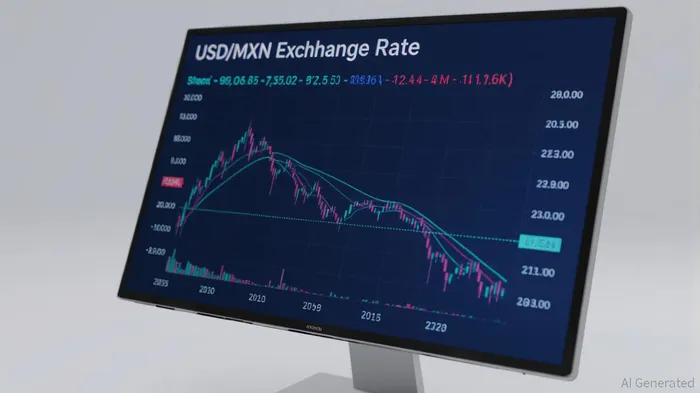
Mexico's economy has long been a barometer of U.S. monetary policy. As of July 2025, Banxico's benchmark rate stands at 10.75%, down from 11.25% in early 2023, but inflation remains elevated at 4.3%—above the 3% target. Peso appreciation against the U.S. dollar (+5% year-to-date) has provided some relief, reducing import costs and easing inflationary pressures. However, Banxico's ability to cut rates further depends on two critical factors:
- Fed Policy Alignment: Mexico's rate differential to the Fed (currently 6.25%) is narrower than Brazil's but still significant. Analysts estimate that a 100 basis point Fed rate cut could enable Banxico to reduce its rate to 7.5% by early 2026. Without such a move, further easing risks reigniting inflation.
- Inflation Dynamics: Mexico's core inflation has cooled slightly, but geopolitical risks—such as U.S. trade policy—remain a wildcard. A stable peso and Fed dovishness would allow Banxico to pivot decisively toward growth.
The chart below illustrates how Mexico's inflation has tracked closely with U.S. levels, underscoring the need for synchronized policy adjustments.
Brazil: Fiscal Challenges and Real Depreciation Limit Flexibility
Brazil's BCB faces a far more complex calculus. With its Selic rate at 14.75%—the highest among major emerging markets—the BCB has prioritized curbing inflation (5.5% in 2025) amid fiscal mismanagement and a weakening real (down 12% vs. USD year-to-date). The real's depreciation has worsened import costs, creating a vicious cycle of inflation and rate hikes.
To ease meaningfully, Brazil requires three simultaneous developments:
1. Fed Rate Cuts: A Fed pivot would reduce capital outflows and ease pressure on the real. A 100 bps Fed cut could lower Brazil's rate buffer to 10% by 2026, but this depends on currency stability.
2. Fiscal Reform: Brazil's 2025 budget deficit is projected at 8.9% of GDP, undermining credibility. Without progress, even a Fed easing could fail to trigger BCB cuts.
3. Inflation Trajectory: The BCB's 2026 inflation target of 3.6% hinges on global commodity prices and domestic supply-side reforms.
This visualization highlights the inverse relationship between Brazil's currency and U.S. rates: a weaker Fed stance could stabilize the real, enabling BCB cuts.
Investment Strategy: Position for Fed Dovishness, Prioritize Mexico
The path forward is clear: position for Fed easing, and overweight Mexico over Brazil. Key reasons include:
- Mexico's Narrower Rate Differential: A Fed cut would directly reduce Mexico's cost of easing, while Brazil's 10.5% rate differential to the Fed requires a more substantial pivot.
- Peso Resilience: Mexico's currency has held up better than the real, offering a buffer against external shocks.
- Lower Fiscal Drag: Mexico's fiscal deficit (4.2% of GDP) is more manageable than Brazil's, reducing tail risks.
Risk Management:
- Mexico's Inflation Surprise: If core inflation rises above 4.5%, Banxico may delay cuts. Monitor CPI data closely.
- Brazil's Fiscal Stagnation: Without credible reforms, BCB cuts could remain elusive even if the Fed eases.
Conclusion
The Fed's next move is the single most critical variable for Latin American rate cuts. Mexico's tighter alignment with U.S. policy and stronger currency position make it the safer bet, while Brazil's success hinges on both Fed action and internal fiscal credibility. Investors should overweight Mexican equities and local debt, while adopting a selective approach to Brazil until clarity emerges on reforms and the Fed's trajectory.
This comparison shows Mexico's lower risk premium, reflecting its superior rate-easing prospects relative to Brazil.







Comentarios
Aún no hay comentarios