
The Fed's Dovish Divide: Assessing Risks and Opportunities in a Stretched Monetary Policy Landscape
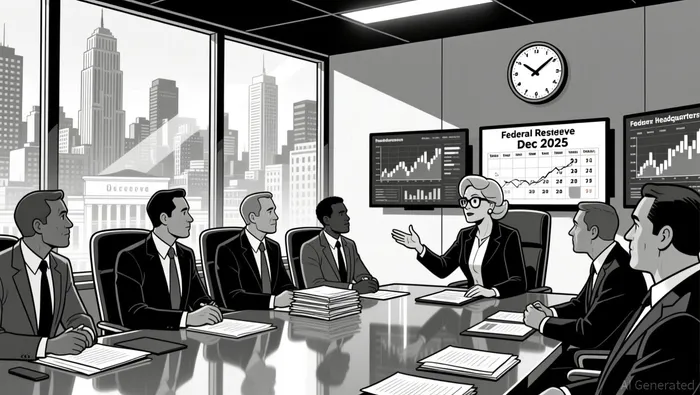
The Federal Reserve's December 2025 policy decision-a 25-basis-point rate cut amid a stark internal divide-has crystallized the central bank's struggle to balance inflation control with labor market stability. This tension, now deeply embedded in the Fed's messaging and forward guidance, has created a fragmented policy environment with profound implications for asset positioning. As the Fed navigates a "broad range of estimates of neutral", investors must grapple with a landscape where dovish and hawkish signals coexist, complicating traditional market positioning strategies.
A Policy Crossroads: Dovish Cuts and Hawkish Caution
The December 2025 meeting marked the third rate cut of the year, reducing the federal funds rate to 3.50%-3.75%. However, the decision was far from unanimous. While Stephen Miran advocated for a larger 50-basis-point cut, Austan Goolsbee and Jeffrey Schmid preferred maintaining rates. This schism reflects a broader debate: should the Fed prioritize cooling inflation, which remains above 2%, or address a slowing labor market, where job gains have moderated?
Chair Jerome Powell's emphasis on a "data-dependent" approach has introduced ambiguity. The Fed's updated Summary of Economic Projections now anticipates only one rate cut in 2026, with some officials forecasting no further reductions. This shift in language-a move from "toward neutral" to "within a range of plausible estimates of neutral" has been interpreted as a hawkish pivot-even as the actual rate cut was implemented. The result is a policy environment where market participants must parse conflicting signals: dovish actions (rate cuts) paired with hawkish rhetoric (caution on future easing).
Strategic Asset Positioning in a Divided Policy Landscape
Fixed Income: Navigating Duration and Yield Curve Dynamics
The Fed's mixed messaging has created a unique opportunity for fixed-income investors. With the yield curve steepening in response to the "hawkish cut", longer-duration bonds have become more attractive as investors anticipate further rate cuts in 2026. Bond laddering-a strategy of spreading investments across varying maturities-emerges as a prudent approach to mitigate reinvestment risk while capturing higher yields.
However, caution is warranted. The Fed's internal divisions and the impending transition to a new chair in May 2026 introduce uncertainty. A new chair could recalibrate the central bank's stance, particularly if inflation remains stubbornly elevated. Investors should consider a barbell strategy: combining short-term cash (to hedge against rate volatility) with select long-duration bonds (to capitalize on expected easing).
Equities: Value Over Growth in a High-Yield Environment
Equity markets have responded to the Fed's dovish actions with optimism, with the S&P 500 nearing record highs. Yet, elevated valuations and a slowing labor market suggest caution. A strategic tilt toward value stocks-particularly those in sectors like energy and industrials-could offer better risk-adjusted returns in a low-growth, high-inflation environment.
Growth stocks, which thrived during the Fed's earlier dovish phase, now face headwinds. A prolonged hawkish pause could pressure earnings multiples, making high-quality, dividend-paying equities more appealing. Investors should also consider hedging against equity volatility through options strategies or defensive sectors like utilities and healthcare.
Alternatives: Diversification in a Stressed Macro Regime
The Fed's policy uncertainty has amplified demand for alternative assets. Gold, traditionally a hedge against inflation and central bank overreach, has gained traction as a portfolio diversifier. Similarly, commodities-especially energy and agricultural products-are poised to benefit from a weaker dollar and supply-side constraints.
Real assets, including real estate and infrastructure, also present opportunities. These sectors offer inflation protection and stable cash flows, countering the risks of a potential economic slowdown.
The Road Ahead: Preparing for Policy Volatility
The Fed's 2026 outlook hinges on three key variables: the trajectory of inflation, labor market resilience, and the new chair's policy priorities. Investors must remain agile, adjusting allocations as new data emerges. A diversified approach-combining fixed-income duration, value equities, and alternative assets-can help navigate the Fed's stretched policy landscape.
In this environment, the mantra is clarity over certainty. As the Fed's internal divisions persist, strategic asset positioning must prioritize flexibility, liquidity, and risk management. The market's ability to adapt to a "neutral" policy regime will define 2026's investment landscape.







Comentarios
Aún no hay comentarios