
The Fed's Diverging Views on Inflation and the Case for a Pro-Dovish Reassessment of Monetary Policy
The Federal Reserve faces a complex inflationary landscape in 2025, marked by divergent regional trends, statistical measurement flaws, and evolving policy frameworks. While headline inflation remains elevated, critical gaps in how inflation is measured-particularly in shelter and core services-suggest that the Fed's current approach may overstate persistent inflationary pressures. These inaccuracies, combined with a cautious dovish shift in policy, present a compelling case for accelerated rate cuts to support economic stability without undermining long-term inflation control.
Statistical Flaws in Inflation Metrics: A Double-Edged Sword
The Fed's reliance on the Personal Consumption Expenditures (PCE) index and Consumer Price Index (CPI) is increasingly challenged by structural flaws in their construction. For instance, shelter inflation, a significant component of both indices, is inherently lagged. The PCE shelter index updates only when leases renew or households move, creating a delayed reflection of market rent changes.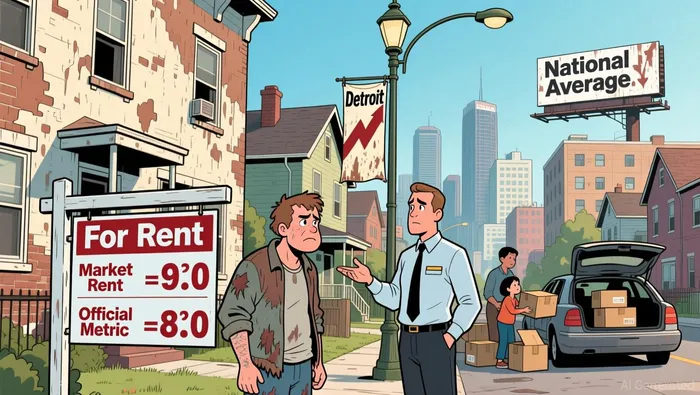 Data from the Chicago Fed indicates that Detroit's inflation has remained below the U.S. average (0.7% vs. 2.9% year-on-year as of August 2025), partly due to slower housing price increases in the region. This divergence highlights how shelter inflation metrics may overstate inflation in certain areas while understating it in others, complicating the Fed's ability to calibrate policy effectively.
Similarly, core nonhousing services inflation is distorted by imputed values. For example, the PCE index for portfolio management services calculates fees based on asset management revenues rather than transaction data, leading to misleading signals. A 2024 study found that while industry expense ratios fell by 6%, the PCE recorded a 20% increase, artificially inflating core PCE inflation by 30 basis points. These inaccuracies risk misallocating policy focus, as they fail to capture true supply-demand imbalances in critical sectors.
Inflation Trends and the Risk of De-Anchoring
Despite these measurement flaws, inflation expectations remain a key concern. Median one-year inflation expectations have held steady at 3.2% as of November 2025, but surges in expectations for specific categories-such as medical care (10.1% expected increase)-signal potential de-anchoring. Historically, unanchored expectations have led to persistent inflation, necessitating aggressive policy responses. However, the Fed's current tools may be hampered by flawed data. For example, the Boston Fed notes that shelter inflation's lag could delay the pass-through of market rent declines to official metrics, creating uncertainty about how long measured inflation will remain elevated.
The Fed's Dovish Shift: A Response to Measurement Challenges
The Federal Open Market Committee (FOMC) has acknowledged these challenges and adjusted its policy stance accordingly. In September 2025, the Fed cut its key rate by 25 basis points, signaling a readiness to ease further in response to labor market softening and evolving inflation dynamics. This dovish shift reflects a recognition that the 2020 Flexible Average Inflation Targeting (FAIT) framework was ill-suited for the high-inflation environment, prompting a return to a more traditional 2% inflation target according to Brookings analysis.
Critically, FOMC minutes from late 2025 emphasize the role of measurement inaccuracies in shaping policy. For instance, officials noted that shelter inflation's lag and core services' imputed values contributed to an overestimation of inflationary pressures, justifying a more measured approach to tightening according to the minutes. This recalibration aligns with broader academic critiques, such as the Roosevelt Institute's analysis of shelter inflation persistence, which argues that current metrics fail to capture real-time housing cost dynamics.
Pro-Dovish Justifications: Why Faster Cuts Make Sense
The case for accelerated rate cuts hinges on two pillars: correcting measurement overestimations and mitigating economic slowdown risks. First, if shelter and core services inflation are overstated due to methodological flaws, actual inflation may be closer to the 2% target than official metrics suggest. This would justify faster cuts to avoid stifling economic growth. Second, external factors-such as Trump-era tariff proposals-threaten to elevate inflation by 0.5% in 2025, according to Goldman Sachs. A proactive dovish stance could offset these risks while maintaining credibility.
Moreover, the Fed's revised policy framework now prioritizes a data-dependent approach, emphasizing flexibility in response to incoming indicators. For example, the Minneapolis Fed estimates that shelter inflation could remain elevated into 2025 due to lagged lease adjustments, but this does not necessarily reflect broader economic health. By cutting rates sooner, the Fed can address labor market imbalances without overreacting to transient inflationary signals.
Implications for Investors
For investors, the Fed's pro-dovish reassessment signals a shift toward accommodative monetary policy, which could bolster equity markets and risk assets. Sectors sensitive to rate cuts-such as housing, consumer discretionary, and high-yield bonds-may outperform as borrowing costs decline. However, the path forward remains contingent on the Fed's ability to balance measurement inaccuracies with real-time economic data. A misstep could reignite inflationary pressures or erode confidence in the central bank's credibility.
In conclusion, the Fed's evolving approach to inflation measurement and policy underscores the need for a nuanced, data-driven strategy. By addressing statistical flaws and adopting a more aggressive dovish stance, the central bank can navigate the 2025 inflation landscape without sacrificing long-term stability-a calculus that investors would be wise to monitor closely.







Comentarios
Aún no hay comentarios