
The Fed's Dilemma: Trusting Distorted Inflation Data in a Politicized Economic Climate
The Federal Reserve's 2026 policy decisions have been shaped by a paradox: the need to rely on inflation data that many economists and market participants now question. The Consumer Price Index (CPI), a cornerstone of monetary policy, has faced unprecedented scrutiny due to methodological distortions, political interference, and operational disruptions. As the U.S. economy navigates a fragile recovery, the Fed's ability to interpret inflation trends-and investors' strategies to adapt-hinge on the reliability of data that is increasingly seen as compromised.
The Fractured Foundation of CPI Data
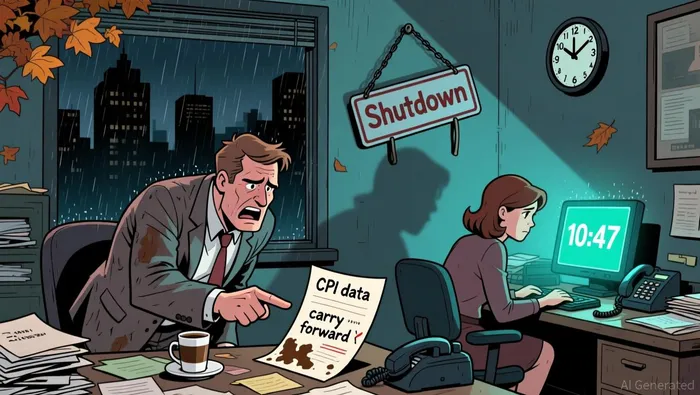
The October 2025 government shutdown exposed critical vulnerabilities in the Bureau of Labor Statistics' (BLS) data collection process. With surveyors unable to gather real-time information, the BLS resorted to "carry forward" assumptions, effectively setting price changes to zero for key categories like housing and energy. For instance, the Owners' Equivalent Rent (OER) component-a 26% weight in the CPI- showed an unusually low 0.90% two-month increase, raising alarms about methodological bias. According to CNBC reports, economists argue that these assumptions likely depressed inflation readings by 0.1–0.2 percentage points, creating a misleading picture of disinflation.
Compounding these issues, leadership changes and budget constraints at the BLS have fueled concerns about politicization. Congressman Sean Casten and 23 House Democrats highlighted how federal hiring freezes and the controversial removal of BLS Commissioner Erika McEntarfer undermined the agency's independence. A report by the Center for Budget and Policy Priorities noted that such disruptions threaten the accuracy of cost-of-living adjustments for Social Security and other programs, further eroding public trust.
The Fed's Cautious Tightrope
Faced with distorted data, the Federal Reserve adopted a cautious approach in 2026. Rate cuts in September and October 2025 were justified by the Fed's belief that inflation had peaked, even as officials acknowledged the limitations of the CPI. New York Fed President John Williams warned that the October–November 2025 CPI figures were "probably pushed down by a 10th or so" due to the government shutdown. Similarly, Richmond Fed President Tom Barkin emphasized reliance on private-sector data and real-time outreach to fill gaps left by official statistics.
The Fed's December 2025 FOMC statement reflected this uncertainty, noting that "elevated uncertainty about the economic outlook remains" and that policy decisions would depend on "incoming data." By January 2026, the Fed had deferred further rate cuts pending a "cleaner" CPI report, signaling a preference for data integrity over political expediency.
Market Strategies in a Climate of Doubt
Investors, too, have adapted to the volatility caused by data distortions. Fixed-income markets have shifted focus to the belly of the yield curve, with strategies emphasizing bond laddering and diversification into high-yield and emerging-market debt. In equities, while AI-driven sectors remain dominant, advisors are urging broader exposure to mitigate concentration risks. A survey by Schwab found that 68% of advisors prioritized macroeconomic stability and inflation hedging in 2026, with cash equivalents and investment-grade bonds gaining favor.
The uncertainty has also spurred interest in alternatives. Commodities and private assets are increasingly seen as hedges against sticky inflation, which many analysts now expect to hover near 3% rather than the Fed's 2% target. Meanwhile, the Federal Reserve's inflation-adjusted exemption thresholds for consumer credit-raised to $73,400 in 2026-highlight the broader economic ripple effects of CPI distortions.
The Political Undercurrents
The politicization of CPI data has added another layer of complexity. Critics argue that leadership changes at the BLS and the adoption of politically expedient methodologies have compromised its non-partisan reputation. As one analyst noted, "The CPI is not just a number-it's a narrative," and the current distortions risk fueling partisan debates over inflation's true trajectory. This dynamic has implications for both policy credibility and market confidence, as investors increasingly question whether official data reflects reality or political agendas.
Conclusion: A Delicate Balance
The Fed's 2026 dilemma underscores the fragility of economic policymaking in an era of data uncertainty. While the central bank has navigated these challenges with measured rate cuts and alternative data sources, the long-term solution lies in restoring trust in the CPI's methodology and institutional independence. For investors, the lesson is clear: in a politicized economic climate, diversification and adaptability are not just strategies-they are necessities.







Comentarios
Aún no hay comentarios